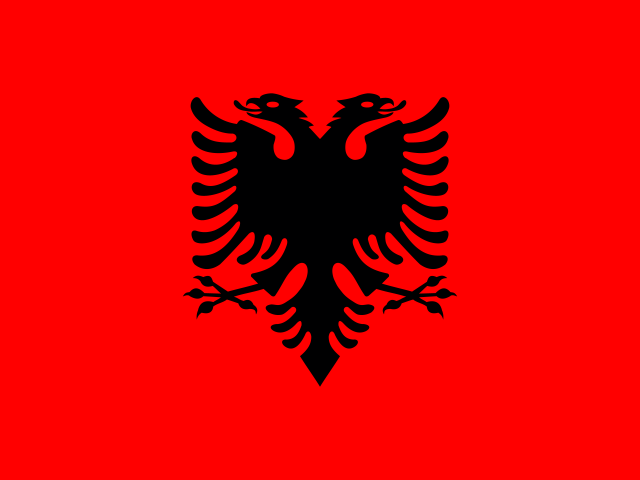
Are Albanians white or Slavic? Albanians are not Slavic, and in the racial categories used in the United States and Europe they are generally classified as white. Albanians are an indigenous European people of the Balkans, descended largely from ancient Paleo-Balkan populations of the western Balkans, most often linked to the Illyrians. Their language, Albanian, forms its own independent branch of the Indo-European family and is not Slavic, Greek, or Latin. This guide explains what that means, where the confusion comes from, and what genetics and language actually show.
A janë shqiptarët sllavë?
No. Albanians are not a Slavic people. The Slavs arrived in the Balkans in the 6th and 7th centuries AD, long after the ancestors of the Albanians were already established in the region. Albanians and Slavic peoples (such as Serbs, Macedonians, Bulgarians and Montenegrins) have lived as neighbors for centuries, which is the main reason the two are sometimes confused, but they are distinct in origin, language and identity.
The clearest evidence is the language. Albanian is not a Slavic language, it is not mutually intelligible with any Slavic tongue, and it sits on its own branch of Indo-European. We cover this in detail in is Albanian a Slavic language.
Are Albanians White?
In the racial classifications used by the US Census and most Western frameworks, Albanians, like other European peoples, are categorized as white or Caucasian. Albania sits in southeastern Europe on the Adriatic and Ionian coasts, and Albanians are a native European population. In everyday terms, questions about whether Albanians are “white” usually reflect the fact that the Balkans are less familiar to many people than western Europe, not any genuine ambiguity about the region being European.
It is worth adding that “white” is a social and administrative category that has shifted over time and varies by country, while ethnicity and ancestry are separate questions. On ancestry, the picture is clear and well studied.
Where Albanians Actually Come From
Albanians are widely regarded as descendants of the ancient Illyrians and other Paleo-Balkan peoples who inhabited the western Balkans thousands of years ago, predating both the Slavic migrations and the Roman conquest. For the full account see nga vijnë shqiptarët and our guide to the Illyrian tribes, the ancestors most often linked to modern Albanians.
The Language Evidence
Language is the strongest single line of evidence for Albanian distinctiveness. Albanian (Shqip) is one of the primary independent branches of Indo-European, with no close living relatives. It contains an ancient native core plus loanwords absorbed over centuries from Latin, Greek, Slavic and Turkish, which is exactly the fingerprint of a people long resident in a crossroads region. Its two main dialects, Gegë dhe Toskë, split along the Shkumbin river.
The very name Albanians call themselves, shqiptar, is native and unrelated to Slavic or Greek terms, as we explain in shqiptar.
What Genetics Shows
Population genetics places Albanians firmly within the European genetic landscape, clustering with other southern European and Balkan populations. Studies consistently show deep continuity in the region rather than a recent arrival, consistent with an indigenous Balkan origin rather than a Slavic one. Genetics, like language, points to Albanians as a long-settled European people, sharing much of their ancestry with their Balkan neighbors but carrying less medieval Slavic-related ancestry than most mainland populations of the region.
Why the Confusion Exists
Several things feed the question. Albania spent decades isolated under communism and was less visible to the wider world than other European countries. It borders Slavic-speaking and Greek-speaking states, so outsiders sometimes assume Albanians belong to one of those larger groups. And the Balkans as a whole are often flattened in the popular imagination. None of this changes the underlying facts of language, history and genetics.
Albanians, Greeks and Slavs: Distinct Neighbors
Albanians, Greeks and the South Slavs are three separate peoples who have shared the Balkans for a very long time. They have influenced one another’s food, music and vocabulary, but they remain distinct in language and identity. Albanians in Greece, for example, include both modern migrants and the historical Arvanitët, yet Albanian identity has never merged into either the Greek or the Slavic world.
How Albanians Are Classified in the United States
In official US statistics, Albanian is an ancestry, not a race. The Census Bureau follows federal standards that define the White category as people with origins in Europe, the Middle East or North Africa, so Albanian Americans are counted as White in race data. Ancestry is recorded separately: the American Community Survey ancestry table lists Albanian next to Greek, Serbian, Italian and other European groups, and that table is the basis for the figure of roughly 228,000 Americans reporting Albanian ancestry. That separation is the short answer to the question in the title. Albanians are classified as white by American definitions, and they are not Slavic by any definition, because Slavic describes a language family and a shared origin, not a race.
Albanian and Its Neighbors at a Glance
| Gjuha | Branch of Indo-European | What that means |
|---|---|---|
| shqip | Its own branch, with no living relatives | First written in 1462; two dialects, Gheg in the north and Tosk in the south, divided by the Shkumbin river |
| Serbian, Montenegrin, Macedonian, Bulgarian | South Slavic | Brought by Slavic migrations into the Balkans in the 6th and 7th centuries |
| grek | Hellenic, its own branch | Neighbor to the south; shares loanwords with Albanian but no common ancestor beyond Indo-European |
| Romanian and Aromanian | Romance | Descended from Latin; Aromanian is still spoken in parts of southern Albania |
| turk | Not Indo-European at all | Five centuries of Ottoman rule left many loanwords in Albanian but did not change its structure |
The table is the whole argument in one place. Albanian sits alone on its branch of the Indo-European tree, the way Greek and Armenian do. A Serbian and a Bulgarian speaker share a recent common ancestor language; an Albanian speaker shares one with neither, nor with a Greek.
A Timeline of Where Albanians Come From
| Data | Ngjarje |
|---|---|
| Shekulli i 4-të para Krishtit | Illyrian kingdoms on the eastern Adriatic are recorded by Greek writers |
| 168 para Krishtit | Rome defeats Gentius, the last Illyrian king; the region becomes Roman Illyricum |
| 2nd century AD | The geographer Ptolemy records a tribe called the Albanoi and a town, Albanopolis, in central Albania |
| 6th to 7th centuries | Slavic peoples migrate into the Balkans and settle the interior |
| 1079 to 1080 | The Byzantine historian Michael Attaleiates gives the first medieval mention of Albanians, the Arbanitai |
| 1190 | The Principality of Arbanon, the first Albanian state, is established around Krujë |
| 1462 | The oldest surviving sentence written in Albanian, a baptismal formula recorded by Archbishop Pal Engjëlli |
| 1555 | The Meshari of Gjon Buzuku, the first known book in Albanian |
| 1908 | The Congress of Manastir adopts the Latin alphabet still used today |
| 1912 | Albania declares independence from the Ottoman Empire in Vlorë |
Every line on that timeline places Albanians in the western Balkans before, during and after the arrival of the Slavs. That continuity, together with the language, is why historians treat Albanians as one of the region’s older peoples rather than as a branch of any neighbor. For the fuller story, read nga vijnë shqiptarët and the guide to the Albanian language.
Why the Slavic Label Keeps Coming Up
Three things feed the confusion. Kosovo, which is about 90 percent Albanian, was part of Yugoslavia, a Slavic-named state, until the 1990s, so Albanians there were long described abroad as Yugoslavs. Many Albanians in the south are Orthodox Christians, a faith often associated with Slavs and Greeks, even though religion does not follow ethnicity in Albania. And foreign readers tend to file everything between Italy and Turkey under one Balkan heading. None of these change the answer. Slavic surnames end in -ić or -ov; Albanian ones come from clans, places and given names, as the guide to mbiemrat shqiptarë shows.
Pyetje të shpeshta
A janë shqiptarët sllavë?
No. Albanians are an indigenous Balkan people descended largely from Paleo-Balkan populations (most often linked to the Illyrians), distinct from the Slavs who migrated into the region centuries later. The Albanian language is not Slavic.
Are Albanians white?
Albanians are a native European people and are classified as white or Caucasian in standard US and European categories.
What ethnicity are Albanians?
Albanian is its own distinct European ethnicity, most closely linked to the ancient Illyrians, with its own language and identity separate from Slavs, Greeks and Italians.
Are Albanians Greek?
No. Albanians and Greeks are separate peoples with separate languages, though they are ancient neighbors who have influenced each other.
What race are Albanians?
In racial terms Albanians are European (white/Caucasian). In terms of ethnicity and ancestry, they are a distinct Balkan people of largely Paleo-Balkan descent, most often linked to the Illyrians.
Mëso më shumë
Dig deeper with nga vijnë shqiptarët, fiset ilire, dhe figura të famshme në historinë e Shqipërisë.
Burimet
- Albanians (Encyclopaedia Britannica)
- Gjuha shqipe (Enciklopedia Britanike)
- Illyrians (Encyclopaedia Britannica)
- US Census Bureau: About the Topic of Race (definition of the White category)
- American Community Survey 5-year estimates, 2020 to 2024, Table B04006: People Reporting Ancestry
- Encyclopaedia Britannica: Albanian language
- Wikipedia: Origin of the Albanians (overview of the scholarly theories)

Autor: Dardanë Halimi
Dardanë Halimi është një shkrimtare dhe profesioniste e komunikimit me titull magjistër në Shkrim, Retorikë dhe Komunikim Teknik nga Universiteti James Madison. Puna e saj përqendrohet në tregimin e historive, përmbajtjen digjitale, arsimin e lartë dhe komunikimin strategjik, me përvojë në shkrimin për organizata akademike, jofitimprurëse dhe marketingu si në Shtetet e Bashkuara ashtu edhe në Kosovë.