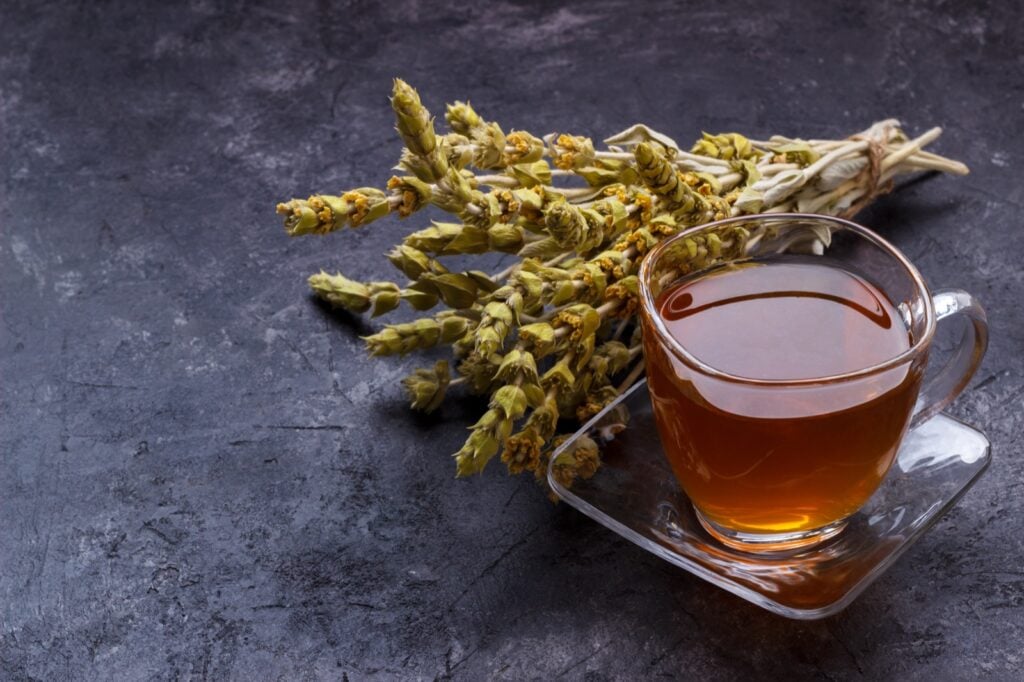

Albanian mountain tea, çaj mali in Albanian, is a herbal tea brewed from the dried flowering stems of Sideritis, a genus in the mint family that grows on high pastures across Albania, Kosovo and the rest of the Balkans. In Albania the plant behind the cup is almost always Sideritis raeseri, which Slow Food’s Ark of Taste records growing all over the country, especially above 800 meters, and being sold dried at farmers’ markets and in supermarkets.
This page covers the plant, where it grows, how it is dried and brewed, what research and the European medicines regulator actually say, and how Albanian-Americans buy it. For raki, coffee, boza and the rest, see our guide to Albanian drinks; this page goes deeper on the tea alone.
Fakte të shpejta
- Albanian name: çaj mali (also written çaji i malit), literally “mountain tea.” The main species in Albania is Sideritis raeseri Boiss. & Heldr., family Lamiaceae.
- Grows wild across Albania above about 800 meters; wild-collected and cultivated mainly in the south and southeast, around Korçë and Gjirokastër.
- Harvest begins in May and June; the plants are dried in a covered, well-ventilated place out of direct sun.
- The European Medicines Agency lists four Sideritis species as a traditional herbal tea for cough with a cold and mild stomach discomfort, on the basis of long-standing use, not clinical trials.
- Its standard tea dose is 2 to 4 g of the dried herb in 150 to 200 ml of water, two to three times a day, for adults only.
Në këtë faqe
- What Çaj Mali Is
- Where It Grows and Who Picks It
- How It Is Dried
- How to Brew Albanian Mountain Tea
- Other Plants Albanians Call “Çaj”
- What the Research Says
- How Albanian-Americans Buy It
- Pyetje të shpeshta
What Çaj Mali Is
Sideritis belongs to Lamiaceae, the mint family, which Britannica describes as 236 genera and more than 7,000 species, mostly herbs with square stems and fragrant volatile oils; sage, oregano and thyme are relatives. The species Albanians pick is Sideritis raeseri Boiss. & Heldr., the accepted name in the GBIF backbone taxonomy. A 2020 paper in Evidence-Based Complementary and Alternative Medicine calls it widely distributed in the Mediterranean, mainly the Balkans and the Iberian Peninsula, and known in English as mountain tea or shepherd’s tea.
The Ark of Taste entry describes sage-green, softly hairy leaves and stems and greenish-yellow flowers. What goes into the pot is the dried upper stem with its flowers and leaves. A 2017 review in the Journal of the Science of Food and Agriculture puts it simply: the dried inflorescences of S. raeseri make a beverage called mountain tea, drunk in Balkan folk medicine for inflammation, stomach complaints and coughs and as a tonic. The European Union herbal monograph groups four species together, S. scardica, S. clandestina, S. raeseri dhe S. syriaca, under the English name ironwort.
Where It Grows and Who Picks It
Sipas Slow Food, the plant grows all over Albania, especially above 800 meters, with Gjirokastër, Korçë, Shkodër and Vlorë counties named in the entry; it is also raised from seed in household gardens. Collection begins in May and June, whole families take part, and the stems are cut with a knife so the root stays and the plant regrows. The entry warns that uncontrolled harvesting, and pulling plants up by the root, threatens wild populations.
A May 2021 Medicinal and Aromatic Plants Sector Study hosted by Albania’s Ministry of Agriculture places mountain tea among the most important flower products in the trade and locates it in the south and southeast, citing a 2010 USAID survey that mapped it to the Korçë and Gjirokastër regions. The study reports that commercial cultivation has not been very successful: around Devoll the plant lost quality and died young on damp ground, and falling prices led farmers to give up, though it did better in the mountains near Prespa and Gjirokastër.
Kosovo drinks the same tea from a sister species. A 2023 review from the University “Fan Noli” of Korçë, published in Science. Business. Society., lists S. raeseri under the local names çaj and çaj mali and S. scardica under çaj mali, both used as flowering aerial parts. A 2014 study in Natural Product Communications analysed S. scardica collected in North Macedonia and S. raeseri from North Macedonia, Albania and Greece, a fair map of where each is gathered.
How It Is Dried
Drying is the step that decides quality. Slow Food records that after harvest the plants are spread out on tables or on cloths on the ground, preferably in a covered but well-ventilated dry place, because direct sunlight is not good for them; some villagers build tents from tree branches to make shade. The 2021 sector study agrees: field-dried plants lose color and other properties, shade drying preserves them, and its export table gives a fresh-to-dried ratio of 1 to 4 or 5. Drying does not strip the aroma: the 2014 aroma study found only minimal differences between fresh and dried material.
How to Brew Albanian Mountain Tea
There are two traditions, and Albanians use both. The Korçë review notes that Albanians and Kosovars make hot teas without distinguishing infusion from decoction; boiling the herb is the older Mediterranean way, and steeping like black tea spread with Ottoman influence (Icka and Damo, 2023).
The village method (a short decoction)
As recorded by Slow Food: cut the dried stems into shorter lengths, drop them into boiling water, simmer for a few minutes, then take the pot off the heat and keep it covered until it is served. Honey and lemon are the usual additions. Flowers, leaves and stems all go in.
The infusion method (the regulator’s dose)
The EU herbal monograph gives the dose used in registered herbal teas: 2 to 4 g of the comminuted (cut) herb in 150 to 200 ml of water as an infusion, two to three times daily, up to 12 g a day. A 2011 study in Natural Product Communications used 2 g bags in boiling water and found that leaves carry more phenolic compounds than flowers or stems.
Serve it the way Slow Food says company and military canteens once did: at breakfast, with sliced bread and cheese. Our guide to the Mëngjesi shqiptar shows where it sits on the morning table.
Other Plants Albanians Call “Çaj”
Ask for çaj in a village and you may get something other than Sideritis. The Korçë review counted about 150 species used for herbal tea in Albania and Kosovo, with Lamiaceae the largest family at 25 species; oregano, chamomile, lemon balm, yarrow and rose hip are the most used overall. The table lists the ones most often sold or served as “mountain tea,” with the local names the review records.
| Name in Albanian | Botanical name | Rajon | How prepared |
|---|---|---|---|
| Çaj mali, çaj | Sideritis raeseri Boiss. & Heldr. | Albania, mainly Korçë and Gjirokastër regions; also collected in North Macedonia and Greece | Dried flowering stems simmered a few minutes and covered, or infused 2 to 4 g per cup |
| Çaj mali | Sideritis scardica Griseb. | Kosovo and North Macedonia (Sharr and neighboring ranges) | Dried flowering aerial parts, brewed the same way |
| Rigon, çaj rigoni, also called çaj mali or çaj i egër | Origanum vulgare L. (oregano) | Albania and Kosovo; among the most used tea plants in both | Dried flowering tops steeped as tea; also drunk for colds and coughs |
| Trumzë, çaj i egër | Satureja montana L. (winter savory) | Listed for Albania and Kosovo in the review | Dried flowering aerial parts steeped as tea |
| Çaj bjeshke, çaj fushe | Stachys species (woundworts) | Listed for Albania and Kosovo in the review | Dried flowering aerial parts steeped as tea, mainly for colds |
Names overlap: the review records “çaj mali” applied to oregano in some districts, so a bag sold as mountain tea is not always Sideritis. Look for the pale, hairy stems and yellow-green flower whorls, or for the botanical name on the package.
What the Research Says
Albanians drink çaj mali for colds and for their stomachs; that use is old and well documented, while proof of benefit in people is not. The European Medicines Agency’s herbal committee is the plainest source. Its assessment of Sideritis herba, adopted on 2 February 2016, concluded that ironwort tea may be used for the relief of cough associated with a cold and for mild stomach and gut discomfort, and that its effectiveness is “plausible” because it has been used safely in this way for at least 30 years; the committee noted “the lack of clinical studies with ironwort.” The monograph itself classifies the tea as a “traditional herbal medicinal product for use in specified indications exclusively based upon long-standing use.”
The laboratory literature is larger but mostly not in humans. The 2017 review reports that Balkan species are rich in flavonoids with antioxidant activity measured in the test tube; the 2011 Macedonian study measured roughly 72 mg of total phenolics in a water infusion from a 2 g bag; and the 2020 study that found an extract relaxed airway tissue used isolated rabbit tracheal rings, not people. None of this shows that a cup of tea treats or prevents any illness, and this page does not offer medical advice.
The regulator’s precautions rarely make it onto a market stall. The EU monograph says use in children and adolescents under 18 is not recommended for lack of data, that safety in pregnancy and breastfeeding has not been established, that people allergic to other mint-family plants should avoid it, and that a doctor should be consulted if a cough lasts more than a week or stomach discomfort more than two. Confirm anything health-related with your own doctor or pharmacist.
How Albanian-Americans Buy It
Mountain tea is an export crop. The 2021 sector study reports that Germany and the United States took 75 percent of Albania’s medicinal plant exports in 2018, and that in 2019 the United States was the second destination with 2,656 tonnes, 23 percent of the total; sage leads, but mountain tea is listed among the exported flower products. Exporters mostly ship semi-processed material, which is why the tea usually reaches American shelves as loose cut stems in a plain bag.
For the household buyer there are three routes. Albanian and Balkan grocers in the diaspora cities stock it; our guides to Albanian grocery stores and butchers dhe where to buy Albanian products in the US list them by city. Many families bring a bag back from Albania or Kosovo in the suitcase, alongside raki and white cheese. And Greek and Turkish shops sell the sister species under their own names, which the EU monograph treats as the same herbal substance. Whatever the label, check for the word Sideritis. To see where it grows, the pastures above Korçë dhe Gjirokastër are collector country in early summer.
Pyetje të shpeshta
What is Albanian mountain tea made from?
It is brewed from the dried flowering stems and leaves of Sideritis raeseri, a mint-family plant that grows wild above about 800 meters across Albania. Slow Food’s Ark of Taste records it in Gjirokastër, Korçë, Shkodër and Vlorë counties, harvested from May and June and dried in the shade before sale.
Is çaj mali the same as Greek mountain tea?
Closely related, and often the same species. Greek mountain tea comes from several Sideritis species, and the EU herbal monograph groups S. raeseri, S. scardica, S. clandestina dhe S. syriaca as one herbal substance. A 2014 study collected S. raeseri in Albania, North Macedonia and Greece alike.
Does mountain tea have caffeine?
Jo. Sideritis is not related to the tea plant Camellia sinensis, and the peer-reviewed reviews describe its contents as flavonoids, phenolic acids, iridoids and essential oil, not caffeine.
Is Albanian mountain tea good for colds?
It is traditionally drunk for coughs and colds, and the European Medicines Agency accepts that use as a traditional herbal medicine for adults, “exclusively based upon long-standing use.” The agency also noted the lack of clinical studies. It is not a treatment for any illness, and anyone with a health concern should ask a doctor or pharmacist.
How much mountain tea should I use per cup?
The EU herbal monograph gives 2 to 4 g of cut dried herb in 150 to 200 ml of water as an infusion, two to three times a day, no more than 12 g a day, for adults. Village practice is a short simmer of a few stems in boiling water, then covered until served, with honey and lemon.
Where can I buy çaj mali in the United States?
Albanian and Balkan grocers in the main diaspora cities stock it, usually as loose cut stems in a bag, and Greek or Turkish shops sell the sister species under their own names. Albania’s 2021 sector study lists the United States as the second export market for its medicinal plants. Check the label for the botanical name Sideritis.
Burimet
- Slow Food Foundation: Mountain tea (Ark of Taste, Albania)
- European Medicines Agency: European Union herbal monograph on Sideritis scardica, S. clandestina, S. raeseri, S. syriaca, herba (2016)
- European Medicines Agency: Sideritis herba, herbal medicine summary
- Ministry of Agriculture and Rural Development of Albania: Medicinal and Aromatic Plants Sector Study (May 2021)
- Icka and Damo, University “Fan Noli” Korçë: Traditional Tea Uses of Wild and Cultivated Plants in Albania and Kosovo, an Ethnobotanical Review (Science. Business. Society., 2023)
- PubMed: Romanucci et al., Traditional uses, chemical composition and biological activities of Sideritis raeseri (J Sci Food Agric, 2017)
- PubMed: Petreska et al., Dietary burden of phenolics per serving of “Mountain tea” (Sideritis) from Macedonia (Nat Prod Commun, 2011)
- PubMed Central: Krasniqi et al., Insight into the Mechanisms Underlying the Tracheorelaxant Properties of the Sideritis raeseri Extract (Evid Based Complement Alternat Med, 2020)
- PubMed: Qazimi et al., Aroma compounds of mountain tea (Sideritis scardica and S. raeseri) from western Balkan (Nat Prod Commun, 2014)
- GBIF Backbone Taxonomy: Sideritis raeseri Boiss. & Heldr.
- Encyclopaedia Britannica: Lamiaceae
Lexime të Ngjashme
- Albanian Drinks: Raki, Coffee, Boza and More
- Mëngjesi Shqiptar: Çfarë Hanë Shqiptarët në Mëngjes
- Tradita e kafesë në Shqipëri
- What Albanian Raki Is Made Of
- Albanian Grocery Stores and Butchers in the US
- Ushqimi Shqiptar: Udhëzuesi i Plotë

Autor: Val Demiri
Valbona është redaktore dhe shkrimtare në ALB Connection, ku ajo mbulon njerëzit, bizneset dhe kulturën që formësojnë diasporën shqiptare. E diplomuar në gazetari në Universitetin e Ajovës, puna e saj përfshin profile të komunitetit, histori suksesi dhe reportazhe mbi jetën shqiptare në të gjithë SHBA-në, Evropën dhe më gjerë. Ajo tërhiqet nga historitë që festojnë arritjet e shqiptarëve dhe e mbajnë komunitetin të lidhur përtej kufijve.