Sa shqiptarë jetojnë në Mal të Zi? The 2023 census recorded 30,978 Albanians in Montenegro, 4.97 përqind of a population of 623,633, and 32,725 people (5.25 percent) gave Albanian as their mother tongue, according to the statistical office MONSTAT. Most live along the border with Albania, in the south and east of the country: they are the majority in Ulcinj (73.53 percent) and Tuzi (62.55 percent) and about a third of the population of Gusinje (34.38 percent), with smaller communities in Bar, Podgorica, Plav and, in the northeast, Rožaje. Albanians are not a diaspora in Montenegro but a long-settled community. The constitution names Albanians in its preamble alongside Montenegrins, Serbs, Bosniaks, Muslims and Croats, and Albanian is one of the languages in official use.
Është pjesë e jonë Shqiptarët në mbarë botën seri.
Fakte të shkurtra: Shqiptarët në Mal të Zi
- Popullsia: 30,978 persona, rreth 4.97 përqind e Malit të Zi (regjistrimi i vitit 2023); 32,725 persona, ose 5.25 përqind, flasin shqipen si gjuhë amtare.
- Statusi: A long-established community, not a diaspora. Albanians are named in the preamble of the constitution, and Article 13 puts Albanian “in the official use” alongside Montenegrin, Serbian, Bosnian and Croatian.
- Ku jetojnë: Mainly Ulcinj (73.53% Albanian) and Tuzi (62.55%) in the south, and Gusinje (34.38%) and Plav (9.43%) in the east, with smaller communities in Bar, Podgorica and Rožaje (2023 census).
- Besimi: Mostly Muslim, with a large Catholic minority in Malësia: in Tuzi municipality, 39.68% of residents declared themselves Catholic in 2023.
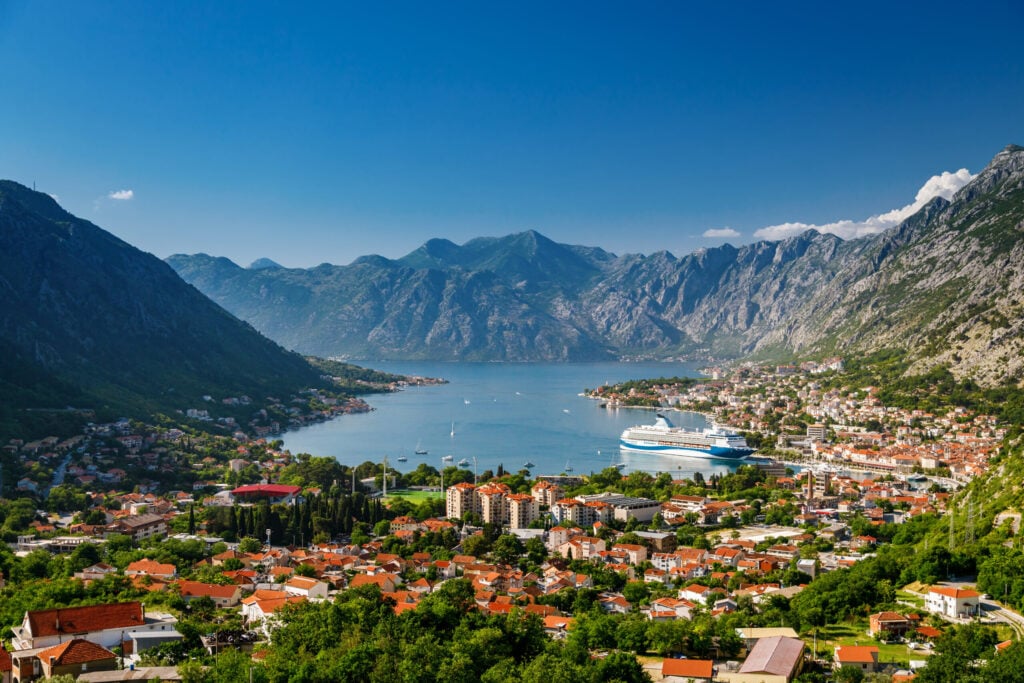
- Zemra e komunitetit: Qyteti i Ulqinit (Ulqin) në bregdetin e Adriatikut.
Në këtë faqe
- Sa shqiptarë jetojnë në Mal të Zi?
- Një popull vendas
- Ulqini: Zemra e Komunitetit
- Ku jetojnë shqiptarët
- Gjuha, Besimi dhe të Drejtat
- Pyetje të shpeshta
Sa shqiptarë jetojnë në Mal të Zi?
The Regjistrimi i vitit 2023 numëruar 30,978 shqiptarë etnikë në Mal të Zi, rreth 4.97 përqind e popullsisë, dhe pak më shumë, 32,725 persona ose 5.25 përqind, e dhanë shqipen si gjuhë amtare. Ata janë një pakicë e vogël në nivel kombëtar, por kompakte dhe e vendosur prej kohësh, duke formuar shumicë të qartë në bashkitë juglindore ku kanë jetuar gjithmonë.
Një popull vendas
Albanians have lived in what is now Montenegro since long before the modern state existed. Their homeland straddles the border with Albania and includes highland clans of Malësia such as the Hoti, Gruda and Triesh, whose customary law, the Kanun, shaped life in these mountains for generations. These lands became part of Montenegro in stages. Ulcinj, under Ottoman rule since 1571, became part of Montenegro in 1880, according to the town’s tourist board. In 1913 the Conference of Ambassadors in London drew a border through Malësia; that August, Le Petit Parisien reported that the heads of the Hoti, Gruda, Kelmendi, Kastrati and Shkreli tribes had gone to the British admiral Burney to protest against it.
Ulqini: Zemra e Komunitetit
The center of Albanian life in Montenegro is the Adriatic town of Ulqin, in Albanian Ulqin. After the Ottoman conquest of 1571 the town became a base for korsarët, and its tourist board dates the end of Ulcinj piracy to the early 19th century, after the military defeat of Napoleonic France. From the middle of the 18th century, Ulcinj traders also bought enslaved Africans, who in time became free townspeople working in farming and seafaring, according to the same source. Balkan Insight reported in 2022 that this small Afro-Albanian community “has long since disappeared”; a local resident told the paper that since Rizo Surla, perhaps its last member, died in 2003 and the others moved away, “only the memory remains”. Today 73.53 percent of the municipality’s residents are Albanian (2023 census). Our guide to Albanian American organizations lists associations of people from Ulqin in the United States, such as the Don Gjon Buzuku Association in Chicago.
Ku jetojnë shqiptarët
Albanians live mainly along the border with Albania, in the south and east of the country. They are the clear majority in Ulqin dhe në Tuzi, komuna e Malësisë që u nda nga Podgorica në vitin 2018, dhe ato formojnë komunitete të rëndësishme në Gusinje dhe Plav dhe përreth kryeqytetit. Harta e hijezon secilën komunë sipas pjesës së saj shqiptare.
Shqiptarët janë rreth 5 përqind e popullsisë së Malit të Zi, 30,978 në regjistrimin e vitit 2023, një komunitet vendas i përqendruar në juglindje pranë kufirit me Shqipërinë. Vendosni miun mbi të ose prekni një komunë.
Komunat e hijezuara nga pjesa e popullsisë etnike shqiptare (regjistrimi i vitit 2023). Burimi: Zyra e Statistikave të Malit të Zi (MONSTAT).
Gjuha, Besimi dhe të Drejtat
Albanian is one of four languages that Montenegro’s constitution places “in the official use” alongside the official language, Montenegrin, and minority nations have a constitutional right to “education in their own language and alphabet in public institutions” (details below). Albanian parties enter parliament under a lower threshold of 0.7 percent for minority lists, and in the 2023 election two Albanian lists won three seats between them (see Albanians in Parliament below).
In faith, the community is mixed: most Albanians are Muslim, and there is a large Katolike Romake minority, above all among the Malësia highlanders. MONSTAT’s 2023 tables give religion by municipality rather than by ethnicity, so there is no exact split, but the pattern is clear. In Ulcinj, 76.90 percent of residents declared Islam and 9.83 percent Catholicism; in Tuzi, 54.68 percent declared Islam and 39.68 percent Catholicism. Nationally, Catholics are 3.27 percent of Montenegro’s population.
The 2023 Census, Municipality by Municipality
Montenegro’s statistical office, MONSTAT, published the ethnicity and language results of the 2023 census on October 15, 2024. The release breaks the numbers down for every municipality, which makes it possible to see exactly where the community lives.
Seven municipalities account for 30,277 of the 30,978 people who declared themselves Albanian, more than 97 percent of the national total. Ulcinj and Tuzi alone are home to 23,197, about three quarters of all Albanians in the country.
| Municipality | Total population | Shqiptarët | Share of municipality | Albanian mother tongue | Share of municipality |
|---|---|---|---|---|---|
| Ulqin | 20,507 | 15,078 | 73.53% | 15,233 | 74.28% |
| Tuzi | 12,979 | 8,119 | 62.55% | 7,820 | 60.25% |
| Bar | 45,812 | 1,919 | 4.19% | 2,030 | 4.43% |
| Podgorica | 179,505 | 1,780 | 0.99% | 2,533 | 1.41% |
| Gusinje | 3,933 | 1,352 | 34.38% | 1,343 | 34.15% |
| Rožaje | 23,184 | 1,176 | 5.07% | 1,006 | 4.34% |
| Plav | 9,050 | 853 | 9.43% | 758 | 8.38% |
| Mali i Zi | 623,633 | 30,978 | 4.97% | 32,725 | 5.25% |
The census also asked which language a person usually speaks, a different question from mother tongue. Nationally, 27,979 people, or 4.49 percent, answered Albanian. In Ulcinj the figure was 14,475 people (70.59 percent of the municipality) and in Tuzi it was 7,123 (54.88 percent). A further 691 people across the country gave the combined answer Albanian and Montenegrin.
One detail stands out in the table. In Ulcinj, Bar and Podgorica, more people reported shqip as their mother tongue than declared Albanian ethnicity. In Tuzi, Gusinje, Rožaje and Plav the pattern runs the other way.
What Changed Since the 2011 Census
The previous census, held in 2011, counted 30,439 Albanians, or 4.91 percent of a population of 620,029. Twelve years later the count was 539 higher and the share had edged up to 4.97 percent. Mother tongue figures barely moved: 32,671 people (5.27 percent) in 2011 and 32,725 (5.25 percent) in 2023.
Behind the stable national total, the local picture shifted:
- Ulqin grew from 14,076 Albanians (70.66 percent of the municipality) to 15,078 (73.53 percent).
- Bar fell from 2,515 (5.98 percent) to 1,919 (4.19 percent).
- Rožaje was almost unchanged, at 1,158 in 2011 and 1,176 in 2023.
- Plav and Gusinje were a single municipality in 2011, with 2,475 Albanians (18.88 percent). Gusinje was created in 2014, when it split from Plav, and in 2023 the two together counted 2,205.
The 2011 figure for Podgorica, 9,538 Albanians, is not directly comparable with today’s, because Tuzi was still governed as part of the capital at that time.
Tuzi: A Municipality of Its Own Since 2018
Tuzi has been an independent municipality since September 1, 2018. It roughly covers the Montenegrin part of Malësia and is made up of more than 40 settlements.
The first local elections after the change were held on March 3, 2019. The Albanian Forum, a coalition of Albanian parties, won half of the 32 seats in the municipal assembly, and its candidate Nik Gjeloshaj became the first Albanian mayor of Tuzi. He held the post for 55 months.
The highlands inside the municipality carry a good deal of Albanian history. Ded Gjo Luli, who commanded the highlanders’ uprising of 1911, was born in Traboin, now part of Tuzi municipality. During that uprising an Flamuri shqiptar was raised on Bratila mountain at Deçiq. Our profile of Ded Gjo Luli tells the full story.
Albanians in Parliament and Government
Montenegro’s parliament has 81 seats, elected from party lists in a single nationwide constituency with a 3 percent threshold. National minority lists benefit from a lower bar: a list that falls short of 3 percent can still win seats if it passes 0.7 percent, and the lists of one minority are added together for up to three seats.
In the parliamentary election of June 11, 2023, the Albanian lists won three seats between them. The Albanian Forum won 1.91 percent of the vote and two seats, and the Albanian Alliance won about 1.5 percent and one seat.
Representation has reached the top of government too. Dritan Abazović, an ethnic Albanian born in Ulcinj and leader of United Reform Action (URA), became prime minister on April 28, 2022 and served until October 31, 2023. He is the first ethnic Albanian to have held the office.
The government that followed also included Albanian ministers. In October 2023 Nik Gjeloshaj resigned as mayor of Tuzi to become deputy prime minister and minister of economy, and Albanian Daily News reported that Albanians would hold three ministerial posts in the new cabinet, the others going to Fatmir Gjeka and Marash Dukaj.
Outside parliament, the community is represented by the Albanian National Council, established in 2008 and based in Ulcinj. The first Albanian political party in the country, the Democratic League in Montenegro, was founded in 1990 by Mehmet Bardhi.
What the Constitution Says
The legal basis for these arrangements is the constitution. Article 13 names Montenegrin as the official language and adds that Serbian, Bosnian, Albanian and Croatian “shall also be in the official use.”
Article 79 lists the rights of minority nations. They include the right to use their own language and alphabet in private, public and official use, the right to “authentic representation” in parliament under the principle of affirmative action, and proportionate representation in public services and state authorities. The reduced electoral threshold described above is how the second of those rights works in practice.
Pyetje të shpeshta
Sa shqiptarë jetojnë në Mal të Zi?
Montenegro’s 623,633 residents in 2023 included 30,978 Albanians, or 4.97 percent. Slightly more people, 32,725 (5.25 percent), gave Albanian as their mother tongue. The 2011 census had counted 30,439 Albanians (4.91 percent).
Ku jetojnë shumica e shqiptarëve në Mal të Zi?
Along the border with Albania, in the south and east: above all in Ulcinj (73.53 percent Albanian in 2023) and Tuzi (62.55 percent), then Gusinje and Plav in the east, with smaller communities in Bar, Podgorica and Rožaje.
A janë shqiptarët vendas në Mal të Zi?
Yes. They are a long-established people who have lived in the region for centuries, including the historic highland clans of Malësia; they are not migrants.
What percentage of Ulcinj is Albanian?
In the 2023 census, 15,078 of Ulcinj’s 20,507 residents declared themselves Albanian, or 73.53 percent, up from 70.66 percent in 2011. 74.28 percent gave Albanian as their mother tongue.
Is Albanian an official language in Montenegro?
Montenegrin is the official language. Under Article 13 of the constitution, Albanian, Serbian, Bosnian and Croatian “shall also be in the official use”, and Article 79 gives minority nations the right to use their language in official dealings and in education.
Has the number of Albanians in Montenegro changed?
Very little nationally: 30,439 in 2011 and 30,978 in 2023. Locally the picture shifted, with Ulcinj gaining and Bar losing Albanian residents, and Tuzi becoming its own municipality in 2018.
Çfarë feje kanë shqiptarët në Mal të Zi?
Most are Muslim, with a large Roman Catholic minority concentrated in Malësia. The census does not cross-tabulate religion and ethnicity, but in Tuzi 39.68 percent of residents declared themselves Catholic in 2023, against 9.83 percent in Ulcinj.
Burimet
- Zyra Statistikore e Malit të Zi (MONSTAT), Regjistrimi i Popullsisë 2023
- Grupi për të Drejtat e Minoriteteve: Shqiptarët në Mal të Zi
- Wikipedia: Shqiptarët në Mal të Zi
- Wikipedia: Ulqini
- MONSTAT: 2023 Census, Population of Montenegro by National or Ethnic Affiliation, Religion, Mother Tongue and Language Usually Spoken (release of 15 October 2024)
- MONSTAT: Census of Population, Households and Dwellings in Montenegro 2011, Release No. 83
- Constitute Project: Constitution of Montenegro, Articles 13 and 79
- Groupe d’études géopolitiques: Presidential and parliamentary elections in Montenegro, March to June 2023
- Exit News: Albanian Candidate Wins Mayoral Election in Tuzi, Montenegro
- Albanian Daily News: Nik Gjeloshaj Resigns as Mayor of Tuz to Become Montenegro’s V.PM
- Wikipedia: 2023 Montenegrin parliamentary election
- Wikipedia: 2019 Montenegrin municipal elections
- Wikipedia: Gusinje Municipality
- Wikipedia: Ded Gjo Luli
- Wikipedia: Tuzi Municipality
- Wikipedia: Dritan Abazović
- Ulcinj Tourist Organisation: The Ulcinj pirates
- Ulcinj Tourist Organisation: Slave trade in Ulcinj
- Ulcinj Tourist Organisation: Ulcinj in New Age
- Balkan Insight: Memory of Vanished African Community Lingers in Montenegrin Town (2022)
- Balkanweb: Le Petit Parisien on the Hoti, Gruda, Kelmendi, Kastrati and Shkreli leaders and the 1913 border
- Balkanweb: Tuzi becomes a municipality with full rights (September 1, 2018)
Lexime të Ngjashme
- Shqiptarët në mbarë botën: Diaspora globale
- Shqiptarët në Maqedoninë e Veriut
- Kanuni: E Drejta Zakonore Shqiptare
- A është Kosova shqiptare?
- Gjuha shqipe
- Shqiptarët në Turqi

Autor: Val Demiri
Valbona është redaktore dhe shkrimtare në ALB Connection, ku ajo mbulon njerëzit, bizneset dhe kulturën që formësojnë diasporën shqiptare. E diplomuar në gazetari në Universitetin e Ajovës, puna e saj përfshin profile të komunitetit, histori suksesi dhe reportazhe mbi jetën shqiptare në të gjithë SHBA-në, Evropën dhe më gjerë. Ajo tërhiqet nga historitë që festojnë arritjet e shqiptarëve dhe e mbajnë komunitetin të lidhur përtej kufijve.