
Albanian pizza isn’t a single dish, it’s an industry. Albanian-American families run a remarkable share of the pizzerias in the Bronx, Westchester, Yonkers, and northern New Jersey, along with major pizza operations in Detroit, Boston, and other cities. The Albanian-American pizza scene is one of the most successful immigrant business stories in modern American food history, quietly built over the past 50 years, family by family, slice by slice. This guide covers how Albanian immigrants came to dominate so much of the New York metro pizza business, what makes Albanian-style pizza distinctive (or not), the most famous Albanian-American pizzerias, and how the tradition has spread across the U.S.
Quick Facts: Albanian-American Pizza
- Number of Albanian-owned pizzerias in the New York metro area: No official count exists. The New York Times reported in April 2001 on a growing number of Albanian-American owners of Italian restaurants and pizza parlors in the city and its suburbs
- Primary regional concentration: Bronx, Yonkers, Westchester County, northern New Jersey, Brooklyn, Staten Island
- Other major hubs: Detroit metro, Boston, Worcester, Chicago suburbs
- Style: Mostly Italian-American style, thin crust, foldable slices, with Albanian family signatures in dough, sauce, or cheese ratios
- The story: Documented accounts describe Albanian immigrants who learned the trade from Italian-American pizzaiolos, then bought family pizzerias as Italians moved to the suburbs and out of the business
The Origin Story
The Albanian pizza tradition in America has several roots:
1. The Arbëreshë Connection
Italo-Albanians (Arbëreshë), descendants of Albanians who settled in southern Italy in several waves from the 15th to the 18th century, many of them after Skanderbeg’s death in 1468 (more on Skanderbeg), had been part of southern Italian immigration to America for generations. The reporting cited below does not tie them directly to the later Albanian pizzeria pattern, but the shared history is part of why many Albanians felt at home in Italian kitchens.
2. The 1960s to 1980s Albanian Wave
As Albanians began emigrating to the U.S. in larger numbers, at first mostly from Kosovo, North Macedonia, and Montenegro (then part of Yugoslavia), since communist Albania barred emigration until 1990, and later from Albania itself, they often found their first work in Italian-American pizzerias and Italian restaurants. The owners, often older Italian immigrants whose children were going to college rather than into the family business, increasingly hired Albanian workers as kitchen help.
3. The Buyout Era (1980s to 2000s)
By the 1980s and 1990s, the second generation of Italian-American pizzaiolos was retiring or moving out of urban areas. Many sold their businesses to their loyal Albanian employees. A pattern emerged: an Italian family sells the Bronx slice shop they’ve run for 40 years to the Albanian guy who’s been making pies there for 15. The Albanian family keeps the Italian name (because the customer base recognizes it), the recipes (because they work), and quietly builds a small empire.
4. The Chain Effect
Once a few Albanian families owned successful pizzerias, they brought relatives over, helped them buy their own pizzerias, and developed extended family business networks. By April 2001 the trend was visible enough for The New York Times to report on the growing number of Albanian-American owners of Italian restaurants and pizza parlors in the city and its suburbs, many still operating under Italian names.
Famous Albanian-American Pizzerias
Without naming specific shops (the scene is full of family operations that prefer low profiles), the Albanian-American pizza scene includes:
- Many of the classic “old school” Bronx slice joints
- Numerous Westchester County pizzerias
- Pizza chains in Yonkers and the Bronx
- Italian-American style pizzerias across northern New Jersey
- Major operations in the Detroit metro
- Pizza shops in Worcester and Boston
If you live in the New York metro area, you’ve almost certainly eaten Albanian-made pizza without knowing it.
Is There a Distinctive “Albanian Pizza” Style?
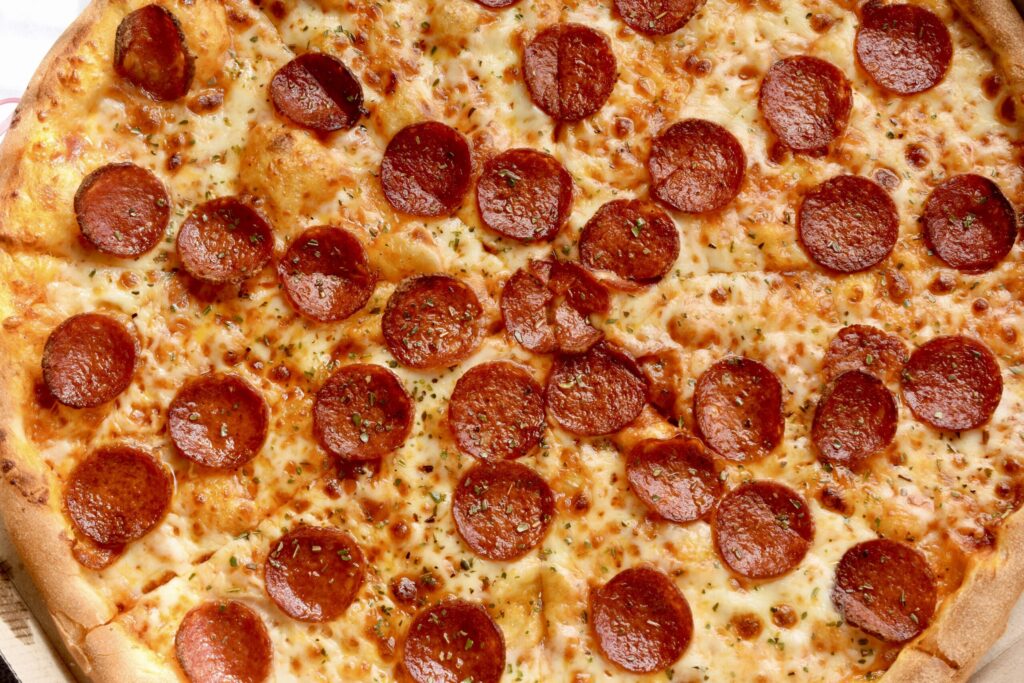
Mostly no, Albanian-American pizza is overwhelmingly Italian-American style: thin foldable slices, classic tomato sauce, mozzarella, optional pepperoni or sausage. The Albanian families inherited Italian recipes and largely kept them. That said, some Albanian touches do show up:
- Slightly thinner, crispier crusts in some shops
- More generous cheese application in others
- Sauce variations influenced by Albanian preferences, sometimes a touch sweeter, sometimes more herbaceous
- House byrek alongside the pizza menu, some Albanian-American pizzerias also sell traditional Albanian byrek
- Albanian conversations in the back kitchen alongside the Italian phrases the older pizzaiolos taught the family
Albanian Pizza vs Italian Pizza vs New York Style
- Italian (Neapolitan) pizza: Soft, thin center with a puffy rim, fresh mozzarella, tomato, basil. Cooked in a wood-fired oven at very high heat.
- New York-style pizza: Thin foldable slice, low-moisture mozzarella, tomato sauce. Usually cooked in a gas deck oven, with a few historic shops still using coal.
- Albanian-American pizza: Essentially New York-style with regional variations. Italian-American technique, often Albanian family.
- Detroit-style pizza: A different tradition entirely (rectangular, thick crust, crispy edges). Albanian-American pizzerias in Detroit make this style too.
The Cultural Significance
The Albanian-American pizza story matters for several reasons:
- It’s one of the most successful immigrant entrepreneurship stories of the modern American economy, yet it gets relatively little attention in mainstream American food media.
- It exemplifies the Albanian-American hard-work ethic, families putting in long days, employing relatives, sending kids to college on slice money.
- It preserves Italian-American food culture in neighborhoods where Italian immigrants have largely moved to suburbs.
- It shows the diaspora’s economic adaptation, Albanians arriving in a new country, learning a trade, then becoming the keepers of that trade.
Action Bronson and Albanian Pizza Culture
Action Bronson, the half-Albanian Queens-born rapper and food media star, has featured Albanian food in his Viceland show F*ck, That’s Delicious, including a visit to an Albanian burek bakery in the Bronx with his cousin Big Body Bes. That coverage is some of the highest-profile mainstream attention Albanian-American food has received.
What Reporters Have Documented: A Timeline
Most of what is said about Albanians and pizza is passed along by word of mouth. A smaller body of journalism puts names, dates and places on the story. The table lists the pieces we found, what each one reported and when. Where a business is named, we repeat only what the outlet published.
| Date | Outlet | What it reported |
|---|---|---|
| April 3, 2001 | The New York Times | Under the headline “The Albanian Connection; As Italians Move Up, a New Group Does the Pizza and Pasta,” the paper reported a growing number of Albanian-Americans becoming owners of Italian-American restaurants and pizza parlors in New York City and the surrounding area. The article opens at a Famous Famiglia pizzeria at Broadway and 50th Street in Manhattan. |
| May 5, 2008 | Philadelphia Magazine | A trends piece titled “The Albanians Are Coming!” listed Italian restaurants in and around Philadelphia opened by Albanians and mentioned “innumerable pizza parlors” without counting them. |
| February 24, 2010 | Bronx Times | A profile of Paul Kolaj, co-founder, president and CEO of Famous Famiglia. It reported that his family fled Kosovo in 1969, that he came to the United States from Italy in 1970 and lived in the Castle Hill Houses in the Bronx, and that he and his siblings founded the company in 1986 in a 300-square-foot storefront at West 96th Street and Amsterdam Avenue. |
| December 15, 2011 | The Bronx Ink (Columbia Journalism School) | A feature on “Little Albania” described Lydig Avenue as a mix of Albanian pizzerias and bakeries, kosher Russian butchers and small European markets. It profiled George Dedvukaj, who immigrated in 1970 after 18 months in Italy, worked in Italian-owned pizzerias in the Bronx for 26 years, and has run Giovanni’s on Arthur Avenue with his family since 1996 after buying it from its Italian owners. |
| February 2023 | D Magazine (Dallas) | Dining critic Brian Reinhart reported that Albanian families are a major force in Dallas-area pizza. He interviewed Tony Hajro, who moved to Rome in 1974, worked in pizza restaurants there and in New Jersey, and opened his first pizza place in Lewisville, Texas, in 1984. |
Read together, these pieces agree on the outline: people arrived with little, worked for years in Italian-owned kitchens, and bought the business when the owners moved on. They span more than two decades and three regions, which suggests the pattern is not limited to the Bronx.
Why Italy Comes Up in Almost Every Story
Italy is the thread that ties these accounts together. Encyclopaedia Britannica notes that Italy lies only about 50 miles (80 km) across the Adriatic from Albania. For people leaving Yugoslavia and, later, Albania, it was the nearest door to the West.
The Bronx Ink reported in 2011 that the first wave of ethnic Albanian immigrants reached the Bronx in the late 1960s and early 1970s, settling around Pelham Parkway, Morris Park and Arthur Avenue as Italian families left for the suburbs. A local Albanian community publisher told the outlet that most early Albanian immigrants had to seek temporary asylum in Italy before they could reach the United States. Two of the men in the table above followed that route: Kolaj’s family fled Kosovo in 1969 and he came to the United States from Italy in 1970, and Dedvukaj spent 18 months in Italy. Hajro, the Dallas pioneer, worked in Rome before he ever saw New Jersey. Bronx Times wrote that Kolaj first found work in Italian restaurants, where he felt at home because of the cultural similarities.
D Magazine traces a later wave to the end of communism in Albania. Albanians watched Italian television as an act of rebellion under Enver Hoxha, the magazine wrote, and migrated when they could: in March 1991 alone, about 25,000 Albanians arrived in Italy. The war in Kosovo then launched a new wave of refugees, many of whom, the magazine wrote, found jobs in the Italian service industry.
Why So Few Shops Call Themselves Albanian
Customers rarely see the word Albanian on the sign. The reporting offers a few reasons, all from owners themselves.
- The customer already knows Italian food. A young Albanian chef in Philadelphia told Philadelphia Magazine in 2008 that he opened an Italian restaurant rather than an Albanian one because “Albanian food is good, but it’s not known.”
- The name came with the shop. In the Bronx Ink account, the Arthur Avenue pizzeria that changed hands in 1996 was bought from its Italian owners and still trades under an Italian name.
- Respect for the tradition they learned. Paul Kolaj told Bronx Times that the family chose the Italian word for family for their company because they valued what they saw in Italian culture: teamwork, discipline and commitment.
It has not always been a comfortable fit. The Bronx Ink reported that Albanians running Italian restaurants in the Bronx sometimes face scorn from customers who accuse them of imitating Italian recipes. One owner quoted in the piece also pointed out that the cycle continues, with newer immigrant groups now working the kitchen jobs Albanians once held.
Beyond New York: Texas, Pennsylvania and Pizza Back Home
The Dallas story shows how the New York and New Jersey kitchens seeded other regions. Tony Hajro told D Magazine that a fellow cook in New Jersey told him the Texas economy was booming, so he moved. He said he counted just six Albanian families in the Dallas area in 1982. By the time the article ran in 2023, the community’s Albanian Independence Day celebration at a resort hotel drew 1,200 guests, and it was held on Thanksgiving Day because, as the magazine put it, that is the one day all the pizza places are closed.
The same article makes a point that surprises many readers: pizza was not part of the food these families grew up with. Hajro said he tasted his first pizza after moving to Rome. Today, he told the magazine, there is a pizza place everywhere you turn in the Balkans. If you want the dishes that were on the family table before pizza, see our guide to Albanian food or find Albanian restaurants near you.
What Nobody Has Counted
None of the articles above is based on a survey of pizzeria ownership, and we have not found a government or industry dataset that records the ancestry of pizzeria owners. Claims that Albanians own a fixed percentage of the pizzerias in the Bronx or anywhere else circulate widely, but we could not trace any of them to a source with a method, so this article does not repeat them. What the record does support is narrower and still remarkable: a documented, decades-long pattern of Albanian families buying and running Italian-American pizzerias in New York, Philadelphia and Dallas, and at least one chain, Famous Famiglia, that grew from a 300-square-foot storefront opened by a family that left Kosovo in 1969.
Thinking about opening a pizzeria or restaurant of your own? Read our step-by-step guide on how to go from working in a restaurant to owning one.
Related: Albanian Bronx.
Frequently Asked Questions
Do Albanians make pizza?
Yes. Reporting by The New York Times (2001), The Bronx Ink (2011) and D Magazine (2023) documents Albanian-American families owning pizzerias in New York City and its suburbs and in the Dallas area. Philadelphia Magazine described the same pattern there in 2008. Most operate under their original Italian names but are Albanian-owned.
Why are Albanian-Americans involved in the pizza business?
Albanian immigrants from the 1960s to the 1990s, first from Yugoslavia and after 1990 from Albania, often found their first work in Italian-American pizzerias. As Italian-American owners retired, they sold their businesses to loyal Albanian employees. Albanian families built family networks of pizzerias, particularly in the New York metro area.
Is Albanian pizza different from Italian-American pizza?
Mostly no, it’s essentially the same New York-style pizza tradition, with some regional and family-specific variations. The Albanian families inherited Italian recipes and kept them. Some shops also sell traditional Albanian byrek alongside the pizza menu.
Are most Bronx pizzerias Albanian-owned?
Nobody has counted, so no share can be stated. What is documented is the pattern: The Bronx Ink reported in 2011 that Albanian immigrants who started in low-skilled restaurant jobs went on to buy Italian restaurants and pizzerias around Arthur Avenue and Pelham Parkway, often from Italian owners who were moving away.
What’s a famous Albanian-American pizza place?
The Albanian-American pizza scene is full of family operations that don’t market themselves as “Albanian”, most operate under their original Italian names. Search our business directory for specific Albanian-owned restaurants and pizzerias.
Where can I find Albanian byrek alongside pizza?
Some Albanian-American pizzerias in the Bronx, Yonkers, and Detroit metro also sell byrek (Albanian phyllo pies). Browse our business directory to find Albanian bakeries and pizzerias near you.
Is Famous Famiglia Albanian-owned?
It was founded by an Albanian family. Bronx Times reported in 2010 that Paul Kolaj, whose family fled Kosovo in 1969 and reached the United States by way of Italy in 1970, founded Famous Famiglia with his siblings in 1986 in a small storefront at West 96th Street and Amsterdam Avenue in Manhattan. He was the company’s president and CEO at the time of the article.
When did Albanians start buying pizzerias in New York?
The documented cases begin in the 1980s and 1990s. Famous Famiglia opened in 1986, and The Bronx Ink reported that one Arthur Avenue pizzeria passed from Italian to Albanian ownership in 1996, after its new owner had spent 26 years working in Italian-owned pizzerias. By April 2001 The New York Times was covering the trend across the city.
Are there Albanian-owned pizzerias outside New York?
Yes. D Magazine reported in February 2023 that Albanian families are a major force in Dallas-area pizza, starting with a shop opened in Lewisville, Texas, in 1984. Philadelphia Magazine wrote in 2008 about Albanian-run Italian restaurants and pizza parlors in that region. Neither outlet gave a total count.
Sources
- The New York Times (April 3, 2001): The Albanian Connection; As Italians Move Up, a New Group Does the Pizza and Pasta
- Bronx Times (February 24, 2010): American Civics honors Famiglia Pizzeria co-founder
- The Bronx Ink (December 15, 2011): “Little Albania” in the Bronx
- D Magazine (February 2023): Albanian Powerhouses of Dallas Pizza Add Their Own Touch to Pizza Sauce
- Philadelphia Magazine (May 5, 2008): Pulse: Trends: The Albanians Are Coming!
- Encyclopaedia Britannica: Albania
Related Reading
- Albanian Food: The Complete Guide
- Popular Foods in Albania
- How Many Albanians Live in the USA?
- Is Action Bronson Albanian?
- Byrek vs Borek vs Burek
- Skanderbeg: Albania’s National Hero
- Best Albanian Restaurants in NYC
- Best Albanian Restaurants in the Bronx
- Albanian Restaurants in New Jersey
Related reading: Albanian Cheese · Albanian Bread · Albanian Breakfast · Albanian Coffee Tradition

Author: Dardanë Halimi
Dardanë Halimi is a writer and communications professional with an M.A. in Writing, Rhetoric, and Technical Communication from James Madison University. Her work focuses on storytelling, digital content, higher education, and strategic communication, with experience writing for academic, nonprofit, and marketing organizations in both the United States and Kosovo.