The Short Version
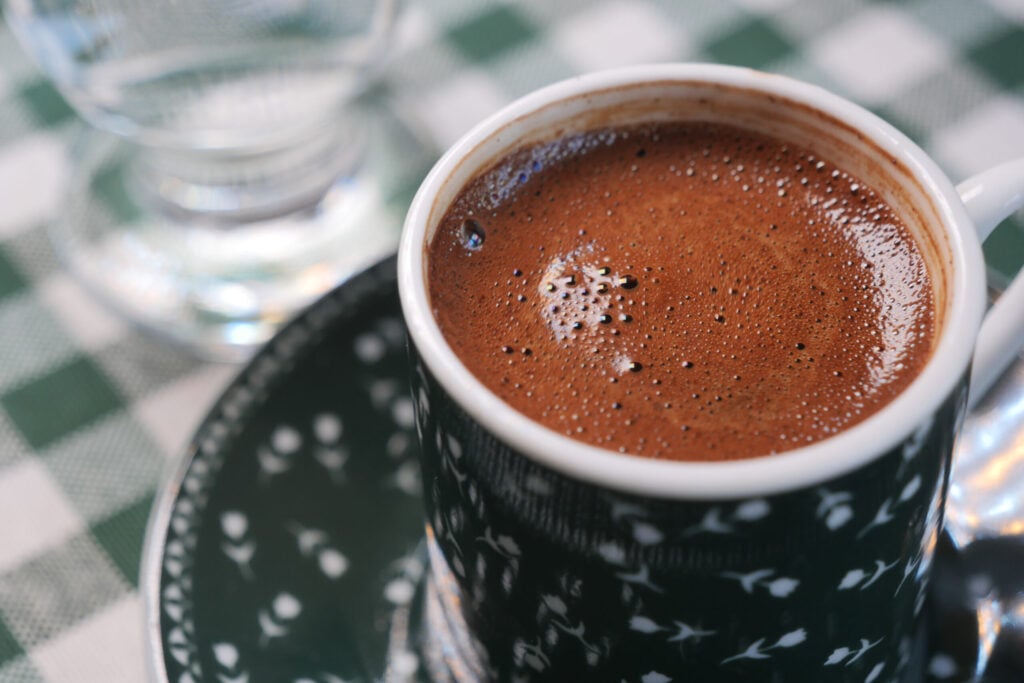
- Main coffee type: Kafe turke (Turkish-style coffee), finely ground, brewed in a copper pot called a xhezve, served unfiltered.
- Other popular types: Macchiato (the favorite café drink in Albania today), espresso, frappe in summer.
- Where it’s drunk: Everywhere, homes, cafes, offices, family gatherings, business meetings, weddings, funerals.
- How often: Several times a day is common for many Albanians.
- The rule: No conversation, no decision, no friendship begins without coffee.
On This Page
- The Three Coffee Eras of Albania
- How to Make Kafe Turke
- The Etiquette of Albanian Coffee
- Cup Reading (Fall)
- The Albanian Cafe Scene Today
- Coffee in the Albanian Diaspora
- Frequently Asked Questions
The Three Coffee Eras of Albania
Albanian coffee culture has gone through three distinct phases:The Ottoman Inheritance (to 1944)
During more than four centuries of Ottoman rule, which ended in 1912, Albanians adopted the coffee tradition that spread from Yemen through the Ottoman world via Istanbul, and it remained the everyday coffee through the decades of independence that followed. The xhezve, the finely ground coffee, the small porcelain cups, the slow brewing process, the cup-reading divination, all came from this period. This is the original Albanian coffee tradition.The Communist Era (1944 to 1991)
Under Enver Hoxha’s communist regime, imported goods, coffee among them, were often scarce, and many families recall stretching coffee with roasted substitutes. The kafe turke tradition survived in homes and in the limited state cafes.The Italian Wave (1991 to Present)
After the fall of communism, Albania reopened to the world, and to Italian coffee. Hundreds of thousands of Albanians emigrated to Italy in the 1990s, and Italian television and returning emigrants brought Italian coffee habits home. Espresso machines flooded into Tirana and Pristina. The macchiato became the default café drink, a small, strong espresso topped with a spoonful of milk foam, drunk at sidewalk tables. Today macchiato and espresso are the usual café orders, while the older tradition lives on in homes and family settings.How to Make Kafe Turke (Albanian Turkish Coffee)
What You Need
- A xhezve (pronounced jez-VEH; Albanian xh sounds like English j), a small copper or brass pot with a long handle, narrowed at the top. Available in sizes for 1, 2, 3, 4, or more cups.
- Very finely ground coffee (almost powder-fine). Pre-ground Turkish-style coffee from Albanian or Turkish stores works best.
- Cold water.
- Sugar (optional, added at brewing time, not after).
- Small porcelain cups (filxhan).
The Method
- Measure water into the xhezve, one filxhan (small cup) of cold water per serving.
- Add coffee, one heaping teaspoon of finely ground coffee per cup.
- Add sugar if desired. Common ways to ask for sweetness: sade (no sugar), pak or e ëmbël pak (a little sweet), e mesme (medium sweet), e ëmbël (sweet). Sugar is added before brewing, not after.
- Stir once, then place over low heat.
- Heat slowly. As the coffee warms, foam (called kaymak in Turkish) will form on top. Do not let it boil over.
- Just as the foam rises, lift the xhezve off the heat. Spoon a little of the foam into each cup first.
- Return to heat briefly, then lift again before the second rise. Some traditional brewers do this three times.
- Pour slowly into each cup, letting the grounds settle at the bottom.
- Let it rest 30 to 60 seconds before drinking so the grounds settle. Never stir before drinking.
- Drink slowly from the top, do not drink the muddy grounds at the bottom.
The Etiquette of Albanian Coffee
Coffee in Albania comes with unwritten rules:- Always offered to guests. Refusing outright can seem impolite. If you don’t want coffee, accepting and sipping slowly is the polite option, or a host will usually offer something else.
- Always served by the host. Even children of the household serve coffee to visiting elders.
- Always with something on the side. A glass of cold water is standard. Often also a small sweet (lokum, a piece of trilecë, or a few cookies).
- Always sat down to drink. Standing coffee is unusual; coffee is a sit-down ritual.
- Always with conversation. Drinking coffee in silence at someone’s home is socially awkward. Coffee is the structure for the conversation, not separate from it.
- Elders first. In many families coffee is served to the eldest guest first.
- Fresh for a second round. Kafe turke cannot be topped up, so a second coffee means a freshly brewed pot.
Cup Reading (Fall)
After drinking kafe turke, the grounds left in the bottom of the cup can be “read”, a fortune-telling practice called fall in Albanian; a fortune teller is a fallxhi or, more often, a fallxhore. The drinker flips the cup upside down on the saucer, lets the grounds dry, then a designated reader (usually an older woman in the family) interprets the patterns. This practice has Ottoman and broader Mediterranean origins (it’s also common in Turkey, Greece, Bosnia, and Lebanon). In modern Albania, cup reading is part-entertainment, part-tradition, part-genuine belief depending on the family. It’s a common social activity at gatherings, weddings, and the long afternoon coffees that older Albanian women hold with friends.Coffee in the Albanian Cafe Scene Today
Visit Tirana, Pristina, Tetovo, or any Albanian city and you’ll see one striking feature: cafes everywhere. Tirana is sometimes called Europe’s café capital per capita. Sidewalk seating fills from early morning to late evening. The typical Albanian cafe order today:- Macchiato, the dominant drink. Small espresso, dollop of foam, fast.
- Kafe turke, still ordered, especially by older customers or in traditional cafes.
- Espresso, standard.
- Cappuccino, for slower morning sessions.
- Frappe, cold whipped coffee, popular in summer (Greek-style).
- Café latte, increasingly common, especially in newer cafes.
Coffee in the Albanian Diaspora
The Albanian coffee tradition has traveled with the diaspora:- The Bronx and Yonkers, NY: Albanian cafes and bakeries serve kafe turke and macchiato alongside byrek and pastries.
- Metro Detroit (including Sterling Heights): Community cafes are important social spaces, especially for older Albanian men.
- Worcester, MA: One of the oldest Albanian communities in the US, where families have kept kafe turke at home through generations.
- Italian-Albanian fusion: Some Albanian-American pizzerias and restaurants serve Italian espresso alongside kafe turke.
Related: Where to buy Albanian coffee.
Frequently Asked Questions
What kind of coffee do Albanians drink?
Traditionally, kafe turke (Turkish-style coffee) brewed in a copper xhezve. In modern cafes, macchiato dominates, followed by espresso and cappuccino. Frappe is popular in summer.
What is a xhezve?
The small copper or brass pot used to brew Turkish-style Albanian coffee. It has a long handle and a narrowed top to help control the foam. Sized for 1 to 6 cups.
How is Albanian coffee different from Turkish coffee?
The brewing method and equipment are essentially identical, Albania inherited the tradition from the Ottoman Empire. The differences are cultural, not technical: how the coffee is served, the role of side foods, and the etiquette around it.
What does “do një kafe” mean?
“Do you want a coffee?”, the standard Albanian invitation, used to start a visit, a conversation, a meeting, a date, or pretty much any social interaction.
Why do Albanians spend so long over coffee?
Coffee in Albania is the container for conversation, not a quick caffeine fix. A coffee with a relative or friend can easily last an hour or more. It is the social ritual itself, not an addition to one.
What is cup reading (fall)?
The practice of interpreting the grounds left in the bottom of a kafe turke cup. The drinker flips the cup upside down on the saucer, lets the grounds dry, then a reader interprets the patterns. Part divination, part entertainment, part Albanian social tradition.
Related Reading
- Albanian Food: The Complete Guide to Traditional Cuisine
- Popular Foods in Albania: 20 Traditional Dishes
- What Is Raki Made Of? The Albanian Spirit Explained
- ALB Connection Business Directory, find Albanian-owned cafes near you
- Albanian Breakfast: What Albanians Eat in the Morning
Related reading: Albanian Cheese · Albanian Pizza · Albanian Bread · What is Albanian Food?

Author: Dardanë Halimi
Dardanë Halimi is a writer and communications professional with an M.A. in Writing, Rhetoric, and Technical Communication from James Madison University. Her work focuses on storytelling, digital content, higher education, and strategic communication, with experience writing for academic, nonprofit, and marketing organizations in both the United States and Kosovo.