Albanian Culture and Traditions: A Complete Guide
A complete guide to Albanian customs, values, faith, celebrations, and the traditions that hold the community together, at home and across the diaspora.
Albanian culture is one of the oldest and most distinctive in Europe, a heritage that has survived empires, isolation, and migration, and that diaspora families carry proudly across generations. It is built on a powerful code of personal honor, legendary hospitality, deep family bonds, and a remarkable tradition of religious tolerance. Whether you grew up in an Albanian household and want to understand your roots more deeply, or you are discovering the culture for the first time, this guide is your complete introduction to the customs, faith, celebrations, names, and language that make Albanians who they are.
Besa: The Albanian Code of Honor
If there is one concept at the heart of Albanian identity, it is besa, usually translated as a pledge of honor, but really meaning something closer to sacred, unbreakable trust. To give your besa is to stake your honor on keeping your word, and the tradition runs so deep that it shaped centuries of Albanian social life through the customary code known as the Kanun.
Besa is most famous for one extraordinary chapter of history: during World War II, Albanians sheltered Jews living in the country and Jewish refugees who had fled there. Yad Vashem records only two cases in which Jews were captured and deported from Albania, and says the help given may have been grounded in besa. It remains a living value, not a museum piece.
Read: What Is Besa? The Albanian Code of Honor Explained
Mikpritja: Albanian Hospitality
Closely tied to besa is mikpritja, the belief that a guest is a blessing who must be honored generously. In Albanian tradition a visitor is offered the best of everything: the best seat, the best food, endless coffee and raki, and a warmth that often surprises first-time guests. Declining hospitality can even cause offense, because offering it is a point of pride.
This is not just etiquette; it reflects a worldview in which community, generosity, and reputation matter enormously. For the diaspora, mikpritja is one of the most cherished traditions to pass down, a way of keeping the warmth of home alive in a new country.
Read: Albanian Hospitality (Mikpritja)
In Albania, faith has rarely divided: Muslims, Catholics, and Orthodox Christians have lived, married, and celebrated side by side for centuries.
Faith and Religious Harmony
Albania is genuinely unusual in the world for its religious harmony. Muslims, Orthodox and Catholic Christians, and members of the mystical Bektashi Sufi order have lived side by side for generations, often within the same family or village, frequently celebrating one another’s holidays. The old saying that the religion of Albanians is Albanianism captures how national identity has tended to come before religious division.
The Bektashi order, a tolerant, mystical branch of Islam with its world headquarters in Tirana, and the autocephalous Albanian Orthodox Church are two of the most distinctive expressions of this heritage.
Read: Bektashi: Albania’s Unique Sufi Muslim Tradition · The Albanian Orthodox Church
Weddings, Holidays and Celebrations
Few cultures celebrate like Albanians. A traditional wedding can stretch across several days, with separate gatherings for the bride’s and groom’s families, live music, traditional dress, and feasts that involve the whole community. Music and dance, including the circle dance known as the valle, sit at the center of every celebration.
The calendar is rich with observances too, from religious holidays shared across faiths to national days and lively New Year traditions that blend the old and the new.
Read: Albanian Wedding Traditions · Popular Albanian Wedding Songs · How Albanians Celebrate New Year · Albanian Holidays and Observances
Names and Identity
Albanian names carry meaning, memory, and even resistance. During the communist era many traditional and religious names were discouraged in favor of Illyrian or invented patriotic names, and the result is a naming culture full of history. First names often celebrate nature, virtues, or national heroes, while surnames frequently trace back to a region, a clan, a profession, or an ancestor.
Read: Albanian Baby Names · Albanian Last Names and What They Mean
- ~7.5MAlbanian speakers worldwide
- 3 faithsliving side by side
- Besathe code that binds it all
The Albanian Language
Albanian, shqip, is one of Europe’s oldest living languages and forms its own independent branch of the Indo-European family, of which it is the only modern representative. It is written in a 36-letter alphabet and has two main dialect groups, Gheg in the north and Tosk in the south, which together shaped the standard language spoken today. Its survival through centuries of foreign rule is itself a point of cultural pride.
Read: Gheg vs. Tosk: The Albanian Dialects Explained
Food, Coffee and Daily Life
Albanian culture is lived around the table. Meals are long, generous, and social, and the cuisine, byrek, qofte, fresh vegetables, dairy, and grilled meats, reflects centuries of Mediterranean and Ottoman influence made distinctly Albanian. Coffee in particular is a daily ritual of connection: an invitation for coffee is really an invitation to sit, talk, and belong.
Read: Albanian Food: The Complete Guide · The Albanian Coffee Tradition
Albanians in the Spotlight
Albanian heritage shows up in some surprising places, including the top of the global pop charts. As more public figures embrace their roots, younger generations in the diaspora are finding new pride in their identity.
Read: Is Dua Lipa Albanian?
Family and the Role of Elders
Family is the bedrock of Albanian life. Traditional Albanian families are close-knit and often multi-generational, with deep respect for parents and elders woven into daily life and major decisions. Elders are honored for their wisdom, and caring for aging parents is considered a sacred duty rather than a burden. Even as diaspora families adapt to American life, these bonds endure, Sunday gatherings, large extended-family celebrations, and a strong sense of obligation to one another remain central to Albanian identity.
Music and Dance
Music runs through every Albanian celebration. The country is especially known for Albanian iso-polyphony, a multi-voiced folk singing tradition that UNESCO proclaimed a Masterpiece of the Oral and Intangible Heritage of Humanity in 2005 and inscribed on its Representative List in 2008. Traditional instruments like the çifteli (a long-necked two-stringed instrument) and the lahuta (a single-stringed instrument played while singing epic songs, inscribed by UNESCO in 2025) accompany folk songs, while the circle dance known as the valle brings whole communities together at weddings and festivals. In the diaspora, this music is one of the most powerful ways younger generations stay connected to their roots.
Traditional Dress and National Symbols
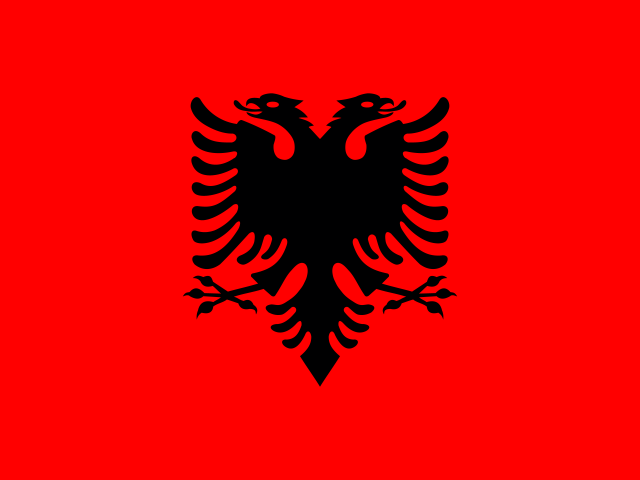
Albanian traditional clothing is among the most varied in the Balkans, with distinct regional costumes, the men’s white felt cap known as the plis, richly embroidered vests, and women’s elaborate dresses that differ from village to village. At the heart of Albanian symbolism is the black double-headed eagle on a red field, drawn from Skanderbeg’s banner and now the centerpiece of the national flag. For many in the diaspora, wearing traditional dress at weddings or flying the eagle flag is a proud public expression of identity.
Albanian Culture at a Glance
Albanian culture is the shared way of life of Albanians in Albania, Kosovo, North Macedonia, Montenegro and a large diaspora: one language, several faiths, a strong code of hospitality and a living folk tradition. The table below gives the basics with their sources, and the sections that follow go deeper.
| Topic | Key facts | Source |
|---|---|---|
| Language | Albanian (shqip), the only modern representative of its own branch of the Indo-European family. Two main dialects, Gheg in the north and Tosk in the south, divided roughly by the Shkumbin River. The standard spelling was adopted in 1909. | Britannica |
| Religion in Albania | Census 2023: Muslim 45.9%, Catholic 8.4%, Orthodox 7.2%, Bektashi 4.8%, Evangelical 0.4%, believers without a denomination 13.8%, atheist 3.6%, preferred not to answer 10.2%, no data 5.6%. | INSTAT, Census 2023, Table 15 |
| National flag | A black two-headed eagle on a red field. Skanderbeg raised a red flag with a black eagle over Krujë on November 28, 1443. | Britannica |
| National day | November 28, the date independence was proclaimed in 1912. | Britannica |
| National anthem | Lyrics by the poet Asdren (Aleksandër Stavre Drenova). | Britannica |
| Besa | A code of honor. Yad Vashem explains that besa literally means “to keep the promise,” so a family hosted by Albanians could trust them with their lives. | Yad Vashem |
| Mikpritja (hospitality) | Britannica describes Albania as known for traditions of hospitality that are based on the kanun, the customary code attributed to the 15th century lord Lekë Dukagjini. | Britannica |
| UNESCO intangible heritage | Five elements: folk iso-polyphony (2008), xhubleta (2022), transhumance (2023, shared with nine other countries), k’cimi dancing of Tropojë (2024) and the lahuta (2025). | UNESCO |
The census percentages are shares of the resident population of 2,402,113, calculated from the counts in INSTAT’s Table 15. For the values themselves, see our guides to besa, Albanian hospitality and the Kanun, and for the symbols, the meaning of the Albanian flag and the national anthem.
Albanian Traditions on the UNESCO Heritage Lists
UNESCO lists five Albanian traditions as intangible cultural heritage. Two of them sit on the list for traditions in need of urgent safeguarding, which means UNESCO judges that they are at risk of disappearing.
| Element | Year | UNESCO list | What it is |
|---|---|---|---|
| Albanian folk iso-polyphony | 2008 (first proclaimed in 2005) | Representative List | Group singing with two solo parts, a melody and a countermelody, over a choral drone. The drone is continuous among Tosks and rhythmic among Labs. It is sung at weddings, funerals, harvest feasts and festivals such as the folk festival in Gjirokastër. |
| Xhubleta, skills, craftsmanship and forms of usage | 2022 | Urgent Safeguarding List | A handmade, bell-shaped garment worn by highland women and girls in northern Albania, mostly black with embroidered motifs. UNESCO notes that few women now know the whole process. |
| Transhumance, the seasonal droving of livestock | 2023 | Representative List | The seasonal movement of herders and their animals between regions, inscribed jointly by Albania, Andorra, Austria, Croatia, France, Greece, Italy, Luxembourg, Romania and Spain. |
| K’cimi dancing of Tropojë | 2024 | Representative List | A dance from the Tropojë region, usually accompanied by drums and performed by men, women and children, usually in couples who dance face to face without touching. |
| Art of playing, singing and making the lahuta | 2025 | Urgent Safeguarding List | A single-stringed wooden instrument played while singing stories of legends, historical events and personal experience, in rural communities of north and northwestern Albania. |
Britannica names two other common folk instruments: the çifteli, a long-necked two-stringed instrument, and the gërnetë, a type of clarinet. Our guides to Albanian music, Albanian dances and folk costumes cover each tradition in detail.
Albanian Literature, Arts and Sport
Albania’s best known writer is Ismail Kadare (1936 to 2024). The Booker Prize Foundation records that he won the inaugural Man Booker International Prize in 2005, that his novels have appeared in more than 40 countries, and that he sought political asylum in France in 1990 after works such as The Palace of Dreams brought him into conflict with the communist authorities. Britannica names the early 20th century poets Gjergj Fishta, Ndre Mjeda and Asdren, and remembers Fan S. Noli, an Orthodox bishop and briefly prime minister, for his translations of world classics into Albanian.
Traditional arts include fine embroidery, lace making and woodworking, along with long epic songs that singers perform from memory. In Tirana, Britannica lists the National Library, the National Theatre, the Opera and Ballet Theatre and the National Museum of History among the main cultural institutions.
Football (soccer) is the most popular sport, according to Britannica, followed by tae kwon do, volleyball, swimming and weightlifting, and chess is a common pastime. The national football team reached the European Championship for the first time at Euro 2016 and for the second time at Euro 2024. Albania first competed at the Olympics in Munich in 1972 and won its first Olympic medals at Paris 2024, when wrestlers Chermen Valiev and Islam Dudaev each took bronze. Kosovo competed at its first Olympics in Rio in 2016, where judoka Majlinda Kelmendi won gold in the women’s 52 kg class.
Etiquette for Visitors and Guests
You do not need to study rules before visiting an Albanian home, but a few habits are documented by the U.S. Peace Corps, which trained American volunteers to live with Albanian host families.
- Answer the welcome. When a host says Mirë se vini! (Welcome!), the set reply taught in the Peace Corps language course is Mirë se ju gjeta!
- Expect to be offered coffee. The same course drills the question Doni një kafe? (Would you like a coffee?), and the Peace Corps welcome book describes people inviting newcomers for coffee soon after they arrive. Saying yes is an easy way to start a conversation.
- Expect generous food. The welcome book warns vegetarians to be tactful, because many families will want to serve meat to an honored guest.
- Dress neatly. It notes that Albanians dress in their best in public and that ragged or unkempt clothing on a foreigner is likely to be taken as an affront.
- Know the toast. Gëzuar! means cheers, and Të bëftë mirë! is said before a meal.
For more everyday customs, see our guides to the xhiro, the evening walk, and to common Albanian phrases.
How Culture Differs in Albania, Kosovo and the Diaspora
Albanians in Albania and Kosovo share a language, a flag and most customs, but their 20th century histories were different, and it shows.
- Dialect. Britannica notes that Albanian speakers in Kosovo and North Macedonia speak eastern varieties of Gheg, while the standard language has been modelled on Tosk since World War II. Since 1974 they have widely used a common spelling with Albania. See Gheg vs. Tosk.
- Religion and the state. Albania banned all religious practice from 1967 to 1990, as the Peace Corps country profile notes, and in the 2023 census about 17 percent of residents described themselves as believers without a denomination or as atheists. Britannica describes Kosovo’s society as largely secular, with Ramadan the most important celebration for Muslims and St. George’s Day (Shëngjergji) celebrated by members of all faiths. Our article on Albania’s religion ban has the background.
- Literature. Britannica observes that Albanian literature in Kosovo developed differently than in Albania, where the communist government imposed more severe ideological constraints.
- Dress and food. In Kosovo many older Albanian men still wear the white brimless cap, the plis, and well known dishes include fli (flija) and pite. Britannica’s examples for Albania include fergesë from Tirana, qofte and raki before a meal.
- Family networks. Britannica describes family support networks in Kosovo as very strong even when some members live abroad. UNESCO, for its part, lists the emigration of young people as one of the threats to passing on iso-polyphony.
For life between two cultures, our guides to Albanian vs. Kosovan, Albanian American identity and teaching kids Albanian go further.
Frequently Asked Questions
What is the Albanian code of honor?
It is called besa, a sacred promise of faith and protection. To give your besa is to stake your honor on keeping your word, a value so deep it shaped centuries of Albanian custom.
What religion are Albanians?
Albanians are religiously diverse and famous for their tolerance. The population includes Sunni Muslims, members of the mystical Bektashi order, and Orthodox and Catholic Christians, who have long lived peacefully side by side.
What language do Albanians speak?
Albanians speak Albanian (shqip), one of Europe’s oldest languages and its own independent branch of the Indo-European family. It has two main dialects, Gheg and Tosk.
What is a traditional Albanian wedding like?
Albanian weddings are large, joyful, multi-day celebrations featuring traditional dress, live music, circle dancing, and generous feasts that involve the entire extended family and community.
What does mikpritja mean?
Mikpritja is Albanian hospitality, the deeply held belief that a guest is a blessing to be honored with the very best of everything.
What is Albanian culture known for?
Albanian culture is known for besa, a code of honor built on keeping your word, and for generous hospitality toward guests. It is also known for religious coexistence, the red flag with the black double-headed eagle, folk iso-polyphony singing, which UNESCO inscribed in 2008, circle dances at weddings, and the novels of Ismail Kadare.
What is the main religion in Albania?
Islam is the largest religion. In Albania’s 2023 census, 45.9 percent of residents identified as Muslim and another 4.8 percent as Bektashi, while 8.4 percent were Catholic and 7.2 percent Orthodox. A further 13.8 percent said they were believers without a denomination, 3.6 percent said atheist, and about 16 percent gave no answer or had no data.
Which Albanian traditions are recognized by UNESCO?
UNESCO lists five: Albanian folk iso-polyphony (inscribed 2008), the xhubleta highland garment (2022), transhumance, shared with nine other countries (2023), k’cimi dancing of Tropojë (2024), and the art of playing, singing and making the lahuta (2025). The xhubleta and the lahuta are on the list of traditions in need of urgent safeguarding.
Is Kosovo culture the same as Albanian culture?
Largely, yes. Albanians in Kosovo and Albania share the language, the flag, most holidays and customs such as besa and hospitality. The differences come from history: Kosovo Albanians speak Gheg varieties, and Britannica notes that their literature developed differently than in Albania, where the communist government imposed more severe ideological constraints.
Who is the most famous Albanian writer?
Ismail Kadare (1936 to 2024) is the best known. He won the inaugural Man Booker International Prize in 2005, and his novels, including The General of the Dead Army and The Palace of Dreams, have been published in more than 40 countries, according to the Booker Prize Foundation. He sought political asylum in France in 1990.
Sources
- INSTAT: Albania Population and Housing Census 2023, Main Results (Table 15, resident population by religion)
- UNESCO Intangible Cultural Heritage: Albania, elements on the lists
- UNESCO: Albanian folk iso-polyphony
- UNESCO: Xhubleta, skills, craftsmanship and forms of usage
- UNESCO: Transhumance, the seasonal droving of livestock
- UNESCO: K’cimi dancing of Tropojë
- UNESCO: Art of playing, singing and making the lahuta
- Britannica: Albania, Cultural life (cultural milieu, daily life, the arts, sports)
- Britannica: Kosovo, Cultural life
- Britannica: Albanian language
- Britannica: Flag of Albania
- Yad Vashem: Albania, Historical Background during the Holocaust
- The Booker Prizes: Ismail Kadare
- U.S. Peace Corps: The Peace Corps Welcomes You to Albania (welcome book, November 2013)
- U.S. Peace Corps Albania: The Albanian Language, Gjuha shqipe, for Invitees (PDF)
- International Committee of Mediterranean Games: Albania wins first historic medals at the Olympic Games
- ESPN: Against all odds, Albania have Euro 2024 knockouts in reach (June 23, 2024)
- ABC News (Australia): Rio 2016, Kosovo wins first ever medal as Majlinda Kelmendi triumphs in judo