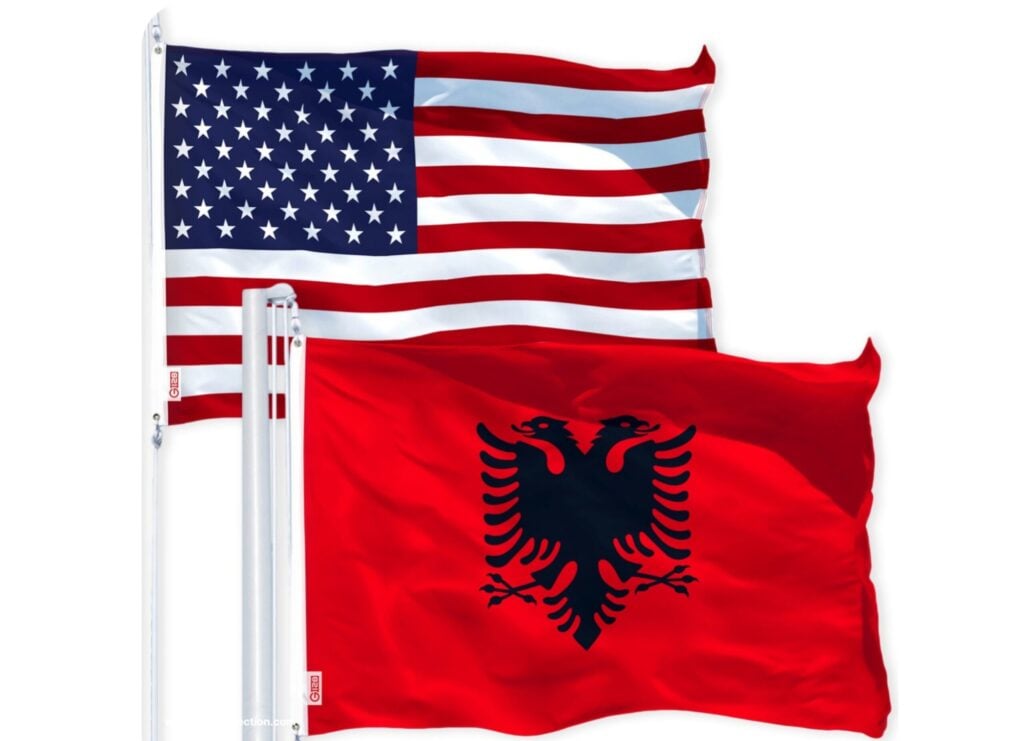
Të jesh shqiptaro-amerikan do të thotë të mbash dy botë të plota brenda një identiteti. Do të thotë të ndihesh plotësisht shqiptar në një mbledhje familjare dhe plotësisht amerikan në punë, dhe ndonjëherë të pyesësh veten se cili version i vetes është i vërtetë. Përgjigja, në të cilën arrijnë përfundimisht shumica e shqiptaro-amerikanëve, është të dyja.
Identiteti shqiptaro-amerikan është një identitet bikulturor i formuar nga ndërthurja e vlerave të trashëgimisë shqiptare (besnikëria familjare, mikpritja, nderi, arsimi) dhe normave kulturore amerikane (individualizmi, lëvizshmëria, pluralizmi). Nuk është një pikë e fiksuar, por një negocim i vazhdueshëm, që duket i ndryshëm nëpër breza, rajone dhe prejardhje familjare. Shumica e shqiptaro-amerikanëve e përshkruajnë atë si një burim krenarie, kompleksiteti dhe qëndrueshmërie.
TLDR
- Identiteti shqiptaro-amerikan është bikulturor, jo një kompromis midis dy kulturave, por një kombinim i të dyjave.
- Vlerat kryesore të shqiptarëve përfshijnë besën (fjalën e nderit), mikpritjen, besnikërinë familjare dhe respektin për pleqtë.
- Shqiptaro-amerikanët e gjeneratës së dytë shpesh përballen me çështje identiteti me të cilat prindërit e tyre nuk u përballën.
- Diaspora shqiptare në Amerikë është një nga më të mëdhatë jashtë Ballkanit.
- Organizatat komunitare, ngjarjet kulturore dhe media ndihmojnë në ruajtjen e identitetit shqiptar ndër breza
Çfarë e bën identitetin shqiptar të dallueshëm
Identiteti shqiptar është i lashtë dhe i ruajtur me egërsi. Gjuha shqipe është një nga më të vjetrat në Evropë, duke i përkatur degës së vet të familjes indo-evropiane pa të afërm të ngushtë të gjallë. Kultura shqiptare është ndërtuar rreth koncepteve që nuk përkthehen qartë në anglisht. Besa, kodi i shenjtë i nderit dhe i mbajtjes së premtimeve, është ndoshta më i diskutuari nga këto. Mikpritja, tradita shqiptare e mikpritjes aq e thellë sa bëhet një detyrim, është një tjetër. Këto nuk janë objekte të çuditshme kulturore. Ato janë vlera të jetuara që shqiptaro-amerikanët i mbartin në jetën e tyre të përditshme.
Scholars of Albanian customary law, such as sociologist Fatos Tarifa, describe how its norms were passed down by word of mouth from generation to generation for centuries. That helps explain how Albanian identity survived Ottoman rule, communist isolation, and diaspora displacement: it was encoded in language, custom, and family practice rather than in institutions that could be dismantled.
Diaspora Shqiptare në Amerikë
Imigracioni shqiptar në Shtetet e Bashkuara ndodhi në disa valë të dallueshme. Vala e parë mbërriti në fillim të shekullit të 20-të, kryesisht nga rajonet jugore të Shqipërisë, dhe themeloi organizatat e para shqiptaro-amerikane, duke përfshirë Federata Pan-Shqiptare e Amerikës (Vatra), e themeluar në Boston në vitin 1912, të njëjtin vit kur Shqipëria shpalli pavarësinë.
Vala më e madhe erdhi pas vitit 1991, kur qeveria komuniste e Shqipërisë u shemb dhe filloi emigrimi masiv. Profili i shqiptaro-amerikanëve në Harvard Growth Lab counted 214,300 Albanian Americans in 2012, and the Census Bureau’s ACS 5-year estimates, 2020 to 2024, put the number of people reporting Albanian ancestry at 228,504, with significant concentrations in New York, Michigan, Massachusetts, and New Jersey. New York City alone has neighborhoods where Albanian is spoken on the street and Albanian-owned businesses line entire blocks.
Si ndryshon identiteti ndër breza
Shqiptaro-amerikanët e gjeneratës së parë, ata që emigruan si të rritur, shpesh ruajnë një identitet të qartë dhe të qëndrueshëm shqiptar. Amerika është vendi ku jetojnë; Shqipëria është ajo që janë. Për fëmijët dhe nipërit e mbesat e tyre, identiteti është më fluid dhe më i kontestuar.
Hulumtime mbi identitetin e emigrantëve të gjeneratës së dytë nga Qendra Kërkimore Pew which surveyed the adult children of Hispanic and Asian immigrants, shows a similar both-at-once pattern: about six in ten considered themselves a typical American, roughly double the share among immigrants, yet most still described themselves with a label tied to their family’s origin rather than simply as American. They were also more educated than the immigrant generation (36 percent with a college degree, compared with 29 percent) and about nine in ten were proficient in English.
Shqiptaro-amerikanët e gjeneratës së tretë, ku ky brez ekziston në numër të konsiderueshëm, përballen me një sfidë të ndryshme: ruajtjen e lidhjes me një kulturë që e njohin kryesisht përmes historive familjare, ushqimit dhe vizitave të rastit, në vend të përvojave të përditshme.
Çfarë çojnë përpara shqiptaro-amerikanët
Disa vlera kulturore vazhdojnë fuqishëm nëpër breza të tërë shqiptaro-amerikanësh. Besnikëria familjare është ndoshta më universalja: pritja që familja të vijë e para, që për të moshuarit të kujdeset brenda familjes dhe jo në institucione, dhe që vendimet e mëdha të përfshijnë të gjithë njësinë familjare. Mikpritja është një tjetër: shqiptaro-amerikanët njihen për bujarinë e tyre me mysafirët, një pasqyrim i mikpritja traditë.
Arsimi është një vlerë e tretë thelbësore. Siç dokumentohet nga Laboratori i Rritjes së Harvardit, 31.9% of Albanian-born adults in the US held at least a bachelor’s degree in 2012, above the 29.2% of other Americans, with Albanian-born women especially far ahead of their peers, reflecting a community-wide emphasis on educational achievement.
Komuniteti dhe Lidhja
Albanian-American identity is maintained through community institutions. Albanian Orthodox churches, mosques, and Catholic parishes serve as cultural anchors. Organizations like the National Albanian American Council advocate for Albanian-American interests at the federal level. Cultural festivals, Albanian-language schools, and community media keep language and tradition alive for younger generations.
Gjeni biznese, profesionistë dhe organizata komunitare në pronësi të shqiptarëve përmes Drejtoria e Lidhjes ALB. Nëse drejtoni një biznes në pronësi të një shqiptari, dorëzo listën tënde për t'u lidhur me komunitetin.
Besa and Mikpritja in the Scholarly Record
The two values named at the top of this article are not just family sayings. They are documented in the Kanun of Lekë Dukagjini, the customary law of the northern Albanian highlands. Sociologist Fatos Tarifa, writing in the journal Oral Tradition in 2008, explains that the Kanun was passed down by word of mouth for centuries before the Franciscan priest Shtjefën Gjeçov, born in Kosovo in 1874, began collecting it in 1913. Gjeçov died in 1929, and the text was completed from his manuscripts and published in book form in 1933.
Tarifa calls besa the cornerstone of the Kanun and notes that the single word covers oath, faith, trust, protection, truce and word of honor. He groups it with nderi (honor) and mikpritja (hospitality) as the three pillars around which highland life revolved. On hospitality, he cites the Kanun’s own definition of the home: “The house of the Albanian belongs to God and the guest.” A guest was to be protected even by a host who was in a blood feud with him. Tarifa also points out that the Kanun of Lekë Dukagjini was one of several regional codes. Others were attributed to Skënderbeu and, in the south, to the region of Labëria, and he adds that foreign travelers described the same hospitality in both northern and southern Albania.
The best-known modern test of besa came during the Second World War. Yad Vashem, Israel’s Holocaust remembrance center, records that about 200 Jews lived in Albania before the war and that an estimated 600 to 1,800 Jewish refugees from Germany, Austria, Serbia, Greece and Yugoslavia entered the country after 1933. When Germany occupied Albania in 1943, Yad Vashem notes, Albanians refused to hand over lists of Jews and gave sanctuary to Jewish refugees as well as to their own Jewish citizens. The museum attributes this to besa, which it translates literally as keeping the promise. For Albanian Americans, it is one of the clearest examples of a heritage value with consequences beyond the family.
How Large Is the Community? Reading the Numbers Carefully
Identity is personal, but it is also counted. The figures below come from the U.S. Census Bureau and from the Harvard Growth Lab study cited in this article. They measure slightly different things, which is why they do not match exactly.
| Measure | Figurë | Burimi |
|---|---|---|
| People reporting Albanian ancestry, 1990 Census | 47,710 | Byroja e Regjistrimit të SHBA-së |
| People reporting Albanian ancestry, 2000 Census | 113,661 | Byroja e Regjistrimit të SHBA-së |
| People reporting Albanian ancestry, ACS 5-year estimates, 2020 to 2024 | 228,504 | U.S. Census Bureau, Table B04006 |
| Largest states, ACS 5-year estimates, 2020 to 2024 | New York 56,959; Michigan 26,598; Massachusetts 21,625; New Jersey 18,304; Florida 17,470 | U.S. Census Bureau, Table B04006 |
| Born in Albania and living in the US, 2012 | 86,600 | Harvard Growth Lab (2015), from the 2012 ACS |
| Albanian ancestry, not born in Albania (“second generation”), 2012 | 127,700 | Harvard Growth Lab (2015), from the 2012 ACS |
| People age 5 and over speaking Albanian at home, 2017 to 2021 | About 163,000 | U.S. Census Bureau, detailed language tables |
Three cautions apply. First, ancestry is self-reported, and the Harvard authors point out that it can refer to either national or ethnic identity, so an ethnic Albanian whose family came from Kosovo or North Macedonia will not necessarily appear in the Albanian count. Second, the Harvard authors note that their method mainly captures families from Albania itself and say the total ethnic Albanian community is probably much larger. They cite an unofficial estimate by Nazi (2000) of 250,000 to 500,000 for the year 2000, but do not endorse a specific number. Third, the community has grown very quickly: the ancestry count more than doubled between 1990 and 2000 and doubled again by the early 2020s. A more detailed breakdown is in our guide to the Popullsia shqiptare në SHBA.
What Researchers Have Found About Albanian Identity Abroad
The most thorough study of how Albanian identity passes from migrant parents to their children was carried out in Europe, not America. For Migrating and Settling in a Mobile World (Springer, 2015, open access), Zana Vathi conducted 167 interviews with Albanian parents, their teenage children and teachers in London, Thessaloniki and Florence. Her conclusions complicate the simple picture of children “losing” an identity their parents “kept”.
- For both generations, ethnic origin in the abstract was not the main reference point. Parents’ sense of belonging was tied mostly to their own past in Albania and to their families, rather than to a symbolic homeland.
- Teenagers identified strongly with the city they lived in and with their peers, and were more drawn than their parents to travel and to a cosmopolitan outlook.
- Language was the feature parents most often named as the heart of being Albanian, yet it was transmitted mostly passively, through daily talk at home. Parents’ appreciation of the language as something to hand down often grew only after many years abroad.
- Vathi closes by asking scholars and policymakers to rethink the label “second generation”, because the young people she met did not see themselves as one uniform group defined by ethnicity.
American survey research points the same way. The Pew Research Center’s 2013 study of second-generation Americans, which surveyed the adult children of Hispanic and Asian immigrants, found that about six in ten considered themselves a “typical American”, roughly double the share among immigrants. At the same time, only 37 percent of second-generation Hispanics and 27 percent of second-generation Asian Americans said they most often describe themselves simply as “American”. Most kept a label that pointed to their family’s origin. Albanians were not part of that survey, but the both-at-once pattern it found is the one this article describes.
Language is where identity is most fragile. A 2006 study by Rubén Rumbaut, Douglas Massey and Frank Bean in Population and Development Review found that even in Southern California, only 17 percent of third-generation Mexican Americans spoke fluent Spanish, and concluded that what is endangered in the United States is never English but the languages immigrants bring with them.
Institutions That Carry the Identity Forward
Alongside the churches, mosques and advocacy groups mentioned above, a few long-running institutions show how the hyphen has been maintained in practice.
- Dielli. The newspaper’s masthead describes it as an Albanian American newspaper devoted to the intellectual and cultural advancement of Albanians in America, published since 1909.
- The Albanian American National Organization (AANO). A registered nonprofit with chapters across the country, AANO awards scholarships and holds an annual convention. Its 78th convention was scheduled for August 2026.
- Community schools and cultural groups. The Massachusetts Albanian American Society (MAAS BESA), founded in 2006, describes a Saturday Albanian language and heritage school and a folk dance program on its website. Similar weekend programs operate in other metro areas.
You can find more groups on our Organizatat shqiptare page and upcoming gatherings on the Ngjarjet në Shqipëri calendar.
Pyetje të shpeshta
Sa shqiptaro-amerikanë ka në SHBA?
In the ACS 5-year estimates, 2020 to 2024, 228,504 people in the United States reported Albanian ancestry, with concentrations in New York, Michigan, Massachusetts, and New Jersey. The community includes both first-generation immigrants and US-born second and third generation Albanian Americans.
Çfarë do të thotë besa në kulturën shqiptare?
Besa është një kod i shenjtë nderi në kulturën shqiptare, që do të thotë një premtim ose zotim solemn që duhet mbajtur pavarësisht kostos personale. Konsiderohet si një nga vlerat përcaktuese të identitetit shqiptar dhe ka rrënjë historike në Kanun, kodi tradicional i ligjeve shqiptare.
Si e ruajnë identitetin e tyre kulturor shqiptaro-amerikanët?
Përmes traditave familjare, përdorimit të gjuhës në shtëpi, pjesëmarrjes në institucionet fetare dhe kulturore shqiptare, pjesëmarrjes në ngjarjet e komunitetit dhe gjithnjë e më shumë përmes platformave dhe mediave dixhitale që lidhin diasporën shqiptare në nivel global.
A është identiteti shqiptar i lidhur me fenë?
Jo kryesisht. Shqiptarët historikisht janë fetarë të ndryshëm, duke praktikuar Islamin, Krishterimin Ortodoks dhe Katolicizmin shpesh brenda të njëjtës familje. Identiteti shqiptar është i rrënjosur në gjuhë, kulturë dhe konceptin e Shqiptarizmit, më shumë sesa në përkatësinë fetare.
What is mikpritja?
Mikpritja is the Albanian tradition of hospitality. In the Kanun of Lekë Dukagjini, the customary law of the northern highlands, the home is defined as belonging to God and the guest, and a host was bound to protect any guest under his roof. Sociologist Fatos Tarifa lists hospitality, honor and besa as the three pillars of that traditional code.
What is the Kanun, and when was it written down?
The Kanun of Lekë Dukagjini is a body of customary law that governed life in northern Albania for centuries and was passed down orally. The Franciscan priest Shtjefën Gjeçov began collecting it in 1913. He died in 1929, and the full text was published from his manuscripts in 1933. Other regions had their own codes.
Why do population figures for Albanian Americans differ so much?
Because they measure different things. The Census Bureau counts people who write in Albanian ancestry: 228,504 in the ACS 5-year estimates, 2020 to 2024. Ancestry is self-reported and can mean national or ethnic identity, so ethnic Albanians from Kosovo or North Macedonia are not always counted. Researchers at Harvard have said the true community is probably much larger than survey counts, without fixing a number.
Burimet
- Oral Tradition journal: Fatos Tarifa, Of Time, Honor, and Memory: Oral Law in Albania (2008)
- Yad Vashem: Besa, A Code of Honor. Muslim Albanians Who Rescued Jews During the Holocaust
- U.S. Census Bureau: American Community Survey 5-year estimates, 2020 to 2024, Table B04006, People Reporting Ancestry
- U.S. Census Bureau: Detailed Languages Spoken at Home and Ability to Speak English for the Population 5 Years and Over, 2017 to 2021
- Harvard Growth Lab: The Albanian Community in the United States, Statistical Profiling of the Albanian-Americans (Nedelkoska and Khaw, 2015)
- Zana Vathi: Migrating and Settling in a Mobile World, Albanian Migrants and Their Children in Europe (Springer, IMISCOE Research Series, 2015, open access)
- Pew Research Center: Second-Generation Americans, A Portrait of the Adult Children of Immigrants (2013)
- Princeton University: Massey study shows rapid loss of Spanish language among Mexican immigrants in the United States (2006)
- Dielli: Albanian American newspaper, since 1909
- Organizata Kombëtare Shqiptaro-Amerikane (AANO)
- Massachusetts Albanian American Society (MAAS BESA)

Autor: Dardanë Halimi
Dardanë Halimi është një shkrimtare dhe profesioniste e komunikimit me titull magjistër në Shkrim, Retorikë dhe Komunikim Teknik nga Universiteti James Madison. Puna e saj përqendrohet në tregimin e historive, përmbajtjen digjitale, arsimin e lartë dhe komunikimin strategjik, me përvojë në shkrimin për organizata akademike, jofitimprurëse dhe marketingu si në Shtetet e Bashkuara ashtu edhe në Kosovë.