
Fakte të shpejta
- Kuptimi i emrit: “"Bukuria e Tokës"”
- Çfarë është ajo: Një grua mbinatyrore me bukuri dhe magji të jashtëzakonshme në folklorin shqiptar
- Shtëpia: Një botë tjetër e largët, shpesh nëntokësore ose përtej shumë pengesave, e ruajtur nga përbindësha
- Roli: Qëllimi i kërkimit të heroit në shumë përralla shqipe
- Homologu: E Bukura e Qiellit, “E Bukura e Qiellit”
Në këtë faqe
- Kush është E Bukura e Dheut?
- Bota Tjetër dhe Kërkimi i Heroit
- Bukuria e Tokës dhe Bukuria e Qiellit
- Në përrallat shqipe
- Pyetje të shpeshta
Kush është E Bukura e Dheut?
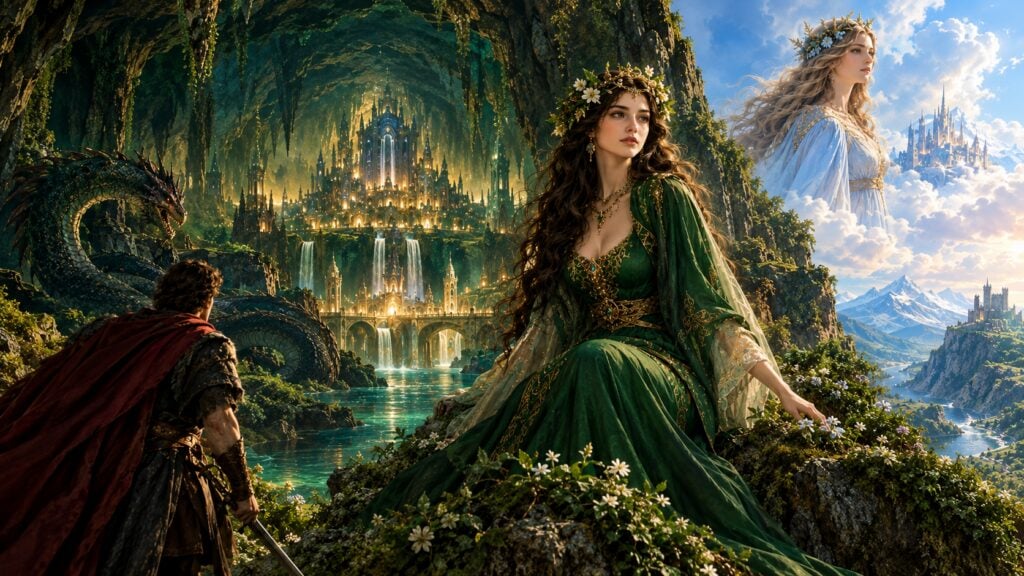
E Bukura e Dheut është një qenie mbinatyrore e besimit popullor shqiptar, një grua, bukuria e së cilës është aq e madhe sa i përket një bote tjetër dhe jo kësaj bote. Ajo nuk është thjesht një zanë; ajo është një figurë e fuqishme dhe magjike që shpesh zotëron objekte ose njohuri të magjishme dhe jeton shumë larg mundësive të njerëzve të zakonshëm. Në disa përralla ajo është e butë dhe e ndihmon heroin; në të tjera është krenare, misterioze ose e rrezikshme. Kjo paqartësi, bukuri që është njëkohësisht bekim dhe rrezik, është qendrore për karakterin e saj.Bota Tjetër dhe Kërkimi i Heroit
E Bukura e Dheut pothuajse gjithmonë jeton në një botë tjetër: një mbretëri nëntokësore, një mbretëri përtej maleve të pakalueshme ose një tokë magjike e ruajtur nga krijesa të frikshme. Për ta arritur atë, një hero duhet të ndërmarrë një mision të rrezikshëm, duke mposhtur përbindësha të tillë si kulshedra dhe duke kaluar sprova në dukje të pamundura. Në këtë mënyrë ajo luan rolin klasik të qëllimit në fund të udhëtimit të heroit, shpërblimi që i jep aventurës kuptimin e saj. Heronjtë që e kërkojnë atë janë shpesh kampionët e legjendës shqiptare, të ngjashëm me krahët me krahë. drangue.Bukuria e Tokës dhe Bukuria e Qiellit
Folklori shqiptar çiftëzohet E Bukura e Dheut me një homolog, E Bukura e Qiellit, “Bukuria e Qiellit”. Së bashku, të dyja përfaqësojnë idealet e bukurisë që i përkasin tokës dhe qiejve. Ky çiftim është tipik për mitologjinë shqiptare, e cila shpesh vepron në kontraste, toka dhe qielli, heroi dhe përbindëshi, rendi dhe kaosi.Në përrallat shqipe
E Bukura e Dheut shfaqet vazhdimisht në përrallat popullore shqiptare, historitë e transmetuara gojarisht brez pas brezi. Vetëm emri i saj u sinjalizon dëgjuesve se po hyjnë në një botë magjie dhe kërkimesh. Së bashku me figura si drangue dhe kulshedra, dhe legjenda të tilla si legjenda e Kalasë së Rozafës, ajo është pjesë e imagjinatës së pasur mitologjike që ka formësuar kulturën shqiptare për shekuj me radhë.Who Wrote the Tales Down: Hahn, Mitko, Dozon and Pedersen
E Bukura e Dheut lived in spoken storytelling long before she appeared in print. The tales we can read today were written down in the second half of the 19th century by a small group of collectors, most of them foreign consuls and linguists who learned Albanian on the spot, plus one Albanian folklorist living in Egypt. Robert Elsie’s Dictionary of Albanian Religion, Mythology and Folk Culture (2001) lists her under the English name “Earthly Beauty”, gives the alternative Albanian form E bukura e dynjas, and calls her one of the most popular characters in Albanian fairy tales.
| Collector | Publication | Viti | Tales that feature her |
|---|---|---|---|
| Johann Georg von Hahn, Austrian consul | Griechische und albanesische Märchen (Greek and Albanian Folk Tales), Leipzig | 1864 | No. 97, “Das Haar der Schönen der Erde” (The Hair of the Beauty of the Earth) |
| Thimi Mitko, Albanian folklorist in Egypt | Albanikê melissa, also known as Bëlietta sskiypêtare (The Albanian Bee), Alexandria | 1878 | “The Boy and the Earthly Beauty”, “The Scurfhead”, “The Three Friends and the Earthly Beauty” |
| Auguste Dozon, French consul | Manuel de la langue chkipe ou albanaise, Paris, and Contes albanais, Paris | 1879 and 1881 | “La Belle de la terre” (no. 5 in Contes albanais), “La Loubie et la Belle de la terre” (no. 12), and the tale Elsie translates as “The Youth and the Maiden with Stars” |
| Holger Pedersen, Danish linguist | Albanesische Texte mit Glossar, Leipzig | 1895 | “The Stirrup Moor”, “Gjizar the Nightingale” |
Hahn (1811 to 1869) is often called the father of Albanian studies. Elsie notes that he learned Albanian while serving at the Austrian vice-consulate in Janina and published the three-part Albanesische Studien in 1854 before turning to folk tales. Dozon (1822 to 1890) was French consul in Janina from 1869 to 1875 and took up Albanian there after meeting Hahn. Most of these texts were reprinted in Tirana in 1963 in the volume Folklor shqiptar 1, Proza popullore, which is the edition Elsie translated from.
Four Tales in Brief
The Hair of the Beauty of the Earth (Hahn, 1864)
Hahn labels this tale as coming “from the Riça”, an Albanian-speaking district. Three brothers find a great hole that leads to the underworld, and the two elder ones lower the youngest into it. He lands at the house of an old sorceress and tells her that a king has sent him for a hair of the Beauty of the Earth. She warns him that the Beauty is guarded by a three-headed dog that sleeps neither by day nor by night. She gives him water that darkens his face so the dog cannot see him, and a pinch of earth of the dead to put in the sleeping Beauty’s ear so she will not wake. He pulls out one golden hair, and crows and ravens carry him back up. Whoever holds the hair shines like the sun. The king makes the boy a great man, and his brothers end up as his servants.
The Boy and the Earthly Beauty (Mitko, 1878)
A dying father warns his son never to go to the village where the Earthly Beauty lives. The son goes anyway and spends his whole fortune for glimpses of her finger and her hand. In his father’s room he then finds a cap that makes him invisible and a jug that summons a band of warriors. She tricks him out of both and has him carried off to a distant place. There he discovers red grapes that make horns grow on the face and white grapes that make them fall off. He returns disguised, uses the grapes on her, and cures her as a “physician” only when she hands back everything she took. Then he marries her.
The Three Friends and the Earthly Beauty (Mitko, 1878)
A boy who calls himself Kordha (the Sabre), after his dead father’s sword, reaches a place where the road divides into seven. An old woman tells him that one road leads to the Earthly Beauty and that many have lost their heads there. He takes it, kills a Kulshedra and its six young, and the palace of the Earthly Beauty rises in front of him. He marries her. Rival kings fail to defeat him in battle, so they have an old woman steal his sabre, the source of his strength, and throw it into the sea. His sworn brothers Ylli (Star) and Deti (Sea) come to the rescue, and Deti dives in to bring it back.
The Stirrup Moor and Gjizar the Nightingale (Pedersen, 1895)
In “The Stirrup Moor” a king’s son fights a feared Moor who keeps an inn by the road. Neither can win, so they become sworn brothers. The Moor later turns out to be the Earthly Beauty in disguise: she takes off a black skin to reveal herself, and she is also the daughter of the king of the jinns. In “Gjizar the Nightingale” a king’s youngest son must fetch a miraculous nightingale for his father’s mosque. The bird belongs to the Earthly Beauty, whose chamber is guarded by a wolf, a tiger and a lion. When she later hears the nightingale sing, she arrives by ship to find the young man who took it.
Recurring Motifs in the Earthly Beauty Tales
- A forbidden or fatal road. A father’s deathbed warning, an inscription saying that whoever takes this road will never return, or an old woman at a crossroads.
- Animal and monster guards. A three-headed dog in Hahn, a lion and a lamb in one of Dozon’s tales, a wolf, tiger and lion in Pedersen, and a Kulshedra in Mitko. Dozon wrote in his preface that she is usually guarded by wild beasts, or simply by the kind of armed retainers who escorted Albanian beys.
- A helper who knows the way. An old sorceress, an old woman at the roadside, and in the tale from Dozon’s Manuel even a family of Kulshedras, who spare the handsome hero and tell him how to open her door.
- Magic objects. A cap of invisibility, a jug that calls up warriors, a golden hair that shines like the sun, a flower or a handkerchief that belongs to her.
- The youngest or poorest hero wins. The youngest of three brothers, a fatherless boy, a despised “scurfhead”.
- She is clever, not passive. She outwits the boy twice in Mitko’s tale, and in “The Youth and the Maiden with Stars” she is the one who notices that the food at a royal feast has been poisoned.
She is not always one person. In Mitko’s “The Scurfhead” the hero goes down three steps under a stone slab and meets “one of the three Earthly Beauties”, who helps him against a dragon and gives him a gift.
Related Figures: Kulshedra, Lubia, and the Sea and Heavenly Beauties
Dozon placed the Belle de la terre first among the supernatural beings of Albanian storytelling. He added that Greek tales have similar figures called the Beauty of the Land and the Beauty of the World, and that in Albanian the name “Beauty of the Earth” is also given to a small animal, the land salamander. Hahn made the same comparison. In his notes to tale 97 he wrote that the underground Beauty of the Earth corresponds to the Greek Beauty of the World in his tale 63, and he singled out the three-headed dog, which he compared to Cerberus, and the earth of the dead as the distinctive features of the Albanian version.
Elsie’s dictionary entry links the Earthly Beauty to two counterparts, the Sea Beauty (E bukura e detit) and the Heavenly Beauty (E bukura e qiellit). The monsters that most often share her tales are the Kulshedra, which Dozon described as a man-eating monster somewhere between human and animal and compared to the lamias of ancient Greece, and the Lubia. In Hahn’s tale 98 a Lubia dries up all the waters of a kingdom and will not release them until the king’s daughter is given to her.
Where to Read the Tales in English
Robert Elsie translated a set of Albanian folk tales into English and placed them on his Albanian Literature website, free to read and to reuse for non-commercial purposes with credit. They include the Mitko and Pedersen tales summarized above and “The Youth and the Maiden with Stars” from Dozon’s Manuel. Hahn’s German and Dozon’s French collections are both in the public domain and can be read in full on the Internet Archive.
Pyetje të shpeshta
Kush është E Bukura e Dheut?
E Bukura e Dheut, “Bukuroshja e Tokës”, është një grua mbinatyrore me bukuri dhe magji të jashtëzakonshme në folklorin shqiptar, e cila jeton në një botë tjetër dhe është qëllimi i kërkimit të heroit në shumë përralla.Çfarë do të thotë “E Bukura e Dheut”?
Përkthehet si "Bukuroshja e Tokës". Emri përdoret edhe në shqipen e përditshme për të përshkruar dikë me bukuri të jashtëzakonshme.E Bukura e Dheut a është e mirë apo e keqe?
Ajo është e paqartë. Në disa përralla ajo është e sjellshme dhe e ndihmon heroin, ndërsa në të tjera është krenare, misterioze ose e rrezikshme, duke reflektuar idenë se bukuria e madhe mund të jetë si bekim ashtu edhe rrezik.Kush është E Bukura e Qiellit?
E Bukura e Qiellit, “Bukuroshja e Qiellit”, është homologu i saj në folklorin shqiptar, duke formuar një çift që përfaqëson bukurinë e tokës dhe të qiellit.Who first wrote down the tales of E Bukura e Dheut?
One of the earliest printed versions is in Johann Georg von Hahn’s Griechische und albanesische Märchen (Leipzig, 1864), tale 97. Thimi Mitko published three more in Alexandria in 1878, Auguste Dozon several in Paris in 1879 and 1881, and the Danish linguist Holger Pedersen two in Leipzig in 1895.
Does E Bukura e Dheut live underground?
In some tales, yes. In Hahn’s tale 97 the hero is lowered through a hole into the underworld, where she sleeps guarded by a three-headed dog. In Mitko’s “The Scurfhead” three Earthly Beauties live beneath a stone slab. In other tales she lives in a palace at the end of a dangerous road.
Where can I read an Earthly Beauty tale in English?
Robert Elsie’s Albanian Literature website has free English translations, including “The Boy and the Earthly Beauty”, “The Three Friends and the Earthly Beauty”, “The Scurfhead”, “The Stirrup Moor” and “Gjizar the Nightingale”. Each page names the 19th-century collection the tale was taken from.
Burimet
- Robert Elsie, Albanian Literature: Folktales (index of English translations)
- Robert Elsie, Albanian Literature: The Boy and the Earthly Beauty
- Robert Elsie, Albanian Literature: The Three Friends and the Earthly Beauty
- Robert Elsie, Albanian Literature: The Stirrup Moor
- Robert Elsie, Albanian Literature: Gjizar the Nightingale
- Johann Georg von Hahn, Griechische und albanesische Märchen (Leipzig, 1864), via Internet Archive
- Auguste Dozon, Contes albanais (Paris, 1881), via Internet Archive
- Robert Elsie, A Dictionary of Albanian Religion, Mythology and Folk Culture (New York University Press, 2001), via Internet Archive
- Robert Elsie, Albanian History: Johann Georg von Hahn, biographical introduction
- Robert Elsie, Albanian History: Auguste Dozon, biographical introduction
- Robert Elsie, Albanian Literature: The Scurfhead
- Robert Elsie, Albanian Literature: The Youth and the Maiden with Stars
- Encyclopaedia Britannica: Holger Pedersen
Lexime të Ngjashme
- Drangue: Heroi me krahë i Shqipërisë
- Kulshedra: Gjarpri-Dragoi i Shqipërisë
- Legjenda e Kalasë së Rozafës
- Supersticionet dhe Besimet Popullore Shqiptare

Autor: Dardanë Halimi
Dardanë Halimi është një shkrimtare dhe profesioniste e komunikimit me titull magjistër në Shkrim, Retorikë dhe Komunikim Teknik nga Universiteti James Madison. Puna e saj përqendrohet në tregimin e historive, përmbajtjen digjitale, arsimin e lartë dhe komunikimin strategjik, me përvojë në shkrimin për organizata akademike, jofitimprurëse dhe marketingu si në Shtetet e Bashkuara ashtu edhe në Kosovë.