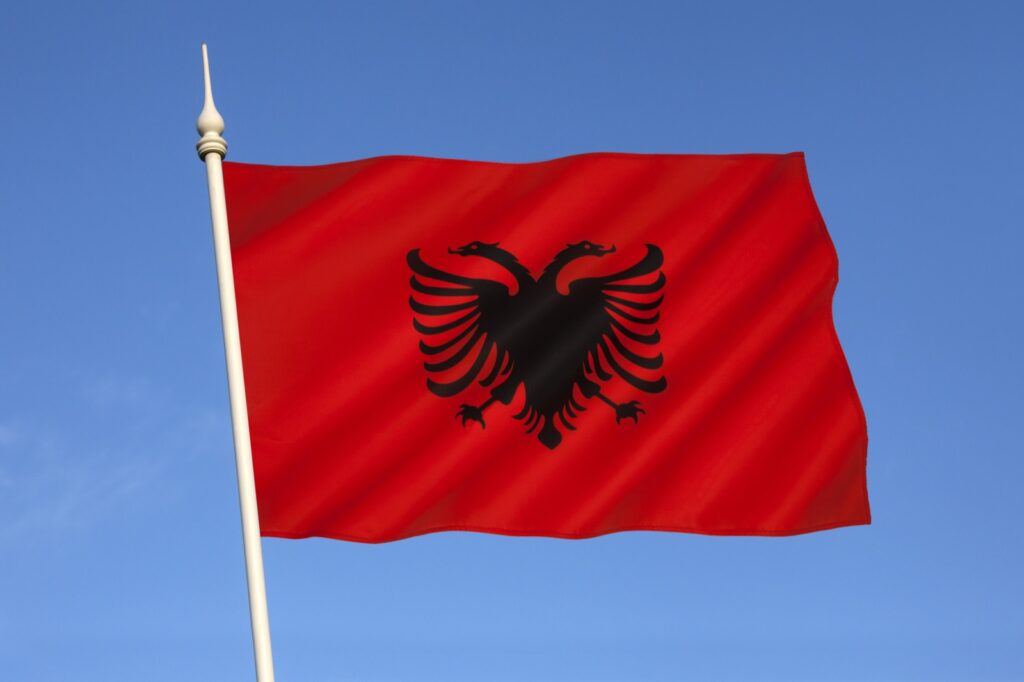
The key Albania facts fit in one sentence: it is a small, mountainous country of 2.4 million people on the Adriatic and Ionian seas, with a language that forms its own branch of the Indo-European family, a red flag with a black double-headed eagle, and four UNESCO World Heritage properties. Everything else on this page builds on that outline.
Below are 30 facts about Albania, grouped by theme. Each one names its source, from the 2023 census to UNESCO, Encyclopaedia Britannica, NobelPrize.org and Yad Vashem, so you can check it yourself.
Fakte të shpejta
- Albania had 2,402,113 residents on September 18, 2023, according to the census by INSTAT, the national statistics institute.
- The country covers 28,748 square kilometers (about 11,100 square miles), slightly smaller than Maryland, according to the CIA World Factbook.
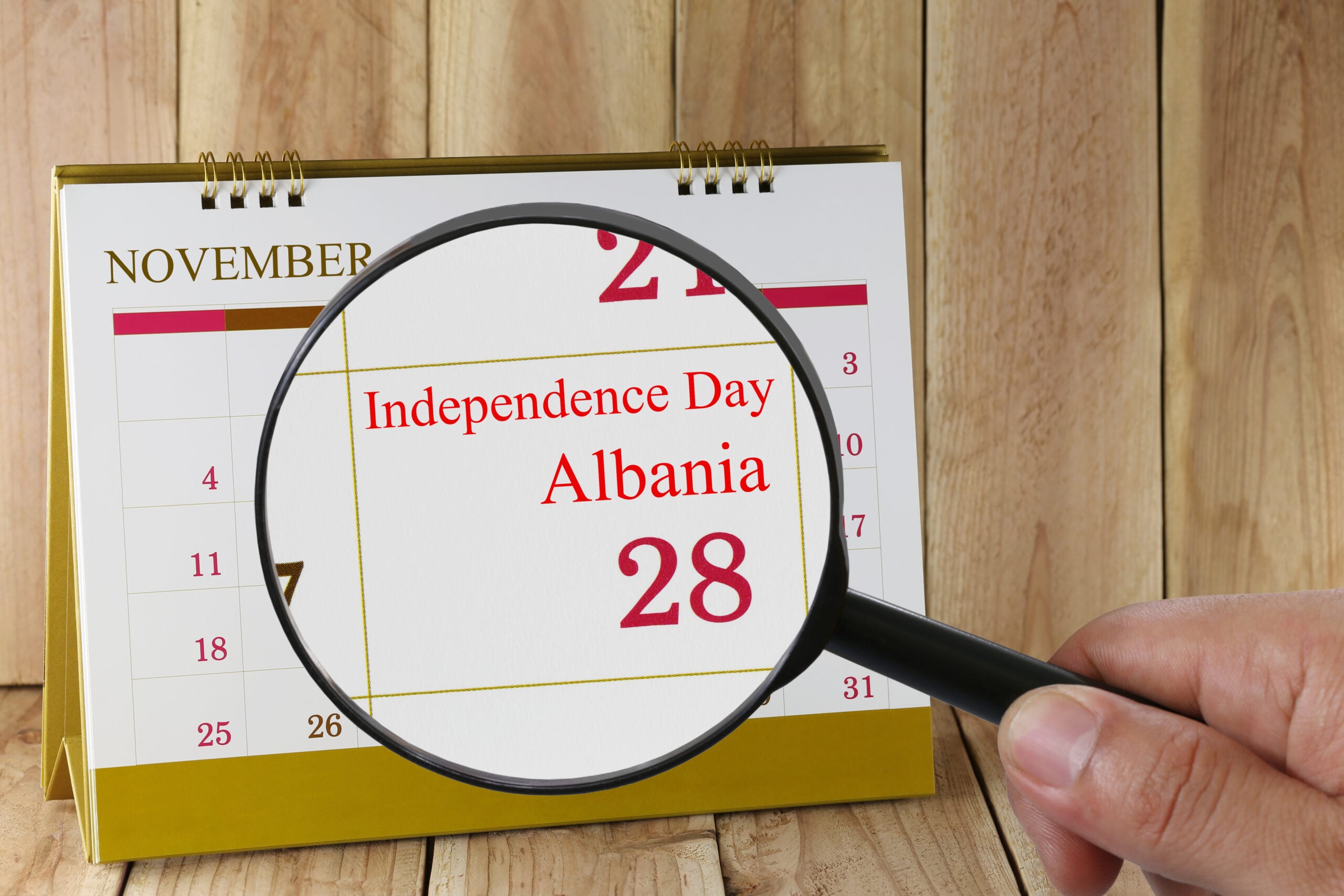
- Independence from the Ottoman Empire was proclaimed at Vlorë on November 28, 1912.
- Albanian is the only modern member of its own branch of the Indo-European language family, according to Britannica.
- UNESCO lists four World Heritage properties in Albania: two cultural, one natural and one mixed.
- Shqipëria u bashkua NATO on April 1, 2009, and has been an EU candidate country since June 2014.
Në këtë faqe
- Albania at a Glance
- Geography Facts
- History Facts
- Language and National Symbols
- People and Culture
- Food Facts
- Nature and Heritage
- Shqipëria Moderne
- Pyetje të shpeshta
Albania at a Glance
| Artikull | Fakt | Burimi |
|---|---|---|
| Official name | Republic of Albania (Republika e Shqipërisë) | CIA World Factbook |
| Kryeqyteti | Tirana (Tiranë), capital since 1920 | Britannica |
| Popullsia | 2,402,113 (Census, September 18, 2023) | INSTAT |
| Zona | 28,748 sq km (about 11,100 sq mi) | CIA World Factbook |
| Valuta | Lek (ALL), issued by the Bank of Albania | Bank of Albania |
| Gjuha zyrtare | shqip | CIA World Factbook |
| Government | Parliamentary republic; one-chamber parliament (Kuvendi) with 140 seats | CIA World Factbook |
| Kodi telefonik | +355 | CIA World Factbook (embassy listings) |
| Time zone | UTC+1, with daylight saving time from the last Sunday in March to the last Sunday in October | CIA World Factbook |
| Pavarësia | 28 nëntor 1912 | CIA World Factbook, Britannica |
| Internet domain | .al | CIA World Factbook |
What is Albania known for?
Ask what Albania is known for and a handful of things come up again and again: the double-headed eagle flag, the national hero Skënderbeu, Mother Teresa, the code of honor called besa, the concrete bunkers of the communist years, a coast on two seas, and the Ottoman-era towns of Berat and Gjirokastër. Each of them appears in the facts below, with a source.
Geography Facts
- Albania is about the size of Maryland. The CIA World Factbook gives a total area of 28,748 square kilometers and describes the country as slightly smaller than that state. Britannica puts its length at about 210 miles (340 km) and its width at about 95 miles (150 km).
- It has four land neighbors, and Italy is close. Albania borders Montenegro, Kosovo, North Macedonia and Greece along 691 kilometers of land boundary, according to the Factbook. Britannica notes that Italy lies only about 50 miles (80 km) away across the Adriatic.
- Most of the country is mountains. About three-fourths of the territory is mountains and hills more than 650 feet (200 m) above sea level, according to Britannica. The highest peak is Mount Korab, which Britannica lists at 2,752 meters (9,030 feet) and the Factbook at 2,764 meters.
- The coast touches two seas. Albania lies on the Strait of Otranto, where the Adriatic meets the Ionian. The Factbook lists 362 kilometers of coastline.
- It shares the largest lake in the Balkans. Lake Shkodër, also called Lake Scutari, is shared with Montenegro and covers about 400 square kilometers. The Factbook notes that it is the largest lake in the Balkans.
History Facts
- Albanians trace their roots to the Illyrians. Britannica writes that Albanians generally consider themselves descendants of the ancient Illyrians. The Illyrians were conquered by Rome in the 2nd century BCE, and the area later passed to the Byzantine Empire.
- Skanderbeg held off the Ottomans for a generation. Gjergj Kastrioti, known as Skanderbeg, organized a league of Albanian princes in 1444 and, according to Britannica, repulsed 13 Turkish invasions between 1444 and 1466. He died at Lezhë in 1468, and his citadel at Krujë fell in 1478.
- Independence came in 1912, with painful borders. On November 28, 1912, Ismail Qemali proclaimed independence at Vlorë before 83 delegates. Britannica adds that in 1913 the great powers drew borders that assigned about half of its territory and people to neighboring states.
- One man ruled for 40 years. Enver Hoxha led communist Albania from 1944 until his death in 1985. Britannica describes it as the most tightly controlled society in Europe. The Factbook notes that the country allied itself first with the USSR, until 1960, and then with China, until 1978.
- Religion was banned outright. The Factbook notes that all mosques and churches were closed in 1967 and religious observance prohibited. Private religious practice was allowed again in November 1990.
- The bunkers are real, and someone counted them. Euronews reported in 2017 that Hoxha commissioned 173,371 concrete bunkers between 1975 and 1983. Other outlets have printed higher numbers (Al Jazeera wrote of more than 250,000 in 2013), so treat any single figure with care. Our guide to Hoxha’s bunkers explains why they were built.
Language and National Symbols
- Albanian has no close relatives. Britannica describes the Gjuhë shqipe as the only modern representative of a distinct branch of the Indo-European family. It is not Slavic, Greek or Romance, though it has borrowed words from its neighbors.
- There are two main dialects. Gheg is spoken in the north and Tosk in the south, divided roughly by the Shkumbin River. Britannica says the two have been diverging for at least a thousand years, yet their less extreme forms are mutually intelligible. The standard language has been modeled on Tosk since World War II.
- The oldest written Albanian is a baptismal formula. It dates from 1462, according to Britannica, which also dates the standard Latin-letter orthography to 1909, after the alphabet congress held in Manastir (today Bitola) in 1908. Before that, Albanian was written in Italian-style, Greek-style and even Turko-Arabic scripts.
- Albanians do not call their country Albania. The local name is Shqipëria, and the people are shqiptarë. The name is popularly read as “land of the eagles.” Britannica notes it may instead derive from shqip, the word for the language itself.
- The flag is a black double-headed eagle on red. The Factbook says the design is said to originate with Skanderbeg in the 15th century. Read more in our guide to the Albanian flag’s meaning.
- The national anthem is a hymn to that flag. “Hymni i Flamurit” was adopted in 1912, with words by Aleksandër Stavre Drenova and music by Ciprian Porumbescu, according to the Factbook.
People and Culture
- The population is shrinking. The 2023 census counted 2,402,113 residents, about 420,000 fewer than in 2011. INSTAT attributes the decline mainly to emigration. Nearly a third of the population, 31.6 percent, lives in the prefecture of Tirana.
- Several faiths share the country. In the 2023 census, 1,101,718 people (about 46 percent) identified as Muslim, 201,530 (about 8 percent) as Catholic, 173,645 (about 7 percent) as Orthodox and 115,644 (about 5 percent) as Bektashi. Another 332,155 said they were believers without a denomination, and 85,311 said they were atheists.
- Mother Teresa was Albanian. NobelPrize.org records that Agnes Gonxha Bojaxhiu was born on August 26, 1910, in Skopje, then part of the Ottoman Empire, and describes her as a Catholic Albanian. She received the 1979 Nobel Peace Prize “for her work for bringing help to suffering humanity” and was declared a saint in 2016.
- Albanians protected Jews during the Holocaust. Yad Vashem, Israel’s Holocaust remembrance center, records that Albania had about 200 Jews before the war and took in an estimated 600 to 1,800 refugees. After the German occupation in 1943, Albanians refused to hand over lists of Jews. Almost all were saved, and there were more Jews in Albania at the end of the war than before it. Yad Vashem ties this to besa, the code of keeping one’s word.
- A Nobel laureate and a Booker winner have Albanian roots. Ferid Murad, who shared the 1998 Nobel Prize in Physiology or Medicine, was the son of a father who emigrated from Albania, according to NobelPrize.org. The novelist Ismail Kadare won the first Man Booker International Prize in 2005.
- Its folk singing is on a UNESCO list. Albanian folk iso-polyphony, sung in several parts over a choral drone, was proclaimed a masterpiece of intangible heritage in 2005 and inscribed on UNESCO’s Representative List in 2008.
Food Facts
- Tavë kosi is the signature dish. Albania’s National Tourism Agency describes this baked lamb and yogurt casserole as a symbol of hospitality for Elbasan and central Albania, often served at holidays and family gatherings. Try it with our tavë kosi recipe.
- The capital’s table mixes pies and syrupy sweets. The same agency lists fërgesë, byrek and tavë kosi among Tirana’s best-known traditional dishes, and baklava, kadaif and revani among its desserts.
- Farms grow what the kitchen uses. By tonnage, Albania’s top agricultural products in 2023 were milk, maize, tomatoes, watermelons, potatoes, wheat, grapes, onions, cucumbers and olives, according to the Factbook. Agricultural land covers about 38 percent of the country.
Nature and Heritage
- There are four UNESCO World Heritage properties. They are Butrint (inscribed 1992), the Historic Centres of Berat and Gjirokastra (2005, extended 2008), the Albanian shore of the Ohrid region (added in 2019 to a property first listed in 1979), and Albanian parts of the Ancient and Primeval Beech Forests of Europe, a property that spans 18 countries.
- Lake Ohrid is millions of years old. UNESCO states that the lake has existed continuously for approximately two to three million years and shelters more than 200 species found nowhere else, including 17 endemic fish. On the Albanian side, the Lin peninsula holds the remains of a church founded in the mid-6th century.
- Europe’s first wild river national park is here. Albania declared the Vjosa Wild River National Park on March 15, 2023. The IUCN cites a park of 12,727 hectares, and says the Vjosa and its tributaries flow freely for more than 400 kilometers from the Pindus Mountains in Greece to the Adriatic.
- Pelicans nest on the coast. The Karavasta lagoon, the largest in Albania, is known for the Dalmatian pelicans that nest on its small islands, according to the National Agency of Protected Areas. It has been a Ramsar wetland since 1995.
Shqipëria Moderne
Albania ended communist rule in the early 1990s and set up a multiparty democracy, the Factbook records. The transition was rough: the collapse of pyramid investment schemes in 1997 caused economic chaos and civil disorder, and in 1999 some 450,000 ethnic Albanians fled to Albania from the war in Kosovo.
Since then the direction has been westward. NATO lists Albania as a member since April 1, 2009. On the European Union track, the European Commission’s timeline shows a membership application in April 2009, candidate status granted by the Council in June 2014, and accession negotiations formally opened at the first intergovernmental conference in July 2022. The negotiating clusters were opened between October 2024 and November 2025, and in July 2026 the first chapters were provisionally closed. Albania is not yet a member, as our explainer is Albania in the EU sets out.
Two more modern facts surprise visitors. Nearly all of the country’s installed power capacity is hydroelectric, 96.7 percent in 2023 according to the Factbook, with solar making up the rest. And Albania keeps its own money: the Bank of Albania is the sole issuer of the lekë, with banknotes from 200 to 10,000 lekë in circulation. Remittances from Albanians abroad still equaled 8.4 percent of GDP in 2024, a reminder of how large the diaspora is.
Pyetje të shpeshta
What is Albania best known for?
Albania is best known for its red flag with a black double-headed eagle, the medieval hero Skanderbeg, Mother Teresa’s Albanian heritage, the besa code of honor, communist-era bunkers, a coastline on the Adriatic and Ionian seas, and the UNESCO-listed towns of Berat and Gjirokastër. Its language is also famous among linguists for having no close relatives.
What are some fun facts about Albania?
A few favorites: Albanians call their country Shqipëria, not Albania. Euronews reported 173,371 bunkers built between 1975 and 1983. Lake Ohrid is two to three million years old, according to UNESCO. The Vjosa became Europe’s first wild river national park in 2023. And almost all of the country’s installed power capacity is hydroelectric.
What language do they speak in Albania?
The official language is Albanian, called shqip by its speakers. Britannica describes it as the only modern representative of its own branch of the Indo-European family. It has two main dialects, Gheg in the north and Tosk in the south, divided roughly by the Shkumbin River, and the standard language is based on Tosk.
What is the population of Albania?
The 2023 census by INSTAT counted 2,402,113 residents on September 18, 2023, about 420,000 fewer than the 2011 census. INSTAT says the decline continues a trend since 1990 that is mainly caused by emigration. About 31.6 percent of residents live in the prefecture of Tirana, and population density is 83.6 people per square kilometer.
Is Albania in the European Union?
No. Albania applied for membership in April 2009, became an official candidate in June 2014 and formally opened accession negotiations in July 2022, according to the European Commission. Negotiations are still under way, so Albania is a candidate country and not a member. It has been a NATO member since April 1, 2009.
What religion is Albania?
Albania has no single religion. In the 2023 census about 46 percent of residents identified as Muslim, about 8 percent as Catholic, about 7 percent as Orthodox and about 5 percent as Bektashi, while many others described themselves as believers without a denomination, as atheists, or chose not to answer. Religion was banned entirely from 1967 until 1990.
Burimet
- INSTAT: Albania Population and Housing Census 2023 (main results)
- CIA World Factbook: Albania (archived edition, page last updated December 26, 2025)
- Encyclopaedia Britannica: Albania
- Encyclopaedia Britannica: Albanian language
- Encyclopaedia Britannica: Skënderbeu
- Encyclopaedia Britannica: Enver Hoxha
- Encyclopaedia Britannica: Vlorë and the Vlorë proclamation
- UNESCO World Heritage Centre: Albania
- UNESCO World Heritage Centre: Butrint
- Qendra e Trashëgimisë Botërore të UNESCO-s: Qendrat Historike të Beratit dhe Gjirokastrës
- UNESCO World Heritage Centre: Natural and Cultural Heritage of the Ohrid region
- UNESCO World Heritage Centre: Ancient and Primeval Beech Forests of the Carpathians and Other Regions of Europe
- Trashëgimia Kulturore Jomateriale e UNESCO-s: Izo-polifonia popullore shqiptare
- NobelPrize.org: Mother Teresa, facts
- NobelPrize.org: Ferid Murad, facts
- Yad Vashem: Besa, A Code of Honor. Muslim Albanians Who Rescued Jews During the Holocaust
- The Booker Prizes: Ismail Kadare
- Euronews: Albania’s communist bunkers put to new use (September 26, 2017)
- Al Jazeera: Communist-era bunkers revamped in Albania (July 28, 2013)
- European Commission, Enlargement: Albania
- NATO: Member countries
- IUCN: Vjosa becomes Europe’s first Wild River National Park (March 15, 2023)
- National Agency of Protected Areas (AKZM): Divjakë-Karavasta National Park
- National Tourism Agency of Albania: Tavë Kosi
- National Tourism Agency of Albania: Tirana
- Bank of Albania: Currency
Lexime të Ngjashme
- Albanian History and Heritage Guide
- Albanian Culture and Traditions Guide
- Nga janë shqiptarët?
- Is Mother Teresa Albanian?
- Jews in Albania
- Best Places in Albania

Autor: Val Demiri
Valbona është redaktore dhe shkrimtare në ALB Connection, ku ajo mbulon njerëzit, bizneset dhe kulturën që formësojnë diasporën shqiptare. E diplomuar në gazetari në Universitetin e Ajovës, puna e saj përfshin profile të komunitetit, histori suksesi dhe reportazhe mbi jetën shqiptare në të gjithë SHBA-në, Evropën dhe më gjerë. Ajo tërhiqet nga historitë që festojnë arritjet e shqiptarëve dhe e mbajnë komunitetin të lidhur përtej kufijve.