The rulers of Illyria were a line of kings and queens who built kingdoms across the western Balkans and fought Macedonia, Greece and Rome for control of the region. From the empire-builder Bardylis to the pirate-queen Teuta and the last king Gentius, these rulers led the Illyrian peoples most often linked to the ancestry of modern Albanians. This guide introduces the most important of them and the world they governed.
The Illyrian Kingdoms
Illyria was not a single unified state but a shifting patchwork of tribes and kingdoms across what is now Albania, Montenegro, Kosovo, Bosnia and beyond. At times powerful rulers united large parts of it into strong kingdoms that could challenge their neighbors. These kingdoms had their own courts, armies and, famously, a formidable navy that dominated the Adriatic. For the language they spoke, see the Illyrian language.
Bardylis
Bardylis was one of the earliest great Illyrian kings, ruling in the 4th century BC. He built a powerful kingdom and defeated Macedonia in battle, even killing a Macedonian king, before eventually being beaten by Philip II, the father of Alexander the Great. Bardylis represents the height of early Illyrian power, when an Illyrian kingdom could dominate its Greek and Macedonian neighbors.
Glaucias and Others
Later kings such as Glaucias continued the tradition of strong Illyrian rulers, at times intervening in the affairs of neighboring kingdoms and even sheltering the young Pyrrhus of Epirus. These rulers navigated a dangerous world of shifting alliances among the Illyrians, Macedonians, Greeks and, increasingly, the rising power of Rome.
Agron and Queen Teuta
King Agron built the most powerful Illyrian kingdom of the 3rd century BC, with a strong fleet that raided across the Adriatic. After his death, his widow Queen Teuta took power as regent and became the most famous of all Illyrian rulers. Her support for Illyrian raiding brought her into direct conflict with Rome, leading to the First Illyrian War. Teuta remains a powerful symbol of Illyrian, and by extension Albanian, defiance.
Gentius, the Last King
Gentius was the last independent king of Illyria, ruling in the 2nd century BC. His conflict with Rome led to the Third Illyrian War, in which he was defeated and captured, and his kingdom was absorbed into the expanding Roman world. With Gentius the independent Illyrian monarchy came to an end, though Illyrian resistance to Rome would flare again spectacularly centuries later in the Great Illyrian Revolt.
The Legacy of the Illyrian Rulers
The kings and queens of Illyria left a legacy of independent power in the western Balkans, a memory of a people who built kingdoms, commanded fleets and stood against the greatest powers of the ancient Mediterranean. For Albanians, who trace much of their heritage to the Illyrians, these rulers are foundational figures, ancient sovereigns of the same lands. That connection is explored in where Albanian people come from, and it is best understood as a deep regional heritage rather than a modern national claim on ancient people.
Why They Matter
The rulers of Illyria show that the western Balkans had its own strong states and famous sovereigns long before the modern nations of the region existed. Figures like Bardylis, Teuta and Gentius anchor the ancient end of the Albanian historical story and stand alongside later heroes in the national memory. For more, see famous figures in Albanian history.
The Rulers of Illyria at a Glance
Illyria was never one kingdom. Several tribal kingdoms rose and fell along the eastern Adriatic, and the rulers below belong to different peoples: the Dardani in the interior, the Taulantii around Durrës, and the Ardiaei on the coast of today’s Montenegro and northern Albania. Dates are approximate, because most come from Greek and Roman writers describing their enemies.
| Ruler | Approximate reign | People | Known for |
|---|---|---|---|
| Bardylis | About 385 to 358 BC | Dardani | Built the first strong Illyrian kingdom and defeated Macedon before falling to Philip II |
| Glaucias | About 335 to 302 BC | Taulantii | Fought Alexander the Great and raised the young Pyrrhus of Epirus at his court |
| Monunius | About 280 BC | Dardani | The first Illyrian ruler to strike coins in his own name |
| Agron | About 250 to 231 BC | Ardiaei | Made the Ardiaean kingdom the strongest Illyrian power at sea |
| Teuta | 231 to 227 BC | Ardiaei | Queen and regent whose fleet provoked the First Illyrian War with Rome |
| Scerdilaidas | About 218 to 206 BC | Ardiaei | Switched between Macedon and Rome, and allied with Rome against Philip V |
| Pleuratus III | About 205 to 181 BC | Ardiaei | Loyal Roman ally who expanded the kingdom as a reward |
| Gentius | 181 to 168 BC | Ardiaei | The last king; sided with Macedon and was defeated by Rome in 168 BC |
Where Their Capitals Stood
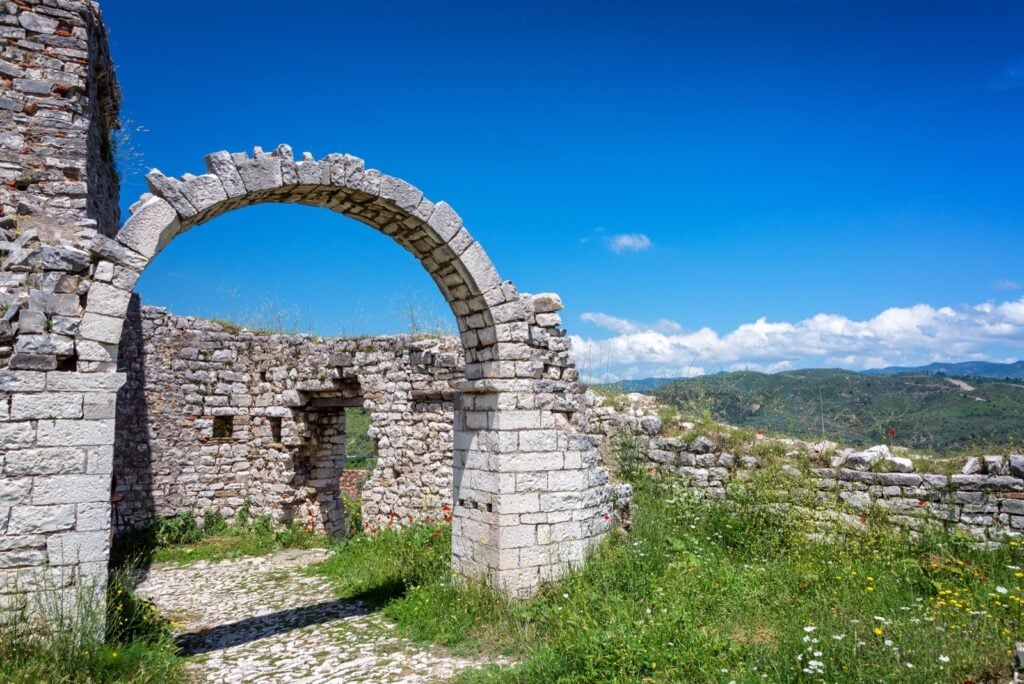
Several of these rulers governed from places that are still Albanian towns. Scodra, the seat of Gentius, is Shkodër, and the fortress of Rozafa above the city stands on the site of his stronghold. Lissus, fortified by the Illyrians in the 4th century BC, is Lezhë, where Skanderbeg later united the Albanian princes. The Taulantii held the coast around Epidamnos, the Greek colony that became Dyrrachium and then Durrës. Rhizon, the Ardiaean capital, is Risan in the Bay of Kotor in Montenegro. Visitors can walk all of these sites today; see our guides to Shkodër and the Albanian coast.
Why Rome Cared
The Illyrian kingdoms mattered to Rome for one reason: the Adriatic. Ardiaean ships raided Italian and Greek traders, and Roman envoys sent to Teuta in 230 BC were killed, giving Rome its excuse for the First Illyrian War the following year. The Second Illyrian War in 219 BC and the final campaign against Gentius in 168 BC each pushed Roman power further down the coast, until the whole region became the province of Illyricum. The Illyrian tribes did not disappear with their kings; they rose once more in the Great Illyrian Revolt of AD 6 to 9, and later gave Rome a string of emperors.
The Illyrian Wars With Rome
| War | Dates | Cause | Result |
|---|---|---|---|
| First Illyrian War | 229 to 228 BC | Ardiaean raids on Italian and Greek shipping under Queen Teuta; Roman envoys killed | Rome lands an army, Teuta accepts a protectorate over the coast; Demetrius of Pharos installed as a Roman client |
| Second Illyrian War | 219 BC | Demetrius of Pharos breaks with Rome and raids the Aegean | Demetrius flees to Macedon; Rome tightens its hold on the coastal towns |
| Third Illyrian War | 168 BC | King Gentius allies with Perseus of Macedon against Rome | A Roman army under Anicius takes Scodra in thirty days; Gentius is paraded in Rome and the kingdom is dissolved |
The three wars span sixty years and one lesson. The Ardiaean kings could defeat any Greek neighbor and hold the sea, but they could not resist a Roman expedition once Rome chose to send one. Gentius, the last of them, lasted a month against the legions in 168 BC. The kingdom became four Roman client districts, then part of the province of Illyricum, and the Illyrians did not rise again as a people until the great revolt two centuries later. Our guide to Queen Teuta tells the first war in full.
What Archaeology Adds
The written sources for these kings are Greek and Roman, and hostile; archaeology is the corrective. Coins are the best of it. Monunius and later Gentius struck their own, with the king’s name in Greek letters, and hoards from Shkodër, Lezhë and the Montenegrin coast show how far Ardiaean money travelled. The walls of Lissus, laid in massive polygonal blocks in the 4th century BC, and the fortifications on the Rozafa hill show what the kingdoms could build. Grave goods from Illyrian tumuli, the burial mounds that dot the Albanian and Kosovar landscape, supply the weapons, jewelry and imported Greek pottery that the histories never mention. The National Historical Museum in Tirana and the museums of Shkodër and Durrës hold the best of these finds, and Lezhë and Rozafa are open to anyone with an afternoon.
Seen together, the coins, the walls and the graves describe a civilization richer and more organized than the Roman accounts of pirates and barbarians allow.
Frequently Asked Questions
Who were the rulers of Illyria?
The kings and queens of the ancient Illyrian kingdoms of the western Balkans, including Bardylis, Agron, Queen Teuta and the last king Gentius.
Who was the most famous Illyrian ruler?
Queen Teuta is the most famous, remembered for her fleet and her defiance of Rome in the First Illyrian War.
Who was the last king of Illyria?
Gentius, defeated by Rome in the 2nd century BC, after which the independent Illyrian kingdom was absorbed into the Roman world.
How are the Illyrian rulers connected to Albanians?
The Illyrians are the ancient people most often linked to Albanian ancestry, so their kings and queens are foundational figures in the deep Albanian historical narrative.
Learn More
Continue with Queen Teuta, the Illyrian tribes, and the Great Illyrian Revolt.
Sources
- Illyria (Encyclopaedia Britannica)
- List of rulers of Illyria (Wikipedia)
- Wikipedia: List of rulers of Illyria
- Encyclopaedia Britannica: Illyria

Author: Val Demiri
Valbona is an editor and writer at ALB Connection, where she covers the people, businesses, and culture shaping the Albanian diaspora. A journalism graduate of the University of Iowa, her work spans community profiles, success stories, and features on Albanian life across the US, Europe, and beyond. She is drawn to stories that celebrate Albanian achievement and keep the community connected across borders.