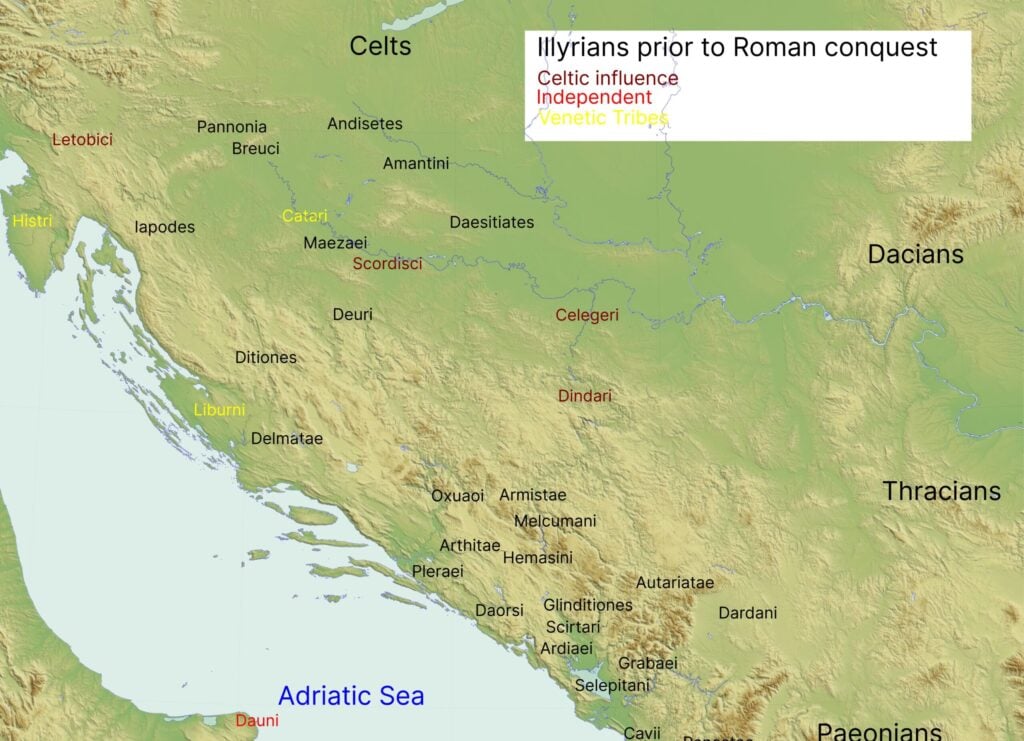
- The Illyrians were an ancient group of tribes in the western Balkans (roughly modern Albania, Kosovo, Montenegro, Serbia, Bosnia, Croatia).
- Attested from at least the 2nd millennium BC through the 1st century AD.
- Major tribes: Ardiaei (coastal, ruled by Queen Teuta), Taulantii, Dardanians (in modern Kosovo), Chaonians (in southern Albania/northwestern Greece), Enchelei, Autariatae.
- Language: Illyrian, an extinct Indo-European language whose exact classification remains debated.
- Roman conquest complete by the early 1st century AD after several wars from 229 BC to 9 AD.
- Modern Albanian national tradition identifies Albanians as descendants of the Illyrians.
- Linguistic and genetic evidence is mixed but broadly supportive of significant ancestral continuity.
Who the Illyrians Were
“Illyrian” is a term used both by ancient Greek and Roman writers and by modern historians to describe a large group of related tribes inhabiting the western Balkan Peninsula. They shared certain cultural features, burial practices, art styles, weapon types, aspects of religion, that distinguished them from their Greek neighbors to the south, Thracian neighbors to the east, and Celtic neighbors to the north. Geographically, Illyrian territory extended roughly from what is today Slovenia and Croatia in the north, through Bosnia and Montenegro, into Albania and Kosovo, and touching parts of northern Greece and western Serbia. This is a vast area, and the Illyrians were never a single unified political entity. They lived in dozens of tribal groupings that occasionally allied, occasionally warred with each other, and often fought outside powers. The earliest secure references to Illyrians appear in ancient Greek writings from the 6th and 5th centuries BC. Herodotus mentions them. Thucydides describes them. By the 4th century BC, Illyrian kingdoms were significant regional powers, engaged in the wars of the Hellenistic world and eventually confronting Rome.The Major Illyrian Tribes
Ardiaei
The Ardiaei were arguably the most politically powerful Illyrian tribe. Based on the Adriatic coast in what is today southern Croatia, Montenegro, and northern Albania, they built a kingdom centered on Skodra (modern Shkodër). Under Kings Agron and, especially, his widow Queen Teuta, they fought the First Illyrian War against Rome from 229 to 228 BC. For the full story of Teuta, see our Queen Teuta profile.Taulantii
Based around the coastal region near modern Durrës, the Taulantii were a coastal Illyrian tribe active in trade with Greek colonies including Apollonia and Epidamnus (ancient Durrës). They played a role in the wars between Alexander the Great’s successors and were later drawn into Roman politics.Dardanians
The Dardanians (also spelled Dardanoi in Greek) inhabited what is today Kosovo and parts of northern North Macedonia. Their kingdom was a persistent regional power that fought both Macedonian and Roman armies over several centuries. The modern name “Dardania” is sometimes used in Albanian political and cultural discourse as a poetic name for Kosovo.Chaonians
The Chaonians lived in Epirus, southern Albania and northwestern Greece. They were part of a broader Epirotan cultural sphere that included both Illyrian-affiliated and Greek-affiliated tribes. Their capital was at Phoenice, which they surrendered to Queen Teuta’s Ardiaei in the late 3rd century BC. Some scholars classify the Chaonians as Illyrian, others as an Illyrian-Greek borderland population.Enchelei
An early Illyrian tribe based around Lake Ohrid and the surrounding highlands. They appear in Greek mythology as the people who received the exiled Theban hero Cadmus. Historical references place them as significant in the pre-classical Illyrian world.Autariatae
A powerful inland tribe in the western Balkans, largely in modern Bosnia and Serbia. They dominated a large area in the 4th century BC before declining after conflicts with Celtic invaders and Macedonians.Other tribes
Dozens of smaller tribes are attested in ancient sources: Delmatae, Iapydes, Liburni, Histri, Ozynthes, Parthini, Pirustae, and many more. The total number of Illyrian-affiliated tribes was probably several dozen, with varying degrees of political organization.The Illyrian Language
Illyrian was an Indo-European language, or perhaps a group of related languages, spoken by these tribes. It is now extinct. No surviving text is written in Illyrian; the language is reconstructed only from:- Personal names attested in Greek and Roman inscriptions
- Place names (toponyms) surviving in the modern Balkans
- A small number of glosses (individual words) mentioned by ancient authors

Illyrian Wars with Rome
Rome and the Illyrian tribes fought a series of wars over roughly two and a half centuries:- First Illyrian War (229 to 228 BC), Rome versus Queen Teuta’s Ardiaei kingdom. Rome’s first military crossing of the Adriatic. Ended with Illyrian defeat and Roman-imposed peace.
- Second Illyrian War (219 BC), Rome versus Demetrius of Pharos, who had betrayed Teuta to Rome and later switched sides. Ended with his defeat.
- Third Illyrian War (168 BC), Rome versus the Illyrian kingdom of Gentius, aligned with the Macedonian king Perseus. Ended with the Roman capture of Gentius and the annexation of the Illyrian kingdom.
- Great Illyrian Revolt (Bellum Batonianum, 6 to 9 AD), the largest Illyrian uprising against Rome after annexation. Three years of intense warfare across Pannonia and Dalmatia. Its final suppression completed Roman control of the Balkans and led to significant demographic and administrative reorganization.
What Happened Under Rome
Roman rule did not immediately or completely erase Illyrian identity. For the first several centuries of Roman rule, Illyrian communities:- Continued using Illyrian personal names alongside Roman naming conventions
- Preserved local religious cults, sometimes syncretized with Roman deities
- Maintained some tribal identifications in inscriptions and administrative records
- Provided soldiers and eventually emperors to Rome, the “Illyrian emperors” of the 3rd century AD, including Aurelian, Diocletian, and Constantine, were of Illyrian ancestry
The Illyrian-Albanian Question
Modern Albanian national identity, since the 19th-century Rilindja Kombëtare, has closely identified Albanians with the ancient Illyrians. The argument, in its strongest form, holds that:- Illyrians never fully disappeared under Roman or subsequent rule
- The Albanian language descends from ancient Illyrian, preserved in the mountainous regions where Roman and Byzantine influence was weakest
- Modern Albanian populations, especially in mountainous and highland areas, are direct genetic and cultural descendants of the ancient Illyrians
- Albanian culture, the Kanun, oral epic tradition, highland warrior culture, preserves ancient Illyrian elements
- Archaeological continuity in the western Balkans through the Roman, Byzantine, and medieval periods is substantial
- Genetic studies of modern Albanians show significant local ancestry consistent with long-term residence in the region
- Ptolemy’s 2nd-century AD geographical work mentions a tribe called “Albanoi” living in what is roughly modern Albanian territory, arguably the earliest attested reference to the modern Albanian ethnic name
- The linguistic evidence connecting modern Albanian directly to Illyrian is fragmentary, some scholars propose Illyrian, others Thracian or Dacian, others a mixed origin
- Population movements during late antiquity and the medieval Slavic migrations complicated the picture considerably
- The strong “Illyrian ancestry” narrative was consolidated during the 19th and 20th centuries as part of nationalist identity-building, and some elements of the popular version go beyond the scholarly evidence
Where to See Illyrian Heritage Today
- National Historical Museum, Tirana, the largest single collection of Illyrian artifacts in Albania, spanning weapons, jewelry, ceramics, and inscriptions
- Rozafa Castle, Shkodër, built on the ancient Illyrian acropolis of Skodra, capital of Queen Teuta’s Ardiaei kingdom
- Apollonia archaeological park, near Fier, Greek colony in Illyrian territory with substantial pre-Roman remains
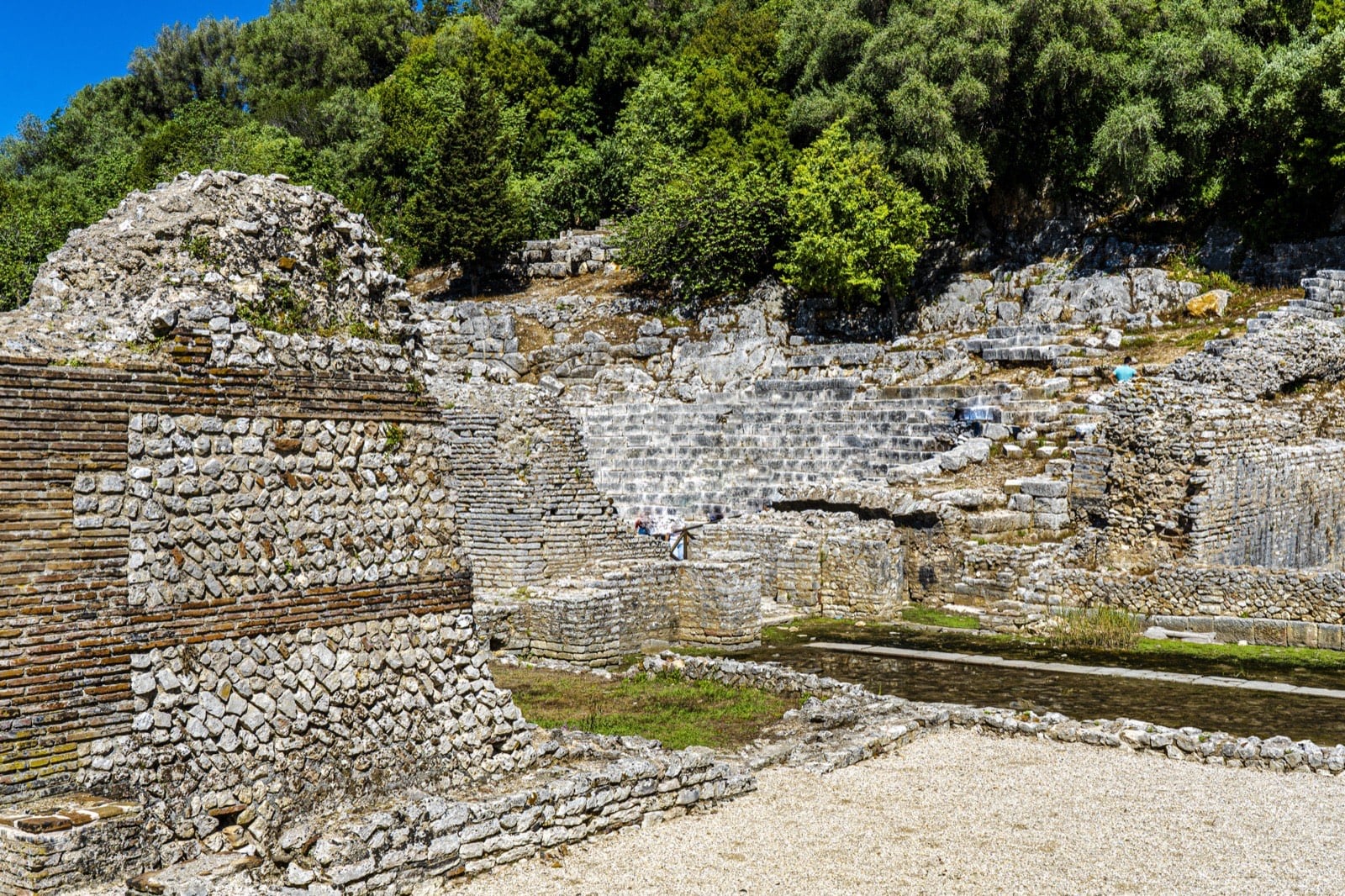
- Butrint National Park, includes Illyrian-era foundations beneath the more famous Greek, Roman, and Byzantine layers
- Dyrrachium (ancient Durrës), layers of Illyrian, Greek, and Roman urban history in a still-inhabited coastal city
- Belsh, near Elbasan, the Illyrian archaeological site of Selca e Poshtme, with impressive Illyrian tombs cut into rock
- Sanctuary of Nymphs at Dodona (Greece), nearby Epirotan and Illyrian religious center

Modern Cultural Uses of “Ilir”
“Ilir” and “Iliria” are very much alive in modern Albanian culture:- “Ilir” is one of the most common Albanian first names for boys
- “Iliria” is used for institutions ranging from universities to newspapers to sports teams
- “Dardania” (from the Dardanian tribe) is a poetic Albanian name for Kosovo
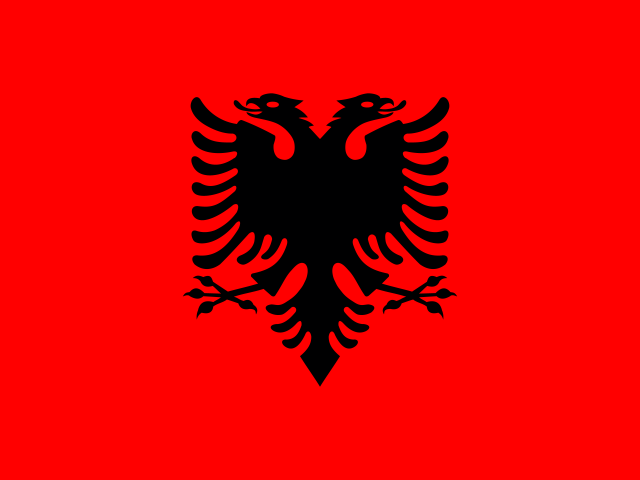
- The double-headed eagle, adopted by Skanderbeg in the 15th century and preserved on the modern Albanian flag, is traced by Albanian tradition to Illyrian antecedents
The Illyrian thread also settles a question people still ask about the modern language: is Albanian a Slavic language, or something older and separate?
Frequently Asked Questions
Who were the Illyrians?
The Illyrians were a large group of related Indo-European tribes who inhabited the western Balkan Peninsula from at least the Bronze Age (2nd millennium BC) through the Roman conquest of the region in the 1st century AD. Their territory covered what is today Albania, Kosovo, Montenegro, Bosnia, Croatia, and adjacent parts of Serbia, Slovenia, and Greece.
What are the main Illyrian tribes?
Major Illyrian tribes included the Ardiaei (Queen Teuta’s tribe, on the coast of modern Albania and Montenegro), Taulantii (near modern Durrës), Dardanians (in modern Kosovo), Chaonians (in southern Albania and northwestern Greece), Enchelei (near Lake Ohrid), and Autariatae (in the western interior). Dozens of smaller tribes existed alongside these major groups.
What language did the Illyrians speak?
The Illyrians spoke Illyrian, an Indo-European language, or group of related languages, that is now extinct. It is reconstructed only from personal names, place names, and a small number of individual words mentioned by ancient authors. The exact position of Illyrian in the Indo-European family remains debated.
Are Albanians descended from Illyrians?
The mainstream Albanian national tradition identifies Albanians as descendants of the ancient Illyrians. Scholarly assessment is more nuanced: modern Albanians descend, in significant part, from ancient populations of the western Balkans (which would have included many Illyrian tribes), with substantial cultural and linguistic transformations over the past two thousand years. Genetic and archaeological continuity is substantial; direct linguistic descent from Illyrian is debated.
Did the Illyrians fight Rome?
Yes, in multiple wars over more than two centuries. The First Illyrian War (229 to 228 BC) began under Queen Teuta of the Ardiaei. The Second (219 BC), Third (168 BC), and the Great Illyrian Revolt (6 to 9 AD) followed. By the early 1st century AD, all Illyrian territory was under Roman control.
What is Dardania?
Dardania was the ancient territory of the Dardanian tribe in what is today Kosovo and parts of northern North Macedonia. The name is preserved as a poetic Albanian name for Kosovo in modern usage. Political parties, cultural institutions, and streets across Kosovo carry the name.
Where can I see Illyrian artifacts?
The National Historical Museum in Tirana holds the largest collection of Illyrian artifacts. Rozafa Castle in Shkodër sits on the ancient Illyrian acropolis of Skodra. Apollonia and Butrint national parks preserve Illyrian-era layers alongside later Greek, Roman, and Byzantine remains. Selca e Poshtme near Belsh has impressive Illyrian rock-cut tombs.
Who is the most famous Illyrian?
Queen Teuta of the Ardiaei, who fought the First Illyrian War against Rome (229 to 228 BC), is the most famous individual Illyrian in modern Albanian tradition. Among Roman emperors of Illyrian ancestry, Aurelian, Diocletian, and Constantine the Great are the most historically consequential.
Related Reading
- Queen Teuta: The Illyrian Warrior Queen
- Butrint National Park: Where Greeks, Romans, and Byzantines Met
- The Kanun: Albania’s Ancient Code of Honor
- Skanderbeg: The Albanian National Hero
- Naim Frashëri: Albania’s National Poet
- Where Are Albanian People From?

Author: Dardanë Halimi
Dardanë Halimi is a writer and communications professional with an M.A. in Writing, Rhetoric, and Technical Communication from James Madison University. Her work focuses on storytelling, digital content, higher education, and strategic communication, with experience writing for academic, nonprofit, and marketing organizations in both the United States and Kosovo.