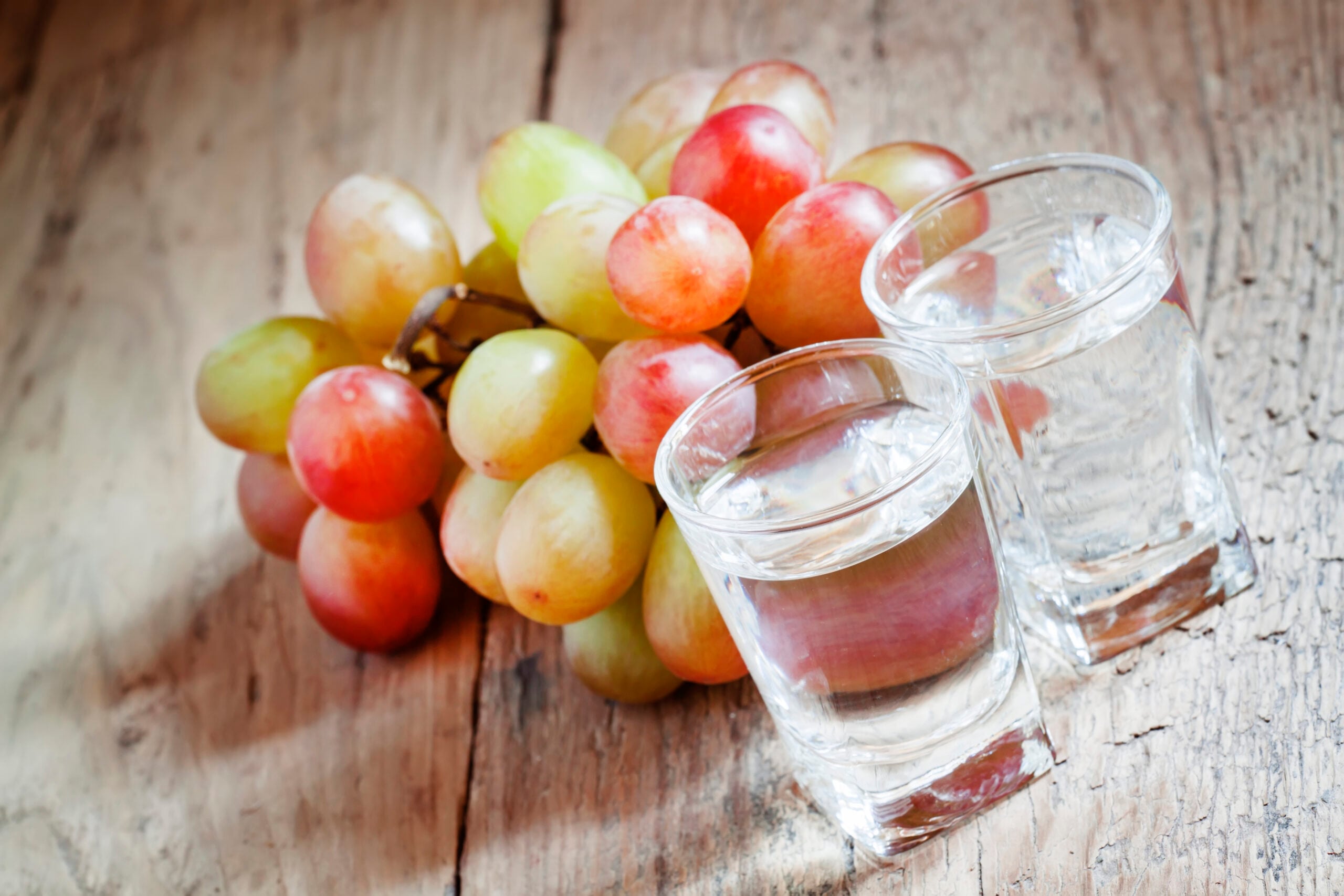

Albanian raki is made from fermented grapes, usually the pomace (the skins, seeds and stems left over from wine-making), which is distilled into a clear, dry brandy; some raki is made from plums, mulberries, quince or other fruit, and, unlike Turkish rakı, which is flavored with anise, it contains no anise. Britannica calls raki “the traditional Albanian drink” and notes it is often drunk before a meal. It is usually distilled twice in a copper still called a kazan; commercial bottles are typically 40-45% ABV (producers list 40% to 45-50%), while homemade raki can be much stronger, up to around 60%.
Albanian raki (pronounced RAH-kee) is one of the most important cultural icons of Albania, Kosovo, and the broader Balkans. It is poured at celebrations, offered to guests, and widely made at home. This guide covers exactly what raki is made of, how it’s made, how it compares to grappa, ouzo, and other related spirits, and why it occupies such a central role in Albanian life.Quick Answers
- What is raki? Raki is the traditional spirit of Albania and Kosovo: a clear fruit brandy, usually bottled at 40 to 45% ABV, sipped from small glasses with food.
- What is the Albanian liquor called? Raki is the Albanian liquor; the best-known bottled Albanian brandy is Konjak Skënderbeu. Our guide to Albanian drinks covers beer, wine, coffee and the rest.
- How is raki made? The fruit is fermented for several weeks, then distilled, usually twice, in a copper still (kazan), with the first and last portions of the run separated off (step by step below). Home distilling is illegal in the US without a federal permit.
On This Page
- Raki Ingredients
- How Raki Is Made
- What Does Raki Taste Like?
- Raki vs. Grappa vs. Ouzo
- Fruit Rakis
- How Strong Is Raki? (Alcohol Percentage)
- The Social Role of Raki
- Albanian Raki Producers
- Other Albanian Spirits
- Is Raki Healthy?
- Frequently Asked Questions
Raki Ingredients
- Primary ingredient: Grape pomace (leftover skins, seeds, stems from wine-making) and/or whole fermented grapes
- Other bases and additions: raki is also made from plums, and in mountain areas from mulberries or walnuts; herbs, honey, sour cherries or walnuts are sometimes added after distillation. Unlike Turkish rakı, it is not flavored with anise.
- Alcohol content: Typically 40-45% ABV (80-90 proof). Homemade can reach 60%+
- Color: Clear (occasionally tinted by fruit infusions)
- Production method: Fermentation, then distillation, usually twice, in a copper still (kazan)
How Albanian Raki Is Made (Step by Step)
Step 1: Collect the Pomace
After grapes are pressed to make wine, the leftover skins, seeds, and stems, called marc in French or pomace in English, contain enough sugar and yeast residue to ferment into alcohol. In rural Albania, families pool together everything left after wine-making. Some raki is made from whole fresh grapes that are fermented without pressing for wine first, this produces a fruitier, smoother raki.Step 2: Ferment
The pomace or whole grape mix is placed in large barrels or plastic containers (modern shortcut) and left to ferment for several weeks. Natural yeasts on the grape skins do most of the work. The mixture bubbles and produces alcohol as the sugar converts.Step 3: Distill (Usually Twice)
The fermented mash is heated in a kazan, a traditional copper still with a long neck that condenses the alcohol vapor. The first distillation produces “raki e parë” (first raki), which is rough and contains impurities. The second distillation refines it into the clear, smooth spirit you actually drink.The first portion of the second distillation, the “heads”, is discarded because it carries low-boiling, undesirable compounds such as acetaldehyde and ethyl acetate. The middle portion, the “heart”, is collected. The end portion, the “tails”, is set aside or re-distilled. Methanol is not confined to the heads: it comes over through the whole run and, in a simple pot still, tends to be highest towards the end, when the vapor is richer in water.
Step 4: Rest and Bottle
Quality raki is rested for at least a few weeks before drinking. Some families age it for months or years. Higher-end commercial brands age in oak barrels, which gives raki a golden color and softer taste.What You Need to Make Raki
Ingredients
- Grape pomace, the leftover skins, seeds, and stems from wine-making.
- OR whole fresh grapes, crushed but not pressed. Yields more, smoother flavor.
- Water, clean, used to adjust mash if needed.
- Optional yeast, traditional method relies on natural yeasts on grape skins, but you can add wine yeast for more reliable fermentation.
- Optional sugar, some makers add sugar to boost yield (controversial, traditionalists consider this cheating).
Equipment
- Large fermentation vessel, traditionally wooden barrels, modern home distillers use food-grade plastic drums (60-200 liters).
- Copper still (kazan), the central tool. Copper is essential because it removes sulfur compounds that would otherwise make raki smell off. A traditional Albanian kazan has a rounded body, a long swan-neck, and a coiled condenser submerged in cold water.
- Heat source, traditionally a wood fire, modern setups use propane or electric.
- Glass jars or bottles, for collecting and aging the finished raki.
- Hydrometer or alcoholmeter, to measure alcohol content.
- Thermometer, to monitor distillation temperature.
Common Mistakes Home Distillers Make
- Skipping the second distillation. In a simple pot still the first run mainly extracts alcohol and is harsh; a second run raises the strength and allows the heads, heart and tails to be separated.
- Treating the heads cut as a methanol cure. The heads are discarded for their sharp, undesirable compounds. Methanol, which can cause blindness and death, forms from pectin in the fruit, is spread through the whole run and tends to be highest in the tail, so cutting the heads alone does not make a spirit safe.
- Using a non-copper still. Copper is essential. Stainless steel stills produce off-flavored raki because they don’t remove sulfur compounds.
- Distilling too fast. Hot, fast distillation pulls bad compounds into the heart. Slow, gentle heat produces cleaner spirit.
- Drinking it too young. Fresh raki tastes harsh. Rest it at least 2 weeks, ideally longer.
The Legal Reality: Home Distillation in the United States
Home distillation of alcohol is illegal under U.S. federal law (26 U.S. Code § 5601) without a federal distilled spirits permit. This applies regardless of state law and regardless of whether you sell or just consume the alcohol yourself. Penalties include fines up to $10,000 and up to 5 years in prison.Rules elsewhere differ by country. Home distilling is widespread in Albania; in 2012 Balkan Insight reported a draft law requiring home distillers to register their stills and pay tax on production above 100 liters. Check the current law wherever you are.
If you want to legally make raki in the U.S., you have three options:- Apply for a federal distilled spirits permit (expensive and bureaucratic for hobbyists).
- Visit Albania, Kosovo, or another Balkan country and make raki there.
- Buy commercial Albanian raki, which some U.S. liquor stores import and sell.
What Does Albanian Raki Taste Like?
Good raki is clean, dry, slightly fruity, with a warm finish. It’s not sweet. The alcohol is present but shouldn’t burn unpleasantly, well-made raki goes down smoothly despite its high proof. Cheap or poorly distilled raki can taste harsh or chemical; this is usually a sign of bad technique or shortened distillation. Regional and family variations matter. Raki from Korçë tastes different from raki from Shkodër or Tetovo. Mulberry raki (raki mani) has a distinct fruitiness. Plum raki (raki kumbulle) is sharper and earthier. (Raki rrushi is grape raki: rrush means grape.)Raki vs Grappa vs Ouzo vs Other Pomace Spirits
Raki belongs to the broader family of grape pomace spirits made across the Mediterranean and Balkans. The main differences:| Spirit | Base | Anise? | Cloudy with water? | Typical ABV |
|---|---|---|---|---|
| Albanian raki | Grape pomace / whole grapes | No | No | 40-45% (up to 60% homemade) |
| Turkish rakı | Grapes + anise | Yes | Yes | ~45% |
| Greek ouzo | Grape alcohol + anise | Yes | Yes | ~40% |
| Italian grappa | Grape pomace | No | No | ~40-50% |
| Greek tsipouro / tsikoudia | Grape pomace | Sometimes | Sometimes | ~40-45% |
| Serbian rakija | Grapes, plums, apricots, etc. | No | No | ~40%+ |
- Albanian raki: Clear, 40-45% ABV typically, no anise. Made from grape pomace or whole grapes. Sometimes flavored with fruit (mulberry, plum, walnut).
- Turkish raki: Anise-flavored, turns cloudy white when mixed with water. Quite different from Albanian raki despite the shared name.
- Greek ouzo: Anise-flavored like Turkish raki, also turns cloudy with water. Lower ABV (40%).
- Italian grappa: Closest cousin to Albanian raki, made from grape pomace, clear, no anise. Usually higher quality (more regulated) and pricier.
- Greek tsipouro / Cretan tsikoudia: Almost identical to Albanian raki in production. Sometimes anise-flavored, sometimes not.
- Serbian rakija: A broader category, includes grape rakija (lozovaca), plum rakija (šljivovica), apricot rakija, and many others. Albanian raki overlaps with grape rakija.
Fruit Rakis: The Variations
Beyond grape raki, Albanians also make raki from plums, and in mountain areas from mulberries or walnuts, as well as other fruit:- Raki mani, from mulberries. Distinctly fruity.
- Raki kumbulle, from plums. Similar to Serbian šljivovica.
- Raki dardhe, from pears. Floral, slightly sweet.
- Raki ftoni (also written raki ftoi or ftoji), from quince, ftua in Albanian. Aromatic, prized.
- Raki arre, walnut-infused. Made by soaking green walnuts in raki for months. Dark brown, herbal, slightly bitter.
- Raki mjalti, raki mixed with honey after distillation.
How Strong Is Raki? (Alcohol Percentage)
Commercial Albanian raki is usually bottled at 40-45% ABV (80-90 proof), sometimes a little more, about the same as whiskey or vodka. Producers’ own figures: Faba Kantina in Fier lists its raki rrushi at 40%, and Kantina Kallmeti near Lezhë gives 45-50% for its raki rrushi, depending on the year.
Homemade raki carries no label and is often stronger. Balkan Insight reported that rakia is “normally 40 per cent, but home-produced rakia can be much stronger, typically as high as 60 per cent”, and that double-distilled rakia may exceed 60%. For comparison, EU rules set a minimum of 37.5% ABV for grape marc spirit and fruit spirit (Regulation (EU) 2019/787).
Because of this strength, raki is usually sipped slowly from small glasses, often with food (meze).
The Social Role of Raki in Albanian Culture
Raki is not just a drink in Albania, it’s a social institution. Some places you’ll encounter it:- The welcome glass. When you arrive at an Albanian home for the first time, you will often be offered raki, sometimes with coffee and a small plate of food.
- The toast. Albanian raki toasts include “Gëzuar!” (“Cheers!”), “Shëndet!” (“Health!”), and “Për ju!” (“For you!”).
- Family occasions. Raki is commonly served at weddings, holidays and other family gatherings.
Albanian Raki Producers
Most Albanian raki is homemade and never bottled commercially. Commercial producers include:
- Skënderbeu: the company behind Konjak Skënderbeu, named after the national hero (read about Skanderbeg), also makes raki and has registered a “Raki Moskat” trademark.
- Kantina Kallmeti in Kallmet, near Lezhë, which makes a raki rrushi at 45-50%.
- Faba Kantina in Fier, which sells a raki rrushi at 40%.
Among raki regions, Skrapar in southern Albania is known for its raki.
For the truly serious experience, however, the best raki in Albania is almost always the unlabeled bottle that comes out of a relative’s cellar.Other Albanian Spirits
Raki is not Albania’s only liquor. Another well-known Albanian spirit is Konjak Skënderbeu, a brandy that its producer says was first made on 1 September 1967. It is aged in oak and blended from aged raki with mountain-plant extracts, fruit, ethyl alcohol, sugar syrup and caramel; the producer lists versions aged 3.5, 5, 6 and more than 13 years. The producer has also registered a fërnet and an orange punch.
Is Raki Healthy?
The short answer: Raki is high-proof alcohol, with all the health considerations that imply. It contains no significant nutrients, calories beyond the alcohol itself, and the same health risks as any other 40-45% ABV spirit.The World Health Organization states that “no level of alcohol consumption is safe for our health“. If you do drink raki, small glasses sipped slowly with food keep the amount down.
Sources and Further Reading
The facts and figures in this article draw on authoritative sources:
- Rakia (Wikipedia)
- CDC / NIOSH: Methanol
- 26 U.S. Code 5601 (Cornell Law)
- Britannica: Albania, daily life and social customs
- Balkan Insight: Albanians Risk Fines on Homemade Hooch (2012)
- Spaho, N. (2017): Distillation Techniques in the Fruit Spirits Production (IntechOpen)
- Regulation (EU) 2019/787 on spirit drinks (EUR-Lex)
- Konjak Skënderbeu (producer site)
- Faba Kantina: Raki rrushi
- Kantina Kallmeti: Raki rrushi Kallmet
- Tasting Table: The Difference Between Raki and Rakija
- WHO Europe: No level of alcohol consumption is safe for our health (2023)
Frequently Asked Questions
What is Albanian raki made of?
Albanian raki is made primarily from grape pomace (the leftover skins, seeds, and stems from wine-making) or whole fermented grapes. It is also made from mulberries (raki mani), plums (raki kumbulle), pears, quince and other fruit. The mixture is fermented and then distilled, usually twice, in a traditional copper still called a kazan.
How strong is Albanian raki?
Commercial Albanian raki is typically 40-45% ABV (80-90 proof). Homemade raki is often stronger, typically up to around 60% ABV, and double-distilled raki may exceed 60%.
Is Albanian raki the same as Turkish raki?
No. Despite sharing the name, Albanian raki is a clear, anise-free grape spirit similar to Italian grappa. Turkish raki is anise-flavored and turns cloudy with water (similar to Greek ouzo).
What does raki taste like?
Good Albanian raki tastes clean, dry, slightly fruity, with a warm finish. It’s not sweet. Fruit-infused varieties (mulberry, plum, walnut) have distinct flavors but the same dry base.
How do you drink Albanian raki?
Albanian raki is drunk from small glasses, sipped slowly, usually with food (meze) on the table and water on the side; it is commonly served before or with a meal.
What is raki ftoni?
Raki ftoni is quince raki, a fruit raki distilled from fermented quince (ftua in Albanian); the name is also written raki ftoi or raki ftoji.
Is raki distilled twice?
Usually, but not always. In a simple pot still the first run mainly extracts alcohol from the fermented mash and gives a harsh spirit; a second run raises the strength and lets the distiller separate the heads, heart and tails. Cutting the heads does not remove methanol, which runs through the whole distillate and tends to be highest in the tail.
Is homemade raki dangerous?
Properly made raki carries the same risks as any other 40-45% ABV spirit. The specific danger in badly made spirits is methanol, which can cause blindness and death. Methanol forms from pectin in the fruit, runs through the whole distillate and tends to be highest in the tail, so discarding the heads alone does not guarantee a safe spirit. EU rules cap methanol in grape marc spirit at 1,000 g per hectolitre of pure alcohol.
Related Reading
- Albanian Food: The Complete Guide to Traditional Cuisine
- Popular Foods in Albania: 20 Traditional Dishes
- Skanderbeg: Albania’s National Hero
- Albanian Coffee Tradition: Culture, Ritual & How It’s Made

Author: Dardanë Halimi
Dardanë Halimi is a writer and communications professional with an M.A. in Writing, Rhetoric, and Technical Communication from James Madison University. Her work focuses on storytelling, digital content, higher education, and strategic communication, with experience writing for academic, nonprofit, and marketing organizations in both the United States and Kosovo.