
Prefer to eat out? Find Albanian restaurants near you, searchable by city or ZIP code.
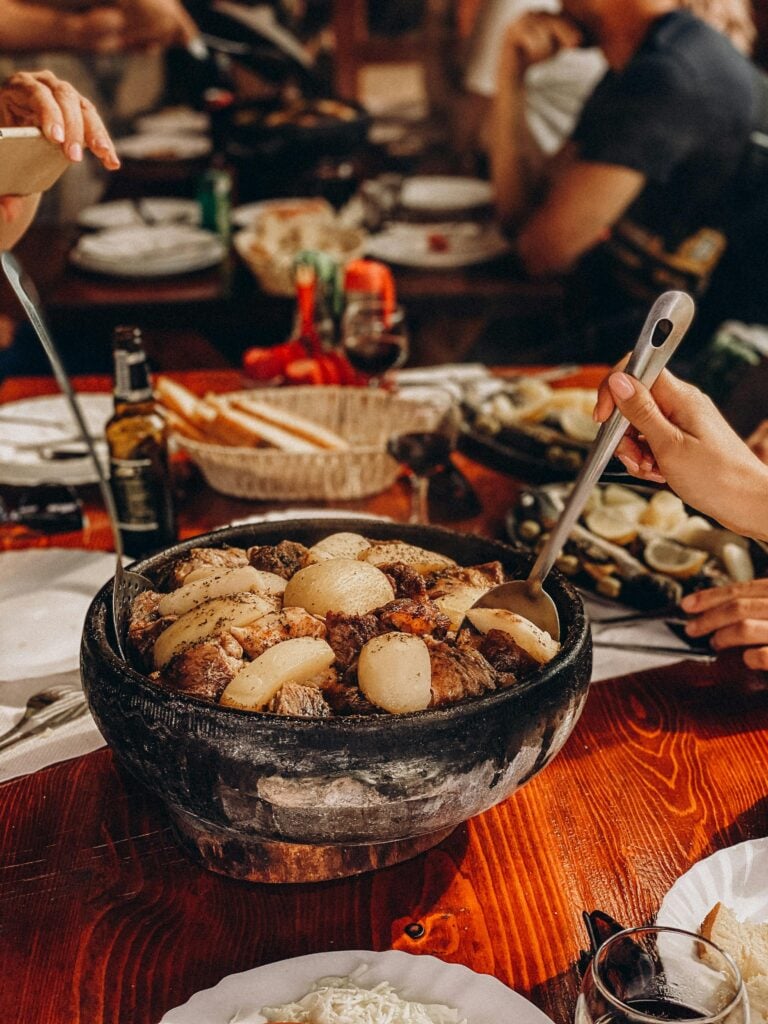
Tavë kosi is an Albanian dish of lamb, traditionally with rice, baked under a tangy custard of yogurt, eggs and flour until the top is golden and puffed. It comes from the city of Elbasan in central Albania and is often called Albania’s unofficial national dish. The recipe card comes first, followed by the history of the dish, tips and storage notes.

Albanian Tavë Kosi (Baked Lamb with Yogurt)
Ingredients
Method
- Season the lamb pieces with salt, pepper, and oregano. Heat vegetable oil in a large skillet over medium-high heat and brown the lamb on all sides, about 8 minutes total. Transfer to a plate.
- Preheat your oven to 350°F (175°C). Grease a deep 9x13-inch baking dish with butter.
- Arrange the browned lamb pieces in a single layer in the baking dish. Add the bay leaf and minced garlic. Pour in just enough water to barely cover the meat (about 1 cup). Cover with aluminum foil and bake for 45 minutes until the lamb is tender.
- While the lamb bakes, prepare the yogurt custard. In a large bowl, whisk together the Greek yogurt, eggs, rice flour, all-purpose flour, melted butter, and milk until completely smooth with no lumps.
- Remove the baking dish from the oven and increase the temperature to 375°F (190°C). Discard the bay leaf. The lamb should be tender and most of the liquid absorbed.
- Pour the yogurt custard mixture evenly over the lamb, making sure it seeps between and around the pieces.
- Return to the oven and bake uncovered for 40-45 minutes, until the top is golden brown and puffed up, and the custard is set with a slight jiggle in the center.
- Let the tavë kosi rest for 10-15 minutes before serving. The custard will settle slightly as it cools. Serve warm, cut into squares, with a simple salad and crusty bread.
Notes
The History of Tavë Kosi
Tavë kosi originated in the city of Elbasan, in central Albania, and is known as Elbasan tava in Turkey and other neighboring countries. The dish reflects Albania’s position at the crossroads of Mediterranean and Ottoman culinary traditions, yogurt-based cooking is common across Turkey and the Balkans, but the Albanian version is distinguished by its simplicity and the quality of its lamb. In Albania, lamb is a prized meat, raised on mountain pastures where sheep graze on wild herbs and grasses that give the meat a distinctive flavor. TasteAtlas dates the dish to the 15th century and notes that the original was topped with kos, Albanian soured milk, where modern recipes use a sauce of yogurt and eggs. Today it is enjoyed across Albania and Kosovo, and TasteAtlas calls it Albania’s unofficial national dish and it is a fixture of Albanian celebrations.What Makes Albanian Tavë Kosi Special
The magic of tavë kosi is in the yogurt custard. Unlike Greek moussaka or Turkish yogurt kebab, the Albanian version uses a custard that puffs up in the oven almost like a soufflé, then settles into a rich, creamy layer that coats each piece of lamb. The key is the ratio of yogurt to eggs to flour, too much flour and it becomes stodgy; too little and the custard won’t set. The rice flour, which the card combines with a little all-purpose flour, acts as a stabilizer that prevents the yogurt from curdling in the oven’s heat. In this recipe the lamb is browned in oil, then baked under foil with garlic, a bay leaf, and about 1 cup of water for 45 minutes, so it is already tender before the custard goes on top. Many traditional versions also cook a little rice with the lamb, which the card leaves out. This two-stage cooking is what separates a good tavë kosi from a great one, the lamb should be fork tender, and the custard should be set with only a slight jiggle in the center and a golden-brown, puffed top. For a thermometer check, the USDA minimum for lamb pieces is 145°F (63°C) with a 3 minute rest, which shoulder baked until tender passes easily, and a casserole that combines meat with an egg custard, like this one, is done at 165°F (74°C).Regional Variations
While the Elbasan version is considered the classic, you will find variations across Albania and Kosovo. The card seasons the lamb with oregano and bakes it with garlic, both of which Wikipedia lists among the usual seasonings, and some cooks stir them into the custard instead. In the diaspora, especially among Albanian communities in New York and Detroit, lamb shoulder is sometimes substituted with lamb leg (easier to find in American grocery stores) or even chicken for a lighter version called tavë kosi me pulë. Some modern cooks bake it in individual ramekins, or add a layer of thinly sliced potatoes beneath the lamb. The classic needs no embellishment: good lamb, good yogurt, eggs, butter, and patience.Tips for the Perfect Tavë Kosi
Use full-fat yogurt. This is non-negotiable. The card calls for full-fat Greek yogurt or strained Albanian kos, and warns that low-fat yogurt will curdle and separate during baking. Albanian yogurt (kos) is naturally thick and tangy. If you cannot find it, full-fat Greek yogurt is the card’s choice. Avoid yogurt with added thickeners like gelatin or pectin. Bring the yogurt to room temperature before mixing the custard. Cold yogurt is more likely to separate when it hits the hot lamb and oven heat. Do not open the oven during the first 30 minutes of baking the custard. Like a soufflé, the custard needs steady heat to puff and set. Opening the door causes a temperature drop that can make it collapse. Rest before serving. Let the dish sit for 10 to 15 minutes after it comes out of the oven. The custard will firm up slightly and be easier to cut into clean portions. Serve it with bread. Albanians always eat tavë kosi with crusty white bread to soak up the creamy yogurt sauce. A simple Albanian salad (sallatë shqiptare) of tomatoes, cucumbers, and raw onion dressed with olive oil and salt, with feta if you like, is the traditional accompaniment.Tavë Kosi at a Glance
The times, temperatures, quantities and yield below come from the recipe card at the top of this page. The first two rows are from TasteAtlas and Wikipedia, and the last two are official US food-safety guidance.
| Item | Details |
|---|---|
| Also known as | Tavë Elbasani, or Elbasan tava, after the city of Elbasan where the dish is thought to originate (Wikipedia, TasteAtlas) |
| Reputation | Often described as Albania’s unofficial national dish (TasteAtlas) |
| Course | Main course |
| Main ingredients | 2 lbs boneless lamb shoulder, 1 cup full-fat Greek yogurt, 4 large eggs, 1 cup whole milk, butter, rice flour, all-purpose flour |
| Prep time | 30 minutes |
| Cook time | 1 hour 30 minutes |
| Total time | 2 hours, plus 10 to 15 minutes of resting |
| Yield | 6 servings from a deep 9×13 inch baking dish |
| Oven temperature | 350°F (175°C) covered for 45 minutes, then 375°F (190°C) uncovered for 40 to 45 minutes |
| Reheating | 325°F (165°C) for 15 to 20 minutes |
| Safe doneness (FoodSafety.gov) | 165°F (74°C) for casseroles that contain meat |
| Safe storage (USDA) | Refrigerate within 2 hours. Baked casseroles with eggs keep 3 to 4 days. Reheat to 165°F (74°C) |
Yogurt Choices, Make-Ahead and Storage Notes for US Kitchens
- Yogurt: buy plain, unsweetened, full-fat Greek yogurt, which is what the card measures. Strained Albanian kos is the card’s other option. The card warns that low-fat yogurt will curdle and separate in the oven.
- Flour: the custard takes 3 tablespoons of rice flour and 2 tablespoons of all-purpose flour.
- Chicken: the card’s notes allow bone-in chicken thighs for a lighter version. FoodSafety.gov’s minimum for all poultry is 165°F (74°C).
- Rice: Wikipedia and TasteAtlas both describe the classic as lamb and rice under the yogurt topping. The card leaves the rice out, and this page follows the card.
- Make-ahead: the card notes that the custard sets firmer overnight and slices more cleanly the next day, so baking a day early works well. Cool the dish, cover it, and refrigerate it within 2 hours.
- Reheating: follow the card, 325°F (165°C) for 15 to 20 minutes, and check that the center reaches 165°F (74°C). The USDA also advises covering leftovers while they reheat, and foil does the job here.
If you have kos or yogurt left over, it goes into kulaç me kos, a quick Albanian yogurt bread that suits this dish. For another baked tavë, see our tavë dheu recipe.
Frequently Asked Questions
What does tavë kosi mean in English?
Tavë kosi translates to “yogurt casserole” or “yogurt baking pan.” Tavë means a baking dish or casserole, and kos means yogurt in Albanian.
Where does tavë kosi come from?
Tavë kosi is traditionally traced to Elbasan, a city in central Albania, which is why it is also called tavë Elbasani, and in Turkey and other neighboring countries Elbasan tava. Today it is cooked across Albania, Kosovo and the diaspora.
Is tavë kosi the national dish of Albania?
Unofficially, yes. TasteAtlas calls it the unofficial national dish of Albania, and Wikipedia describes it as one of the country’s national dishes. We found no record of an official designation.
Does tavë kosi have rice in it?
Traditionally, yes: Wikipedia and TasteAtlas both describe the classic as lamb and rice under the yogurt topping. This page’s recipe card leaves the rice out and uses rice flour in the custard instead, so add a little cooked rice around the lamb if you want the older style.
Can I make tavë kosi with chicken instead of lamb?
Yes, tavë kosi me pulë (chicken tavë kosi) is a popular lighter variation, and the recipe notes suggest bone-in chicken thighs. Reduce the first, covered bake to about 25 minutes, since chicken cooks faster than lamb, and make sure the chicken reaches 165°F (74°C) by the time the dish comes out of the oven.
What is the best yogurt for tavë kosi?
The best yogurt for tavë kosi is full-fat yogurt with no added thickeners. The recipe card uses full-fat Greek yogurt, or strained Albanian kos if you can find it, loosened in the custard with a cup of whole milk. Avoid anything low-fat, which the card warns will curdle and separate.
How do I store leftover tavë kosi?
Refrigerate leftover tavë kosi in an airtight container within 2 hours, and eat it within 3 to 4 days. Reheat in a 325°F (165°C) oven for 15 to 20 minutes, as the recipe notes say, covered with foil, until the center reaches 165°F (74°C). The custard will not puff up again on reheating but will still taste excellent.
Looking to connect with the broader Albanian community? Browse our directory of Albanian-owned businesses, or explore Albanian restaurants in the Bronx to try tavë kosi made by professionals.Sources
- TasteAtlas: Tavë kosi
- Wikipedia: Tavë kosi
- FoodSafety.gov: Cook to a Safe Minimum Internal Temperature
- FoodSafety.gov: Cold Food Storage Chart
- USDA Food Safety and Inspection Service: Leftovers and Food Safety

Author: Dardanë Halimi
Dardanë Halimi is a writer and communications professional with an M.A. in Writing, Rhetoric, and Technical Communication from James Madison University. Her work focuses on storytelling, digital content, higher education, and strategic communication, with experience writing for academic, nonprofit, and marketing organizations in both the United States and Kosovo.