The State of Albanian-Owned Restaurants in America
The State of Albanian-Owned Restaurants in America
A data report on the 563 Albanian-owned food businesses across the United States: where they are, what they cook, and the families behind them.
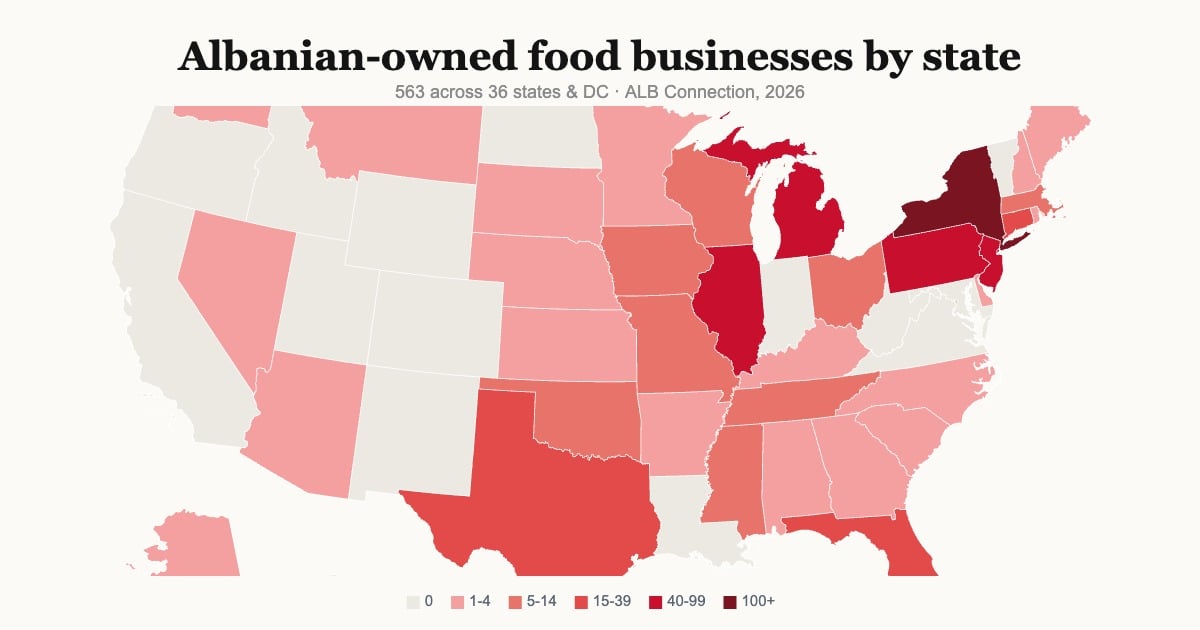
"Albanian-owned restaurant" papers over a much larger US food economy: 563 distinct, verifiable Albanian-owned food businesses across 36 states and the District of Columbia, roughly 41% of every Albanian-owned business in America.
Key findings
- Food is the defining Albanian-American industry. 563 of the 1,375 Albanian-owned US businesses in ALB Connection's June 26, 2026 directory snapshot operate in food, or roughly 41% of all Albanian-owned US enterprise. No other sector comes close.
- Restaurants lead, but the food economy is broader than restaurants. 434 full-service restaurants, plus 50 pizzerias, 32 coffee shops, 24 bakeries, 13 grocery stores, 7 specialty Albanian grocers, 8 food and beverage suppliers, 6 catering services, 5 butchers, and 3 Albanian food workshops.
- New York metropolitan area is the food capital. 190 of the 563 Albanian-owned US food businesses are in New York State alone, and roughly 130 of those sit inside New York City. New York City listings (Manhattan plus businesses listed citywide as "New York") form the largest single group, with 79 verified Albanian-owned food businesses.
- The Bronx is dense beyond its size. 34 Albanian-owned food businesses serve roughly 9,500 Albanian-American Bronx residents, or approximately one Albanian-owned food business per 280 Albanian-Americans in the borough.
- Detroit metro is the leading non-NYC food cluster. 53 Michigan food businesses spread across Detroit, Sterling Heights, Shelby Township, Troy, Rochester, and Birmingham, anchored by one of the longest-tenured Albanian-American communities in the country. New Jersey ranks higher by state total (61) but is more diffuse across smaller-city clusters.
- Philadelphia is the surprise number three. 28 Albanian-owned food businesses in Philadelphia alone, more than any individual Michigan city in the directory.
- Pizza is its own category. 50 Albanian-owned pizzerias, concentrated in the New York metro, continue a four-decade pattern in which Albanian immigrants entered, worked, and ultimately bought the pizzerias of New York's older Italian-American families.
- The Albanian-American food concentration is unusual. 41% of all Albanian-owned US businesses are in food, compared with roughly 3% of all US businesses being restaurants or foodservice outlets nationally, a concentration multiple of about 13x.
How this report defines "Albanian-owned food business." The figures cover all businesses in the ALB Connection directory tagged in at least one of 10 food-related categories: Restaurants, Pizza, Coffee Shops, Bakeries, Grocery Store, Albanian Grocery Stores, Food and Beverage Suppliers, Catering Services, Butcher, and Albanian Food and Culinary Workshops. Businesses tagged in multiple food categories are counted once. Data was retrieved from the ALB Connection directory on June 26, 2026 (after a community-driven cleanup pass). Because the directory grows continuously, totals differ slightly from the companion State of Albanian-Owned Business in America report, which uses a later July 2026 snapshot (1,459 US businesses). Full methodology is in the About section.
Albanian-Americans and the US restaurant industry
To understand what 563 Albanian-owned US food businesses mean, it helps to know the size of the US restaurant industry and where Albanian-American enterprise fits inside it.
The US restaurant industry, 2026
According to the National Restaurant Association's 2026 State of the Restaurant Industry report, the United States has more than 1 million restaurant and foodservice outlets, projected to generate $1.55 trillion in sales in 2026, while employing approximately 15.8 million workers. The restaurant and foodservice industry is the nation's second-largest private employer.
Immigrants own roughly one-third of US restaurants
The Independent Restaurant Coalition, citing US Census Bureau data, reports that immigrants own approximately 29% of all US restaurants and hotels, more than twice the 14% immigrant ownership rate for businesses overall. A 2017 Chicago Council on Global Affairs analysis put the figure even higher, estimating that 37% of small US restaurant owners are immigrants. Among working chefs, 43% are foreign-born.
Where Albanian-Americans sit inside this picture
Albanian-Americans are a small US community, roughly 222,964 people per Neilsberg's analysis of US Census ACS 2019-2023 data, but the Albanian-American business community is unusually concentrated in food. ALB Connection's directory shows 41% of all Albanian-owned US businesses are food businesses, compared with roughly 3% of all US businesses being restaurants or foodservice outlets nationally. That is a community-level concentration multiple of about 13x.
The pattern fits a longer immigrant-restaurant arc that scholars and trade press have documented at large: immigrant entry into US food service tends to combine three things: low capital barriers, family-labor flexibility, and a cultural product that can be sold across ethnic lines. For Albanian-Americans, that arc has produced a US food economy of 563 distinct, verifiable businesses across 36 states and DC, the great majority of them concentrated in the post-1991 immigration corridor running from New York to Detroit through Philadelphia and Chicago.
Inside the food economy: 10 sub-segments
"Albanian-owned restaurant" is a phrase that papers over a much more varied US food economy. The 563 businesses break down into 10 distinct sub-segments, each with its own geographic concentration and growth pattern.
| Sub-segment | Businesses | Share of US Food Total | Where they concentrate |
|---|---|---|---|
| Full-service restaurants | 434 | 77.1% | NYC metro, Detroit metro, Philadelphia, Chicago |
| Pizzerias | 39 | 6.9% | Bronx, Westchester County, Yonkers, NJ |
| Coffee shops | 28 | 5.0% | NYC, Detroit suburbs |
| Bakeries | 23 | 4.1% | NYC metro, Philadelphia |
| Grocery stores | 13 | 2.3% | NYC metro, Detroit metro |
| Food and beverage suppliers | 7 | 1.2% | NY, NJ, PA |
| Albanian grocery stores | 7 | 1.2% | Bronx, Staten Island, NJ, Detroit suburbs |
| Catering services | 5 | 0.9% | NY, NJ, PA |
| Butchers | 5 | 0.9% | Bronx, Detroit metro |
| Albanian food and culinary workshops | 2 | 0.4% | NYC area |
| Total | 563 | 100% |
Primary sub-segment assignment uses category priority order: full-service restaurants first, then pizza, bakeries, coffee shops, catering, butchers, and grocery in that order. Businesses tagged in multiple categories are counted once under their highest-priority sub-segment. Total pizzeria count including those primarily tagged as restaurants reaches 50; total coffee shop count reaches 32; total bakery count reaches 24.
New York: the capital of Albanian-American food
Roughly one in three Albanian-owned US food businesses is in New York State. Of those 190, roughly 130 sit inside New York City itself. Add Yonkers, Mount Vernon, Mamaroneck, and the rest of Westchester County, and the New York metropolitan area accounts for more than one in four Albanian-owned US food businesses overall.
| City / Borough | Albanian-Owned Food Businesses |
|---|---|
| New York City (Manhattan and citywide listings) | 79 |
| Bronx | 34 |
| Staten Island | 9 |
| Brooklyn | 7 |
| Yonkers | 6 |
| Astoria, Queens | 4 |
| Mamaroneck, Westchester County | 3 |
For comparison: the New York State Comptroller's office and industry data estimate that New York City has roughly 25,000 food establishments overall. Measured citywide, the roughly 130 Albanian-owned food businesses in ALB Connection's directory equal about 0.5% of New York City's food establishments, in line with the community's roughly 0.46% share of the city's 8.2 million residents. That figure is almost certainly an undercount: many Albanian-owned pizzerias and Italian restaurants do not publicly identify their owners' heritage (see Known limitations below).
The Bronx pizza story
The Bronx is the densest Albanian-American food community in the United States. ALB Connection's directory identifies 34 verified Albanian-owned food businesses across the borough, concentrated heavily on and around Lydig Avenue in the Morris Park section, a corridor that New York food writers have called "Little Albania" since at least 2011.
According to Neilsberg's analysis of US Census ACS data, the Bronx is home to roughly 9,546 Albanian-American residents. That puts the borough's Albanian-American food-business density at approximately one verified Albanian-owned food business per 280 Albanian-American residents, the highest such ratio in the country.
How Albanian families took over New York pizza
The Bronx food density is rooted in a four-decade transition in New York's pizzeria industry. Beginning in the 1980s, Albanian immigrants, many of them from Kosovo and Montenegro, began working as cooks and counter staff in established Italian-American pizzerias across the Bronx, Westchester, and northern New Jersey. As older Italian-American owners aged out or moved to the suburbs, their Albanian employees often bought the businesses outright.
The pattern produced some of New York's best-known pizza names. Patsy's Pizzeria, a Manhattan landmark since 1933, was acquired in 1991 by Frank Brija, an Albanian-American from Kosovo, who trademarked the name and built a chain. Giovanni's Italian Restaurant on Arthur Avenue, perhaps the Bronx's most famous Little Italy address, has been run since 1996 by George Dedvukaj, a Catholic Albanian-American from Montenegro who worked in Italian-owned Bronx pizzerias for 26 years before buying his own. New York food media including the Red Sauce America project, New York Eats Here, and others have all noted the same underlying shift: many of the city's most storied Italian-American food businesses now have Albanian-American owners.
ALB Connection's directory captures this transition. Of the 50 Albanian-owned pizzerias in the directory, the great majority sit inside the historic New York pizza corridor running from the Bronx through Westchester and into the New Jersey suburbs.
The Detroit metro food cluster
Michigan is the third-largest state for Albanian-American food businesses in the United States, with 53 verified Albanian-owned food establishments in ALB Connection's directory. New Jersey holds the second spot with 61. Unlike the New York concentration, the Michigan cluster is suburban and metropolitan rather than urban-core, spread across the Macomb and Oakland County suburbs north of Detroit.
| Michigan City / Township | Albanian-Owned Food Businesses |
|---|---|
| Detroit | 8 |
| Rochester | 5 |
| Shelby Township | 4 |
| Troy | 4 |
| Birmingham | 4 |
The Detroit Albanian community is among the oldest in the United States. As Harvard's Growth Lab study of Albanian-Americans notes, Massachusetts and Michigan together host some of the most established, multi-generational Albanian-American families in the country, many of whom have moved from earlier industrial-era trades into restaurant and hospitality ownership over the last two decades.
Philadelphia: the surprise number three
Among individual US cities, Philadelphia ranks third for Albanian-owned food businesses, behind only the citywide and borough-level entries for New York City. The city alone hosts 28 verified Albanian-owned food businesses, more than any single Michigan city.
Philadelphia's Albanian-American food scene runs from full-service Italian restaurants like Verona, opened by Endrit Bodi at the age of 24, to La Voglia Restaurant, founded by Arber Mullai. Both owners followed a pattern common in the Philadelphia Albanian community: arrival from Albania, early work inside the city's established Italian-American restaurant scene, and eventual transition into ownership.
The broader Pennsylvania Albanian-American community, anchored in Philadelphia, totals about 4,702 residents per Neilsberg's ACS-based ranking, making it the sixth-largest US Albanian-American city by population.
Voices from the kitchen
The numbers in this report represent thousands of individual decisions to open, run, and pass down food businesses. Below are four Albanian-American food entrepreneurs profiled in ALB Connection's editorial archive, spanning New York, Cleveland, and Philadelphia. All quotes are from published ALB Connection interviews; linked profiles include the full conversation with each owner.
"I came to the United States in 1992 with my husband and children. We settled in Astoria because of the community. I spent 17 years working in a bakery before I took over BZ Grill. It was the middle of COVID. Everyone said it was a bad time. I knew it was my time."
"My love for food traces back to my upbringing in Fier, Albania, where farm-to-table cooking was a way of life. After moving to Cleveland as a teenager in 1996, I carried those flavors with me. Tricks in the Kitchen is about making Albanian-inspired cooking simple, healthy, and joyful for home cooks everywhere, not just our community."
"I came to the United States to study, but life had different plans. At 24 I opened Verona Italian Restaurant in Philadelphia. I had no ownership experience, just years of managing other people's restaurants. The plunge taught me that the people who succeed in this industry are the ones willing to take the first step before they feel ready."
"La Voglia was a culinary dream I had carried since I was young in Albania. Building it in Philadelphia, in a city with such a deep Italian-American food culture, meant earning a place at a table that was already crowded. We did it the only way we knew how: long hours, traditional technique, and treating every guest like family."
Read more featured business owner profiles → · For journalists looking to interview owners profiled by ALB Connection, contact editorial@albconnection.com.
Food as cultural infrastructure
For most Albanian-American communities, food businesses do more than generate revenue: they function as everyday community centers. The Bronx's Lydig Avenue Albanian corridor, the Detroit metro's Macomb and Oakland County Albanian restaurants, and the Astoria Albanian-Greek food scene are all places where second-generation Albanian-American families introduce their children to the cuisine of the homeland.
Several annual events anchor the cultural calendar around food:
- Albanian Independence Day, November 28, commemorating the 1912 declaration of independence in Vlorë, draws large community gatherings at Albanian-owned restaurants across the country.
- Albanian-American Heritage Month observances in the spring increasingly feature restaurant-week programming in cities including New York, Detroit, and Philadelphia.
- Community soccer tournaments, particularly in the Bronx and the Detroit suburbs, function as informal trade shows for Albanian-owned caterers, butchers, and grocery suppliers.
The 22 community organizations and chambers in ALB Connection's directory, including the Albanian American Chamber of Commerce of Southeast Michigan, often anchor their networking calendars at member-owned restaurants. The reverse is also true: Albanian-American restaurants are the most common visible touch point through which non-Albanian neighbors first encounter Albanian-American life.
For journalists: story angles and connected reporting
This report is built to support journalism on the Albanian-American food economy across multiple beats: food media, immigration, small business, regional metro coverage. Below, we map common story angles to the data in this report and to ALB Connection's broader reporting and directories. Journalists are welcome to cite any data here with attribution; the underlying anonymized dataset is available on request for verification. Contact details are at the end of this report.
| Story angle | Relevant data points | Connected reporting |
|---|---|---|
| How Albanians came to own New York pizza | 50 Albanian-owned US pizzerias; Bronx and Westchester concentration; Frank Brija acquired Patsy's Pizzeria in 1991; Albanian-owned share of NYC pizza estimated significant | Albanian-owned pizzerias in New York, Albanian restaurants directory |
| "Little Albania" on Lydig Avenue, Bronx | 34 Bronx food businesses; 9,546 Albanian residents; ~1 food business per 280 Albanian-Americans; densest US Albanian-American food community | Albanian businesses in the Bronx, Restaurant directory |
| Detroit metro Balkan-Italian-Albanian food scene | 53 Michigan food businesses; Sterling Heights, Troy, Birmingham, Shelby suburbs; long-tenured community | Detroit Albanian businesses, SE Michigan Albanian Chamber |
| Philadelphia's Albanian-Italian restaurant corridor | 28 Philadelphia food businesses; 4,702 Albanian-American residents; sixth-largest US Albanian-American city | Albanian businesses in Philadelphia |
| Immigrant entrepreneurship in US food | Albanian-Americans 13x more concentrated in food than US business average; mirrors broader immigrant-restaurant pattern (29% of all US restaurants are immigrant-owned) | State of Albanian-Owned Business report |
| Generational handoff inside ethnic restaurant economies | Albanian acquisition of Italian-American pizzerias since the 1980s; multi-generational Detroit / Massachusetts communities now expanding into ownership | Featured owner profiles |
| The Albanian grocery and butcher economy | 20 Albanian-owned US grocery stores + 5 butchers; concentrated in Bronx, Staten Island, Detroit suburbs; underdocumented supply chain serving wider Balkan diaspora | Food and local guides |
| Cultural infrastructure: restaurants as community spaces | 22 chambers and community organizations; Independence Day and Heritage Month gatherings hosted at Albanian-owned restaurants | Community organizations, Events |
About ALB Connection
ALB Connection is a community-built editorial publication and business directory serving the Albanian-American diaspora. Founded in 2023, the publication maintains one of the largest verified directories of Albanian-owned businesses available, and produces editorial coverage on Albanian-American history, culture, and current affairs.
ALB Connection is a commercial publisher, not a nonprofit research institute. The business directory is both the data source for this report and the primary product offered by ALB Connection. Listing is free and does not require payment. The verification standards described in the methodology section below are designed to ensure the directory reflects publicly visible, third-party-verifiable Albanian-owned businesses, regardless of whether they have engaged commercially with ALB Connection.
Press contact
For journalist inquiries, requests to license raw or anonymized data for verification, requests for high-resolution charts and maps, or to interview ALB Connection's editorial team or be connected with featured business owners, contact:
ALB Connection
Email: editorial@albconnection.com
Website: albconnection.com
How to cite this report
ALB Connection (2026). The State of Albanian-Owned Restaurants in America. Retrieved from https://albconnection.com/state-of-albanian-owned-restaurants-in-america/
Appendix: Albanian-owned food businesses by US state
The full state-by-state breakdown of the 563 verified Albanian-owned US food businesses in the ALB Connection directory as of June 2026, in descending order. Reporters covering specific states may request a list of cities-by-state for any entry by contacting editorial@albconnection.com.
Show the full state-by-state table (36 states + DC)
| Rank | State | Food Businesses | Share of US Total |
|---|---|---|---|
| 1 | New York | 190 | 33.7% |
| 2 | New Jersey | 61 | 10.8% |
| 3 | Michigan | 53 | 9.4% |
| 4 | Illinois | 49 | 8.7% |
| 5 | Pennsylvania | 48 | 8.5% |
| 6 | Connecticut | 29 | 5.2% |
| 7 | Texas | 24 | 4.3% |
| 8 | Florida | 20 | 3.6% |
| 9 | Massachusetts | 14 | 2.5% |
| 10 | Missouri | 9 | 1.6% |
| 11 | Oklahoma | 7 | 1.2% |
| 11 | Iowa | 7 | 1.2% |
| 13 | Ohio | 6 | 1.1% |
| 14 | Mississippi | 5 | 0.9% |
| 14 | Tennessee | 5 | 0.9% |
| 14 | Wisconsin | 5 | 0.9% |
| 17 | Georgia | 4 | 0.7% |
| 17 | Minnesota | 4 | 0.7% |
| 19 | Arizona | 3 | 0.5% |
| 20 | North Carolina | 2 | 0.4% |
| 20 | Alabama | 2 | 0.4% |
| 20 | District of Columbia | 2 | 0.4% |
| 23 | Nebraska | 1 | <0.2% |
| 23 | South Dakota | 1 | <0.2% |
| 23 | New Hampshire | 1 | <0.2% |
| 23 | Montana | 1 | <0.2% |
| 23 | Kansas | 1 | <0.2% |
| 23 | Arkansas | 1 | <0.2% |
| 23 | Nevada | 1 | <0.2% |
| 23 | Delaware | 1 | <0.2% |
| 23 | Kentucky | 1 | <0.2% |
| 23 | South Carolina | 1 | <0.2% |
| 23 | Alaska | 1 | <0.2% |
| 23 | Rhode Island | 1 | <0.2% |
| 23 | Maine | 1 | <0.2% |
| 23 | Washington | 1 | <0.2% |
| — | Total (36 states + DC) | 563 | 100% |
Source: ALB Connection business directory, June 2026 snapshot. Counts reflect publicly visible, third-party-verified Albanian-owned food businesses meeting the two-signal verification standard described in the methodology.
About this report
Data collection
The data in this report comes from the ALB Connection business directory, which has been built continuously since 2023 through five complementary channels:
- Direct business submissions through our open listing form at albconnection.com.
- Grassroots door-to-door outreach in metropolitan areas including New York City, the Detroit metro, Philadelphia, and Boston.
- Featured owner profiles in long-form editorial pieces written by community contributors.
- Community-sourced editorial leads from Albanian-American writers, contributors, and community members.
- Independent research and word-of-mouth verification, requiring at least two independent verification signals per listing.
Food category scope
The 563 figure in this report is the count of unique Albanian-owned US businesses tagged in at least one of these 10 food-related categories in the ALB Connection directory:
- Restaurants
- Pizza
- Coffee Shops
- Bakeries
- Grocery Store
- Albanian Grocery Stores
- Food and Beverage Suppliers
- Catering Services
- Butcher
- Albanian Food and Culinary Workshops
Businesses tagged in multiple food categories are counted once. The primary sub-segment assignment used in section three follows priority order: full-service restaurants first, then pizza, bakeries, coffee shops, catering, butchers, grocery, and specialty grocery. This means the "Pizza" sub-segment count of 39 is lower than the raw Pizza category total of 50, because 11 of those pizzerias are also tagged as full-service restaurants and are assigned to that higher-priority sub-segment.
Collection period and verification
Data in this edition was collected from January 2023 through June 2026. Businesses are included only when at least two independent verification signals match, for example a publicly available website identifying the owner as Albanian and editorial coverage in an Albanian-American outlet, or a verified phone number and direct community confirmation.
Disclosure
ALB Connection is a commercial editorial publication and business directory, not a nonprofit research institute. The business directory is both the data source for this report and the primary product offered by ALB Connection. Listing is free for all businesses and does not require payment or any commercial relationship with ALB Connection. The verification standards described above are designed to ensure inclusions reflect publicly visible, third-party-verifiable Albanian-owned food businesses regardless of any engagement with ALB Connection's commercial operations. The authors have no undisclosed conflicts of interest with the businesses, communities, or geographies analyzed in this report.
Known limitations
- Digital-presence bias. Our verification standard requires at least some public, verifiable digital footprint. The directory undercounts very small home-based food operations, pop-ups, and businesses that intentionally do not market online.
- Self-identification of heritage. Food businesses owned by Albanian-Americans who do not publicly identify their heritage may not appear in the directory. This is a particularly important caveat for the New York pizza count, where Albanian ownership of historically-Italian-named businesses is common but is not always publicly advertised.
- Geographic coverage. Coverage is strongest in NY, NJ, MI, IL, PA, CT, MA, and FL, where grassroots outreach has been most intensive.
- Point-in-time data. Figures reflect a June 2026 snapshot. An updated edition is planned annually.
Sources cited in this report
- National Restaurant Association (2026). 2026 State of the Restaurant Industry. restaurant.org
- Independent Restaurant Coalition. The Impact of Immigration on Independent Restaurants and Bars. independentrestaurantcoalition.com
- New York State Office of the Comptroller. Restaurant Sector, New York City Industry Sector Dashboards. osc.ny.gov
- Neilsberg (2025). Albanian Population in United States by City. Based on US Census American Community Survey 2019-2023 5-Year Estimates. neilsberg.com
- Nedelkoska, L. and Khaw, N. (2015). The Albanian Community in the United States: Statistical Profiling of the Albanian-Americans. Growth Lab at Harvard's Center for International Development. growthlab.hks.harvard.edu
- Wikipedia. Patsy's Pizzeria.
- Bronx Ink. "Little Albania" in the Bronx. bronxink.org
- Red Sauce America. A Brief History of New York City's Oldest Pizzerias. redsauceamerica.com
- ALB Connection (2026). The State of Albanian-Owned Business in America. albconnection.com
Access to underlying data
The full directory of Albanian-owned businesses worldwide, including the 563 verified US food businesses cited in this report, is publicly viewable in the ALB Connection business directory. Journalists, academics, and researchers may request the anonymized underlying dataset for verification or further research by contacting editorial@albconnection.com.