The State of Albanian-Owned Business in America
The State of Albanian-Owned Business in America
A data report on where Albanian-Americans build businesses, what they build, and the communities they have created across the United States.
ALB Connection maintains one of the largest directories of Albanian-owned businesses available: 4,767 across 19 countries. This report focuses on the 1,597 based in the United States, the most complete picture to date of where Albanian-Americans build businesses and what they build.
Key findings
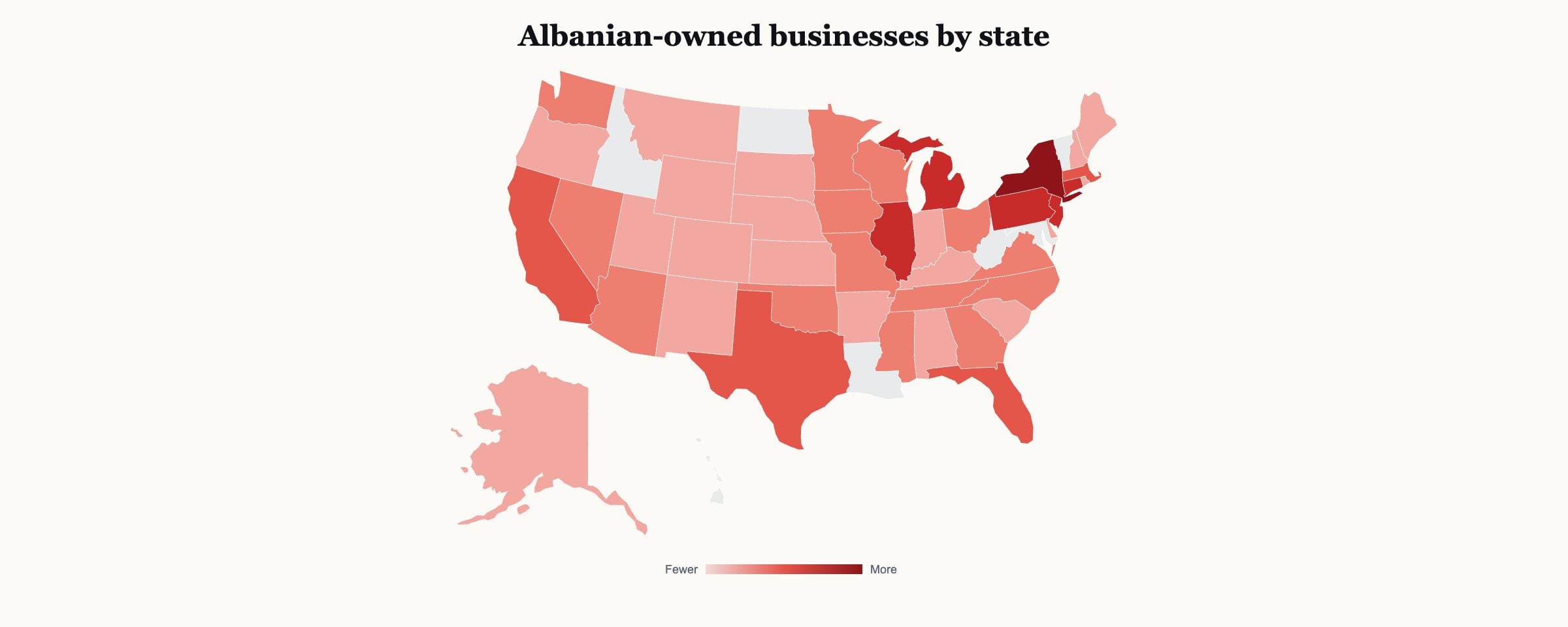
- Heavy geographic concentration: New York State is home to roughly 39% of all Albanian-owned US businesses tracked in this report, more than the next three states combined.
- A food economy: 1 in 3 Albanian-owned businesses in the United States is a food business, and more than 1 in 4 is a restaurant. Including pizzerias, coffee shops, and bakeries, food accounts for more than a third of every Albanian-owned business in America.
- The Bronx is the densest community: The Bronx alone hosts 88 Albanian-owned businesses, more than 39 entire US states. With an estimated 9,546 Albanian residents (US Census ACS), that is approximately 1 verifiable Albanian-owned business per 108 Albanian-Americans in the borough.
- Online and findable: About three in four Albanian-owned US businesses in the directory list their own business website (not just a social-media page), and three in four have a verified email address.
- 44 states and DC, 532 cities: Albanian-American enterprise is no longer confined to the historic Northeast and Midwest. Verifiable Albanian-owned businesses now operate in 44 states and the District of Columbia, across 532 cities and towns.
- A global footprint: Outside Albania itself (2,000 businesses), the United States is the largest hub of Albanian-owned enterprise in our directory, ahead of Kosovo (984) and Canada (100).
Albanian-Americans in context: a small, concentrated, entrepreneurial community
To understand why these numbers matter, it helps to know the size and shape of the Albanian-American population behind them.
According to the most recent U.S. Census American Community Survey (2019-2023 5-Year Estimates), an estimated 222,964 Americans identify as having Albanian ancestry, either alone or in combination with another heritage, as compiled by the demographic research firm Neilsberg. By population, Albanian-Americans are one of the smallest European-origin diasporas in the country, yet they have built a remarkably visible business presence relative to their size.
Where Albanian-Americans live
The community is heavily concentrated in a handful of metropolitan regions. According to Neilsberg's ACS-based ranking, the largest Albanian-American populations in any single US municipality are:
| Rank | City / Borough | Albanian Population | % of Local Population | % of US Albanian Population |
|---|---|---|---|---|
| 1 | New York City | 37,526 | 0.44% | 16.8% |
| 2 | Bronx borough | 9,546 | 0.67% | 4.3% |
| 3 | Queens borough | 9,356 | 0.40% | 4.2% |
| 4 | Staten Island borough | 8,282 | 1.68% | 3.7% |
| 5 | Brooklyn borough | 7,519 | 0.28% | 3.4% |
| 6 | Philadelphia | 4,702 | 0.30% | 2.1% |
| 7 | Jacksonville | 4,054 | 0.42% | 1.8% |
Source: Neilsberg, based on U.S. Census Bureau American Community Survey 2019-2023 5-Year Estimates.
Adding the five New York City boroughs together, the New York metropolitan area is home to more than 72,000 Albanian-Americans, roughly one third of every Albanian in the United States. The neighborhood-level concentrations are striking: in Staten Island, 1.68% of all residents identify as having Albanian ancestry, the highest share of any large American city.
How Albanian-Americans compare to other Balkan diasporas
By population, Albanian-Americans (~223,000 per Neilsberg / US Census ACS 2019-2023) sit between two larger neighboring Balkan communities and are several times larger than a third. Each row below cites the same Neilsberg ancestry-ranking series used for the Albanian-American number wherever a parallel ranking exists, with the U.S. Census ACS as the underlying data source. The comparison is useful because all four communities share post-Ottoman and post-Yugoslav migration arcs to the United States, yet they have built strikingly different business footprints:
| Community | US population (latest estimate) | Source | Largest settlement hubs |
|---|---|---|---|
| Greek Americans | ~1,200,000 | Neilsberg / Wikipedia (US Census ACS 2019-2023) | New York, Chicago, Boston, Tarpon Springs FL |
| Bosnian Americans | ~350,000 (2020) | Wikipedia (Karamehic-Oates 2020, Washington University Global Studies Law Review) | St. Louis, Chicago, Jacksonville, Utica NY, Detroit |
| Albanian Americans | ~223,000 | Neilsberg (US Census ACS 2019-2023) | New York metro (72,000+), Detroit metro, Boston, Philadelphia |
| Macedonian Americans | ~65,179 | Neilsberg (US Census ACS 2019-2023); Wikipedia reports 65,107 per 2024 ACS 1-Year | New York metro, Detroit, Ohio, Illinois, Connecticut |
All four communities are sized using the U.S. Census American Community Survey self-reported ancestry data, retrieved via Neilsberg's standardized city-level ancestry rankings where available. The Bosnian-American figure is drawn from Wikipedia's published estimate citing Karamehic-Oates (2020), as Neilsberg does not publish a parallel Bosnian-ancestry ranking; this is a minor methodological gap noted for transparency.
Two observations stand out from the comparison. First, Albanian-Americans are roughly two-thirds the size of the Bosnian-American community but are concentrated in fundamentally different metros (New York and Detroit vs. St. Louis, Chicago, and Jacksonville), reflecting their distinct migration timing and refugee histories. Second, while we do not currently have an apples-to-apples directory for the other Balkan-American communities to support a direct per-capita business-density comparison, the visible Albanian-American business presence in New York and Detroit, including the 84 businesses in the Bronx alone, is unusually dense given the community's size. Future editions of this report will aim to incorporate cross-community comparison once parallel directories become available.
An entrepreneurial profile rooted in education
The Harvard Kennedy School Growth Lab has produced the most rigorous academic profile of Albanian-Americans to date. In "The Albanian Community in the United States: Statistical Profiling of the Albanian-Americans" (Nedelkoska and Khaw, 2015), researchers Ljubica Nedelkoska and Nina Khaw used American Community Survey microdata to characterize the community across two waves:
- First-generation Albanian-Americans (those who arrived after the fall of Communism in 1991-92) are more highly educated than non-Albanian Americans of comparable demographics. The education advantage is especially pronounced among Albanian-American women.
- Second-generation Albanian-Americans show educational outcomes similar to the general US population of comparable demographics.
- Despite their qualifications, first-generation Albanian-Americans earn less than non-Albanian Americans of comparable backgrounds. Harvard researchers attribute this not to ethnicity but to the general immigrant earnings gap, which narrows with time spent in the US.
- New York, Michigan, and Massachusetts together host nearly 60% of all Albanian-Americans, with the Massachusetts community being the oldest, best-educated, and highest-earning of the three.
Read in light of these academic findings, ALB Connection's directory of 1,597 verifiable US businesses suggests one clear thing: a community of roughly 223,000 people has produced, at minimum, one verified registered business for every 140 community members. That is a remarkable ratio for a small immigrant population, and one that almost certainly understates the true rate of Albanian-American entrepreneurship, since our directory captures only businesses with at least two verifiable digital and human signals (see methodology below).
Selected per-capita observations
- The Bronx: 88 Albanian-owned businesses for a population of approximately 9,546 Albanian-Americans, roughly 1 verifiable Albanian-owned business per 108 Albanian-American residents. By this measure, the Bronx is the densest Albanian-American business community in the United States.
- Staten Island: Albanian-Americans make up 1.68% of all residents, the highest share in any large US city, and the borough hosts dozens of Albanian-owned construction, real estate, and food businesses in our directory.
- Detroit metro: Sterling Heights, Shelby Township, Troy, and the surrounding suburbs of Macomb and Oakland counties host the second-largest Albanian-American business cluster outside greater New York, anchored by a community Harvard estimates includes some of the longest-tenured Albanian-American families in the country.
For further demographic context, see Wikipedia's overview articles on Albanian Americans and the Albanian diaspora.
New York is the capital of Albanian America
Nearly four in ten Albanian-owned businesses in the United States are in New York State, home to 623 of them. The greater New York City area, the Bronx, Staten Island, Yonkers, Brooklyn, and Westchester County, holds the largest concentration of Albanian enterprise anywhere outside the Balkans. The Bronx alone has 88.
After New York, the largest communities are in Michigan (195, centered on metro Detroit and the suburbs of Troy, Sterling Heights, and Shelby Township), Pennsylvania (136, led by Philadelphia), Illinois (136, greater Chicago), New Jersey (117), and Connecticut (77).
Businesses by US state, hover a state for the count
Top US states, 1,597 businesses across 44 states and DC
A food and trades economy
More than one in four Albanian-owned businesses in America is a restaurant (453). Add pizzerias (50), coffee shops (36), bakeries (24), grocers, butchers, caterers and food suppliers, and more than a third of all Albanian-owned US businesses are in food. It is the defining industry of the community.
Beyond food, Albanian-Americans cluster in the building trades and professional services: construction and home improvement (162), beauty and wellness (94), real estate (87), legal services (53), financial services (38), automotive (33), and electrical (28). A hands-on, entrepreneurial, service-driven community.
Top US industries
A food economy. Restaurants, pizzerias, coffee shops, and bakeries together make up more than a third of every Albanian-owned business in America.
The cities where Albanian-Americans build
The map of Albanian-American enterprise runs through a handful of cities: New York City and its boroughs, Philadelphia, Chicago, and the Detroit suburbs. Below are the cities with the most Albanian-owned businesses in the directory.
Top US cities
Voices from the directory
The numbers in this report represent thousands of individual decisions to build something. Below are five Albanian-American business owners profiled in ALB Connection's editorial archive, drawn from across the geographies and industries documented above. All quotes are from published ALB Connection interviews; the linked profiles include the full conversation with each owner.
"I came to the United States in 1992 with my husband and children. We settled in Astoria because of the community. I spent 17 years working in a bakery before I took over BZ Grill. It was the middle of COVID. Everyone said it was a bad time. I knew it was my time."
"Growing up Albanian, you're taught to outwork everyone in the room and never complain. That mindset carries into everything I do, especially patient care. Detroit is where that mindset turned into action, a city where hard work meets opportunity."
"My family left Permet in 1997 in the middle of Albania's national turmoil. We moved first to Greece, then to the United States. My grandparents were entrepreneurs in southern Albania. That instinct doesn't go away, it just looks for a new city to take root in. Mine was Philadelphia."
"My main goal has always been to build bridges, between talent and capital, innovation and markets, local ambition and global scale. My Albanian upbringing taught me that we rise together. That sense of loyalty and collaboration is central to how I lead, mentor, and connect people."
"I started The Petal Room NY in 2024 after I was given flowers during my recovery from surgery. I felt it more than I expected to. Albanian values of hospitality, hard work, and community are how I treat every customer. My advice to anyone starting out: start before you are ready, and let your mistakes teach you."
Read more featured business owner profiles → · For journalists looking to interview owners profiled by ALB Connection, contact editorial@albconnection.com.
More featured business owner stories
The five owners quoted above are a small sample of more than 50 long-form Albanian-American business owner profiles published by ALB Connection since 2023. A few additional stories that map to angles in this report:
Browse all our featured business owner stories →
A global community
ALB Connection is open to Albanian-owned businesses everywhere, and the full directory reflects the reach of the Albanian diaspora and homeland alike. Beyond the United States, it spans Albania, Kosovo, Canada, the United Kingdom, Switzerland, Germany, Australia, and eleven other countries.
Worldwide footprint, 4,767 businesses
The civic infrastructure behind the businesses
A community's business presence is only one face of its public life. Albanian-Americans have also built a wide civic infrastructure, chambers of commerce, cultural organizations, professional associations, religious institutions, and annual cultural events, that supports and reinforces the entrepreneurial economy documented in this report.
Chambers, professional groups, and community organizations
ALB Connection maintains a directory of Albanian-American community organizations, which currently includes chambers, cultural foundations, and professional associations across major hubs. Key examples include:
- The Albanian American Chamber of Commerce of Southeast Michigan, hosted within the Southeast Michigan Chamber of Commerce, supporting the dense Detroit-area business cluster.
- Cultural and educational organizations in New York, Boston, Chicago, and the Detroit metro, many of which run annual events, Saturday-school programs in Albanian language and history, and youth scholarships.
- Religious institutions, including Catholic, Orthodox, Bektashi, and Sunni Muslim communities, that have been central to Albanian-American identity for over a century.
For the full list of organizations in our directory, see Albanian-American community organizations.
Cultural events as economic infrastructure
Annual events including Albanian Independence Day celebrations (November 28, marking the 1912 declaration of Albanian independence in Vlorë), Kosovo Independence Day (February 17), Albanian-American Heritage Month observances, traditional folk-dance festivals, and community soccer tournaments draw thousands of attendees annually and serve as critical networking venues for Albanian-owned businesses.
See our directory of Albanian-American events and cultural calendars for current listings.
Historical roots
The first significant wave of Albanian migration to the United States arrived between 1900 and 1920, settling primarily in industrial New England: Massachusetts, Connecticut, and the New York metro. A second, much larger wave followed the fall of communism in Albania (1991) and the Kosovo War (1998-99). The community has thus matured from a small early-20th-century immigrant population into a third- and fourth-generation citizenry whose business presence reflects both the long-standing Boston and Detroit communities and the more recent New York and New Jersey concentration of post-1991 arrivals.
For journalists: story angles and connected reporting
This report is built to support journalism on the Albanian-American community across multiple beats. Below, we map common story angles to the data in this report and to ALB Connection's broader reporting and directories. Journalists are welcome to cite any data here with attribution. The underlying anonymized dataset is available on request for verification; contact details are at the end of this report.
| Story angle | Relevant data points | Connected reporting |
|---|---|---|
| Immigrant entrepreneurship | 1,597 verifiable Albanian-owned US businesses; 1 business per ~140 community members | Restaurants directory, Legal services, Construction and contractors |
| The Bronx Albanian community | 88 Albanian-owned businesses in the Bronx; 9,546 Albanian residents; ~0.67% of Bronx population | Bronx Albanian restaurants, Albanians in NYC and Queens |
| Detroit / Sterling Heights cluster | Michigan ranks among the top three states for Albanian-owned businesses; Sterling Heights and Shelby Township host major restaurant and construction clusters | Southeast Michigan Albanian Chamber, Contractors directory |
| Philadelphia and Pennsylvania community | Philadelphia hosts 4,702 Albanian residents, 6th-largest US city for Albanians; 136 Albanian-owned businesses in PA | Albanian businesses in Philadelphia |
| Cultural life of the diaspora | Active organizations and chambers in NYC, Boston, Detroit, Philadelphia; annual cultural events (Independence Day, Heritage Month, folk festivals) | Community organizations, Albanian-American events |
| Food and restaurant scene | Albanian-owned food businesses (restaurants, pizzerias, coffee shops, bakeries) — more than a third of all Albanian-owned US businesses | Albanian restaurants directory, Albanian-owned pizza in NY |
| Civic engagement and identity | 44 states and DC represented; established chambers; cultural and religious institutions across faiths | Where Albanian people come from, Albanian independence |
About ALB Connection
ALB Connection is a community-built editorial publication and business directory serving the Albanian-American diaspora. Founded in 2023, the publication maintains one of the largest verified directories of Albanian-owned businesses available and produces editorial coverage on Albanian-American history, culture, and current affairs.
Press contact
For journalist inquiries, requests to license raw or anonymized data for verification, requests for high-resolution charts and maps, or to interview ALB Connection's editorial team or be connected with featured business owners, contact:
ALB Connection
Email: editorial@albconnection.com
Website: albconnection.com
How to cite this report
ALB Connection (2026). The State of Albanian-Owned Business in America. Retrieved from https://albconnection.com/state-of-albanian-owned-business-in-america/
About this report
Data collection
The data in this report comes from the ALB Connection business directory, which has been built continuously since 2023 through five complementary channels:
- Direct business submissions. Owners and managers submit their businesses through our open listing form at albconnection.com.
- Grassroots door-to-door outreach. ALB Connection team members have visited Albanian-owned businesses in multiple metropolitan areas, including New York City, the Detroit metro, Philadelphia, and Chicago, to onboard businesses in person, documented in video on our Instagram.
- Featured owner profiles. ALB Connection has profiled Albanian-owned businesses in long-form editorial pieces written by community contributors over the course of three years. Each profiled business is added to the directory after editorial verification.
- Community-sourced editorial leads. Albanian-American writers, contributors, and community members flag businesses in their networks. Each lead is then independently researched and verified before listing.
- Independent research and word-of-mouth verification. Each candidate listing is verified online through one or more of the following signals: a business website with Albanian-owner identification, an "About Us" page describing Albanian heritage or family roots, owner names cross-referenced against community records, prior press coverage in Albanian-American or mainstream outlets, and public business filings where available.
Collection period and verification standards
Data in this edition was collected from January 2023 through October 2026. Businesses are included in the directory only when at least two independent verification signals match, for example, a publicly available website identifying the owner as Albanian and editorial coverage in an Albanian-American outlet, or a verified phone number and direct community confirmation.
Disclosure
ALB Connection is a commercial editorial publication and business directory, not a nonprofit research institute. The business directory is both the data source for this report and the primary product offered by ALB Connection. Listing is free for all businesses and does not require payment or any commercial relationship with ALB Connection. The verification standards described above are designed to ensure inclusions reflect publicly visible, third-party-verifiable Albanian-owned businesses regardless of any engagement with ALB Connection's commercial operations. The authors have no undisclosed conflicts of interest with the businesses, communities, or geographies analyzed in this report.
Known limitations
Like any community-built dataset, ours has known limitations:
- Digital-presence bias. Our verification standard requires at least some public, verifiable digital footprint, which means our directory undercounts very small sole proprietorships, home-based operations, and businesses that intentionally do not market online. The website figure ("about three in four list a business website") should be understood as a property of our identified businesses, not necessarily of the underlying Albanian-American business population.
- Self-identification of heritage. Because Albanian ancestry is not always publicly disclosed, businesses owned by Albanian-Americans who do not publicly identify their heritage may not appear in the directory.
- Geographic coverage. Coverage is strongest in NY, MI, MA, IL, NJ, PA, CT, and FL, where grassroots outreach has been most intensive. Coverage in California, Texas, and the South-Central states is improving but remains lower than in the Northeast and Midwest.
- Point-in-time data. The figures represent a snapshot as of October 7, 2026; the report was first published with a July 2026 snapshot and updated after a data cleanup. This is the first annual edition; an updated edition is planned each year.
Appendix: Albanian-owned businesses by US state
The full state-by-state breakdown of the 1,597 verified Albanian-owned US businesses in the ALB Connection directory as of October 7, 2026, in descending order by count. Reporters covering a specific state may request a city-level list by contacting editorial@albconnection.com.
Show the full state-by-state table (44 states and DC)
| Rank | State / territory | Businesses | Share of US total |
|---|---|---|---|
| 1 | New York | 623 | 39.0% |
| 2 | Michigan | 195 | 12.2% |
| 3 | Pennsylvania | 136 | 8.5% |
| 3 | Illinois | 136 | 8.5% |
| 5 | New Jersey | 117 | 7.3% |
| 6 | Connecticut | 77 | 4.8% |
| 7 | Massachusetts | 62 | 3.9% |
| 8 | Florida | 60 | 3.8% |
| 9 | Texas | 47 | 2.9% |
| 10 | California | 21 | 1.3% |
| 11 | Ohio | 11 | 0.7% |
| 12 | Oklahoma | 10 | 0.6% |
| 13 | Wisconsin | 9 | 0.6% |
| 14 | Tennessee | 8 | 0.5% |
| 14 | Iowa | 8 | 0.5% |
| 16 | Missouri | 7 | 0.4% |
| 17 | Arizona | 6 | 0.4% |
| 17 | North Carolina | 6 | 0.4% |
| 19 | Delaware | 5 | 0.3% |
| 19 | District of Columbia | 5 | 0.3% |
| 19 | Mississippi | 5 | 0.3% |
| 19 | Nevada | 5 | 0.3% |
| 23 | Virginia | 4 | 0.3% |
| 23 | Georgia | 4 | 0.3% |
| 23 | Minnesota | 4 | 0.3% |
| 26 | South Carolina | 3 | 0.2% |
| 26 | Washington | 3 | 0.2% |
| 28 | Arkansas | 2 | 0.1% |
| 28 | Alabama | 2 | 0.1% |
| 30 | Hawaii | 1 | 0.1% |
| 30 | Nebraska | 1 | 0.1% |
| 30 | South Dakota | 1 | 0.1% |
| 30 | New Hampshire | 1 | 0.1% |
| 30 | Montana | 1 | 0.1% |
| 30 | Kansas | 1 | 0.1% |
| 30 | New Mexico | 1 | 0.1% |
| 30 | Indiana | 1 | 0.1% |
| 30 | Oregon | 1 | 0.1% |
| 30 | Colorado | 1 | 0.1% |
| 30 | Kentucky | 1 | 0.1% |
| 30 | Alaska | 1 | 0.1% |
| 30 | Wyoming | 1 | 0.1% |
| 30 | Rhode Island | 1 | 0.1% |
| 30 | Maine | 1 | 0.1% |
| 30 | Utah | 1 | 0.1% |
Source: ALB Connection business directory, October 7, 2026 snapshot. Counts reflect publicly visible, third-party-verified Albanian-owned businesses meeting the two-signal verification standard described above.
Sources cited in this report
- Nedelkoska, L. and Khaw, N. (2015). The Albanian Community in the United States: Statistical Profiling of the Albanian-Americans. Growth Lab at Harvard's Center for International Development. growthlab.hks.harvard.edu
- Neilsberg (2025). Albanian Population in United States by City. Based on U.S. Census American Community Survey 2019-2023 5-Year Estimates. neilsberg.com
- U.S. Census Bureau. American Community Survey. census.gov/programs-surveys/acs
- Wikipedia. Albanian Americans, Albanian diaspora.
- Southeast Michigan Chamber of Commerce. Albanian American Chamber of Commerce of Southeast Michigan.
Access to underlying data
The full directory of 4,767 listings worldwide, including the 1,597 verified US businesses cited in this report, is publicly viewable in the ALB Connection business directory. Journalists, academics, and researchers may request the anonymized underlying dataset for verification or further research by contacting editorial@albconnection.com.
See also our deep-dive: The State of Albanian-Owned Restaurants in America — data on 563 Albanian-owned US food businesses across 36 states and DC.