On This Page
- The greetings, with pronunciation
- When Bajram falls
- The two Bajrams
- How Albanians celebrate
- Bajram in the United States
- Frequently asked questions
The Greetings, With Pronunciation
| Albanian | Pronunciation | Meaning | When to use it |
|---|---|---|---|
| Gëzuar Bajramin! | guh-ZOO-ar bye-RAH-meen | Happy Bajram! | The standard greeting for either Bajram |
| Urime Bajramin! | oo-REE-meh bye-RAH-meen | Congratulations on Bajram! | Equally common, slightly more formal |
| Gëzuar Fitër Bajramin! | guh-ZOO-ar FEE-tuhr bye-RAH-meen | Happy Eid al-Fitr! | Specific to the end of Ramadan |
| Gëzuar Kurban Bajramin! | guh-ZOO-ar koor-BAHN bye-RAH-meen | Happy Eid al-Adha! | Specific to the feast of sacrifice |
| Gëzuar edhe ty! | guh-ZOO-ar EH-dheh tee | Happy Bajram to you too! | The reply |
| Bajramin e keni për mbarë! | bye-RAH-meen eh KEH-nee puhr m-BAH-ruh | May your Bajram be blessed! | A warmer, traditional wish |
| Agjërim të lehtë! | ah-GYUH-reem tuh LEH-tuh | An easy fast! | During Ramadan, before Fitër Bajrami |
When Bajram Falls
Both Bajrams follow the Islamic lunar calendar, so they move about eleven days earlier each year and the exact day depends on the new moon. The 2026 dates are those in the calendar of the Muslim Community of Albania (KMSH); the 2027 dates follow the calendar published in August 2026 by Turkey’s Diyanet and should be confirmed by the KMSH and the Islamic Community of Kosovo closer to the time; 2028 is an approximate projection:| Year | Fitër Bajrami (Eid al-Fitr) | Kurban Bajrami (Eid al-Adha) |
|---|---|---|
| 2026 | 20 March | 27 May |
| 2027 | 9 March | 16 May |
| 2028 (approximate) | 26 February | 5 May |
The Two Bajrams
Fitër Bajrami ends the month of Ramadan. The morning begins with the Bajram prayer at the mosque, families visit each other through the day, children receive small gifts of money, and the table is set with sweets: baklava, kadaif, hallvë and trileçe. In Albania and Kosovo it is usually called Bajrami i Madh, the Great Bajram, which is also its name in Albania’s official holiday calendar. Kurban Bajrami commemorates Abraham’s sacrifice. Families who can afford it sacrifice a lamb or a share of a larger animal, and the meat is divided by custom into thirds: for the household, for relatives and friends, and for the poor. It is also the season of the Hajj, and pilgrims returning from Mecca are welcomed with visits.How Albanians Celebrate
Bajram in Albania and Kosovo is a family day more than a public spectacle. New or best clothes are worn, homes are cleaned in the days before, and the first visits go to parents and the eldest relatives, then to neighbors. Coffee is served to every visitor along with sweets, which is why pastry shops are busy in the days before each Bajram. Cemeteries are visited to remember the dead. What strikes visitors most is that the greeting crosses religious lines: Catholic and Orthodox Albanians wish their Muslim neighbors Gëzuar Bajramin, and receive Gëzuar Krishtlindjet and Gëzuar Pashkët in return at Christmas and Easter. The Bektashi community, an Albanian-centered Sufi order, marks the Bajrams as well as its own feast of Nevruz in March; our guide to the Bektashi tradition explains the difference.Bajram in the United States
In the American diaspora the Bajram prayer draws the largest crowds of the year to Albanian mosques and Islamic centers, from the Albanian Islamic Cultural Center on Staten Island to the Albanian Islamic Center of Michigan and the Albanian centers in Waterbury, the Chicago area and Philadelphia. Many hold community meals after the prayer, and the Albanian bakeries and restaurants listed in our directory take Bajram orders for baklava and lamb. Our directory of Albanian churches and mosques lists the centers by state, the events calendar carries Bajram gatherings as they are announced, and if you want to bring the sweets yourself, start with our baklava recipe.Sources and Further Reading
- Public holidays in Albania, Wikipedia
- Eid al-Fitr and Eid al-Adha, Wikipedia
- Albania: Religion, Britannica
Bajram Vocabulary
| Albanian | Meaning |
|---|---|
| Bajrami i Madh, Fitër Bajrami | Eid al-Fitr, the Great Bajram, ending the month of Ramadan |
| Bajrami i Vogël, Kurban Bajrami | Eid al-Adha, the Small Bajram or Bajram of the Sacrifice, about ten weeks later |
| Ramazan | Ramadan, the month of fasting |
| Iftar | The evening meal that breaks the fast |
| Syfyr | The meal before dawn during Ramadan |
| Bajramllëk | The money or small gift given to children at Bajram |
| Xhami | Mosque; the Bajram morning prayer is the one time the whole neighborhood attends |
| Teqe | A Bektashi lodge, where the Bektashi community gathers for its own observance |
| Për shumë vjet | For many years, the reply to any holiday greeting |
The Bajram Table
The morning after prayer is for visiting, and every household lays out the same tray: baklava first, then gurabija, sheqerpare, hallvë and a bowl of sweets and sugared almonds, with Turkish-style coffee and a glass of juice or dhallë. Lunch is the meal of the year. For Fitër Bajram it is usually byrek, roast lamb or veal, pilaf and salads; for Kurban Bajram it centers on the sacrificial lamb, a third of which is given to the poor, a third to relatives and a third kept for the family table. The baklava recipe is on the site, along with gurabija and revani.
Bajram in Albania’s Religious Mix
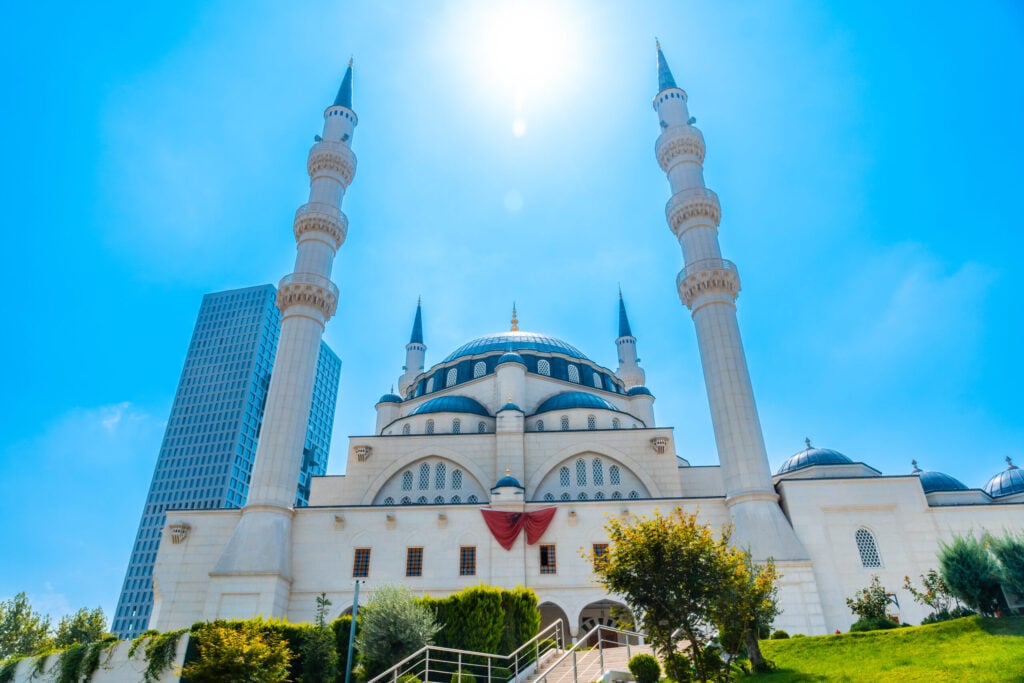
Both Bajrams are public holidays in Albania and Kosovo, and in Albania so are Christmas, Orthodox Easter and Catholic Easter, which tells you how the country handles faith. On Bajram morning, prayers in Tirana and Prishtina draw crowds that spill out of the mosques, and through the day Christian neighbors come to offer greetings. Many mixed families keep both sets of holidays. The Bektashi, whose world center is in Tirana, observe the Bajrams as well as their own feast of Nevruz in March. The line that the faith of Albanians is Albanianism is quoted most often on these days, and with reason. For the background, see our guides to Albanian holidays and the Bektashi.
Bajram Etiquette for Visitors
If you are invited to an Albanian home for Bajram, three customs matter. Arrive with something sweet, a box of baklava or chocolates rather than flowers, and never with alcohol unless you know the family drinks. Greet everyone in the room individually, elders first, with the greeting and the handshake or kiss on both cheeks that the family uses. And accept what is offered: the tray of sweets and the coffee are not optional, and a visit of twenty minutes with a coffee is the standard unit of the day, repeated at house after house. Children will be given money, and it is fine to bring a small note for the children of the house. Dress is smart, as it is for any Albanian occasion. Non-Muslim guests are welcomed as a matter of course, and the greeting Gëzuar Bajramin from a visitor of another faith is received as a real courtesy.
The greeting itself travels well beyond Albania. Albanian is spoken across Kosovo, North Macedonia, Montenegro and the diaspora, so Gëzuar Bajramin will be understood, and appreciated, from Prishtina to Tetovo to the Bronx.
Whatever else you say, say it with a smile and expect a warm answer back.
Related: Religion in Albania.
Frequently Asked Questions
Quick answers about Bajram greetings and customs.
What does Gëzuar Bajramin mean?
Literally “joyful Bajram,” the equivalent of Happy Eid. Gëzuar is the same word used in Gëzuar Krishtlindjet, Happy Christmas, and Gëzuar, Cheers.
How do you reply to Gëzuar Bajramin?
Gëzuar edhe ty, Happy Bajram to you too, or simply Faleminderit, gjithashtu, thank you, likewise.
Is Bajram the same as Eid?
Yes. Bajram is the Albanian and Balkan word, from Turkish bayram, for the two Eids: Fitër Bajrami is Eid al-Fitr and Kurban Bajrami is Eid al-Adha.
Can non-Muslims say Gëzuar Bajramin?
Yes, and in Albania and Kosovo they do. Exchanging religious greetings across faiths is a point of pride in Albanian culture.
What do people eat on Bajram?
Sweets on both: baklava, kadaif, hallvë, trileçe. Lamb on Kurban Bajrami, shared with relatives and the poor.
Is Bajram a holiday in Albania?
Yes. Both Bajrams are official public holidays in Albania. Kosovo observes both Bajrams as public holidays.
Sources
- Wikipedia: Eid al-Fitr
- Wikipedia: Islam in Albania
- Muslim Community of Albania (KMSH): 2026 calendar (PDF, in Albanian)
- Evrensel: Diyanet’s 2027 calendar (in Turkish)
Related: Hello in Albanian: how to greet someone properly
Val also writes a weekly letter on Substack: stories, history and the people behind Albanian businesses, for anyone who loves Albanian culture.
Read it on Substack →
Author: Val Demiri
Valbona is an editor and writer at ALB Connection, where she covers the people, businesses, and culture shaping the Albanian diaspora. A journalism graduate of the University of Iowa, her work spans community profiles, success stories, and features on Albanian life across the US, Europe, and beyond. She is drawn to stories that celebrate Albanian achievement and keep the community connected across borders.