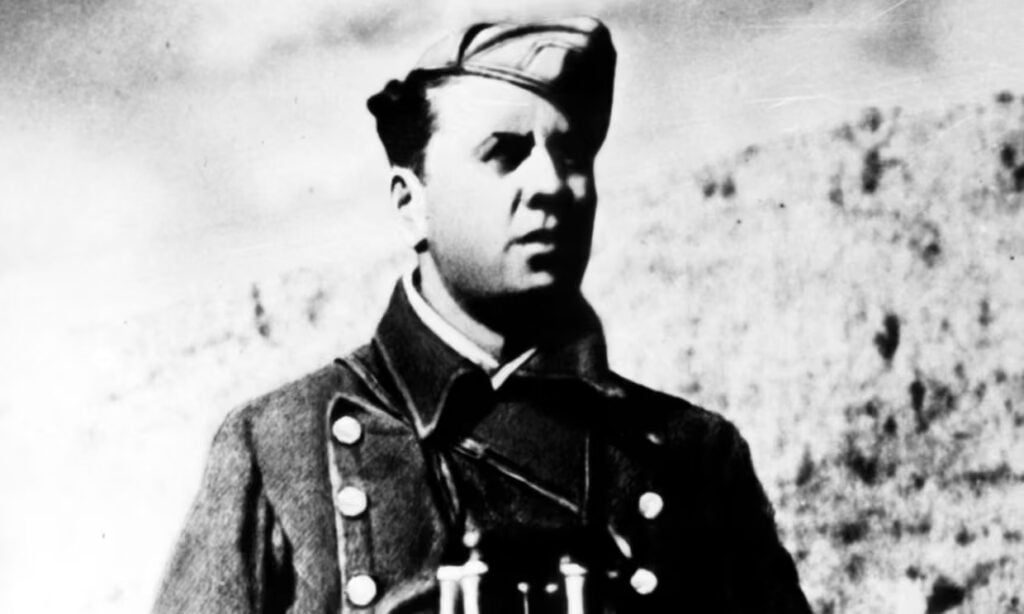
Quick Facts
- Born: October 16, 1908, Gjirokastër, southern Albania
- Died: April 11, 1985, Tirana (aged 76)
- In power: 1944 to 1985 (41 years)
- Position: First Secretary of the Party of Labour of Albania (the de facto top role)
- Ideology: Marxist-Leninist (Stalinist after 1948; Maoist after 1961; Hoxhaist after 1978)
- Major actions: Banned religion (1967), built 173,000 bunkers, broke with USSR (1961) and China (1978), executed and imprisoned tens of thousands
- Estimated deaths under his rule: 5,000 to 10,000 executed; 50,000 to 80,000 imprisoned in labor camps; thousands more died of malnutrition and forced labor
On This Page
- Early Life and the Path to Power
- The Partisan War
- The Three Great Breaks
- The Religion Ban (1967)
- The Bunkers and the Camps
- Daily Life Under Hoxha
- Death and Aftermath
- Why Hoxha Still Matters
- Frequently Asked Questions
Early Life and the Path to Power
Hoxha was born in 1908 in Gjirokastër, the same stone city that produced writer Ismail Kadare and the recently exhumed bones of King Zog (see our pieces on King Zog and famous Albanians). His family was middle-class Muslim Bektashi; his uncle was a prominent Albanian nationalist. He attended secondary school in Gjirokastër and Korçë, then won a scholarship to study in France in the 1930s. In Paris, Hoxha became fluent in French and was radicalized by exposure to French communist circles. He returned to Albania in 1936 and worked as a French teacher in Korçë and Tirana through the late 1930s. When Mussolini’s Italy invaded Albania in April 1939, Hoxha lost his teaching job. He opened a small tobacco shop in Tirana that became a clandestine meeting place for anti-fascist activists. In November 1941, with help from Yugoslav communist representatives, Hoxha founded the Communist Party of Albania. He was 33.The Partisan War, 1941 to 1944
From 1941 to 1944, Hoxha led the communist-dominated National Liberation Movement in guerrilla war against the Italian and (after 1943) German occupiers. The Albanian partisan war was unusual: it was fought without significant Allied support, on extremely difficult terrain, against vastly larger occupying forces. The partisans won. By November 29, 1944, the last German troops withdrew from Shkodër. Hoxha and his communist comrades entered Tirana as liberators. Within months, the communists had eliminated their non-communist resistance partners through a mixture of trials, assassinations, and political pressure. By 1946, Hoxha was unchallenged leader of a one-party state. (More on the various Albanian “independence” dates.)The Three Great Breaks: Yugoslavia, USSR, China
The Break with Yugoslavia (1948)
Initially, Hoxha’s Albania was essentially a Yugoslav client state. Tito was building plans to integrate Albania into a Yugoslav federation. When Stalin broke with Tito in 1948, Hoxha sided with Stalin and purged Yugoslav-loyal officials. From then on, Albania and Yugoslavia were enemies.The Break with the USSR (1961)
When Khrushchev denounced Stalin in 1956 and began “de-Stalinization,” Hoxha refused. He remained a devout Stalinist long after Stalin’s death. By 1961, Hoxha had publicly broken with Moscow, accusing Khrushchev of “revisionism”, a betrayal of true Marxism. Albania was expelled from the Warsaw Pact in 1968. The USSR cut off all aid.The Break with China (1978)
Albania spent the 1960s and 1970s as a Chinese client state, the only European country aligned with Maoist China. When Deng Xiaoping began China’s economic reforms after Mao’s death in 1976, Hoxha denounced this too as revisionism. In 1978, China cut off aid to Albania. Hoxha now believed he ran the only “true” Marxist-Leninist state on Earth. He developed his own ideology, Hoxhaism, which influenced a small number of communist parties globally but had essentially no real-world influence.The Religion Ban, 1967
In 1967, inspired by China’s Cultural Revolution, Hoxha launched a campaign to abolish all religion in Albania. Churches and mosques were closed, destroyed, or converted into warehouses and cinemas. The Albanian constitution of 1976 explicitly declared Albania the world’s first officially atheist state. Religious practice became a criminal offense. Albanian Catholic, Orthodox, Sunni Muslim, and Bektashi clergy were arrested, executed, or sent to labor camps. Holding religious services in private homes was punishable by years in prison. This is one of the most unusual experiments in modern history, the systematic state-led extinction of religion. It mostly failed. When religion was allowed again in 1991, Albanians returned to their traditional faiths almost immediately. But two generations grew up religiously illiterate, and many of the country’s historic religious buildings were lost forever.The Bunkers, the Camps, the Surveillance State
Hoxha was paranoid about invasion, sometimes by NATO, sometimes by Yugoslavia, sometimes by Greece. From the late 1960s onward, he ordered the construction of 173,000 concrete bunkers across Albania. They cover every hilltop, beach, mountain pass, and city square. Many still stand today. The total cost was a major drag on the Albanian economy. The internal security apparatus, the Sigurimi, was modeled on the Soviet KGB and East German Stasi. It penetrated every workplace and family. Estimates suggest one in three or four Albanians was an informant. Sigurimi files from the era show informants reporting on their own parents, spouses, and children. Political prisoners were held in a network of camps and prisons across Albania, the most infamous being Spaç Prison in the northern mountains and the labor camps at Burrel. Tens of thousands died in these facilities through execution, malnutrition, forced labor, or torture.Daily Life Under Hoxha
For ordinary Albanians, life under Hoxha was defined by:- Closed borders. Leaving Albania was essentially impossible for most people. Those who tried were often shot.
- No private cars. Even by the 1980s, only government officials could own private vehicles. Albania had perhaps 5,000 cars total in a country of 3 million.
- State control of media. Foreign broadcasts (especially Italian and Yugoslav TV) were technically illegal but widely watched in secret near the coast.
- State-owned everything. All housing, employment, food distribution, and consumer goods were controlled by the state.
- Chronic shortages. Food rationing was permanent. Coffee, sugar, and meat were luxury items.
- Forced labor brigades. Students, professionals, and ordinary workers were regularly assigned to weeks of agricultural or construction labor.
- Travel restrictions even within Albania. Moving between cities required permits.
Hoxha’s Death and Aftermath
Enver Hoxha died on April 11, 1985, of heart failure after years of declining health. His chosen successor, Ramiz Alia, took over but lacked Hoxha’s ruthless grip. Within six years, the regime collapsed. Mass protests, student strikes, the Albanian embassy migrations in Tirana (when thousands of Albanians stormed Western embassies seeking asylum in 1990), and finally multi-party elections in 1991 ended communist rule in Albania. The transition was chaotic and violent. The 1990s saw economic collapse, the 1997 pyramid scheme crisis, mass emigration to Italy and Greece, and the Kosovo War. Albania today, a NATO member, EU candidate, and tourism destination, is still recovering from the legacy of 47 years of Hoxhaism.Why Hoxha Still Matters
You cannot understand modern Albania without understanding Enver Hoxha. The 47 years of his rule explain:- Why Albania is poorer than its Balkan neighbors despite similar history.
- Why Albanian emigration to Italy, Greece, the U.S., and Germany has been so large since 1991.
- Why Albania has a very young population (huge baby boom in the 1960s to 70s).
- Why Albanian religious life is famously tolerant and intermixed, the religious distinctions Hoxha tried to abolish actually came back blurred and overlapping.
- Why Albania’s tourism infrastructure is still developing, the country was completely closed for 47 years.
- The roots of Albania’s complex relationship with Russia (skeptical), China (skeptical), and the West (mostly positive).
Frequently Asked Questions
Who was Enver Hoxha?
Enver Hoxha was the communist dictator who ruled Albania from 1944 until his death in 1985-41 years. He turned Albania into the most isolated communist state in the world, banned religion, built 173,000 bunkers, and broke alliances with Yugoslavia, the USSR, and China.
How long did Hoxha rule Albania?
41 years, from November 1944 (when the partisans entered Tirana) to his death in April 1985.
Did Hoxha really ban religion?
Yes. In 1967, inspired by China’s Cultural Revolution, Hoxha launched a campaign to abolish all religion in Albania. Churches and mosques were closed or destroyed, religious practice was criminalized, and Albania was declared the world’s first officially atheist state in the 1976 constitution.
Why are there so many bunkers in Albania?
Hoxha was paranoid about invasion (from NATO, Yugoslavia, or Greece). Between roughly 1968 and 1985, his regime built approximately 173,000 small concrete bunkers across Albania. Many still stand today.
How many people died under Hoxha’s regime?
Estimates suggest 5,000 to 10,000 people were executed, 50,000 to 80,000 imprisoned in labor camps, and thousands more died from malnutrition, forced labor, or persecution. Exact figures are still being investigated by Albanian historians.
What happened to Albania after Hoxha died?
His successor Ramiz Alia held on until 1991, when mass protests and the collapse of Eastern European communism forced multi-party elections. The transition to democracy was chaotic; Albania spent the 1990s in economic crisis. The country is now a NATO member and an EU candidate.
Related Reading
- King Zog of Albania: The Self-Crowned Monarch
- When Did Albania Gain Independence?
- Skanderbeg: Albania’s National Hero
- 10 Famous Albanians That Left Their Mark on History
- Where Are Albanian People From?
- Is Albania Safe to Visit Today?

Author: Dardanë Halimi
Dardanë Halimi is a writer and communications professional with an M.A. in Writing, Rhetoric, and Technical Communication from James Madison University. Her work focuses on storytelling, digital content, higher education, and strategic communication, with experience writing for academic, nonprofit, and marketing organizations in both the United States and Kosovo.