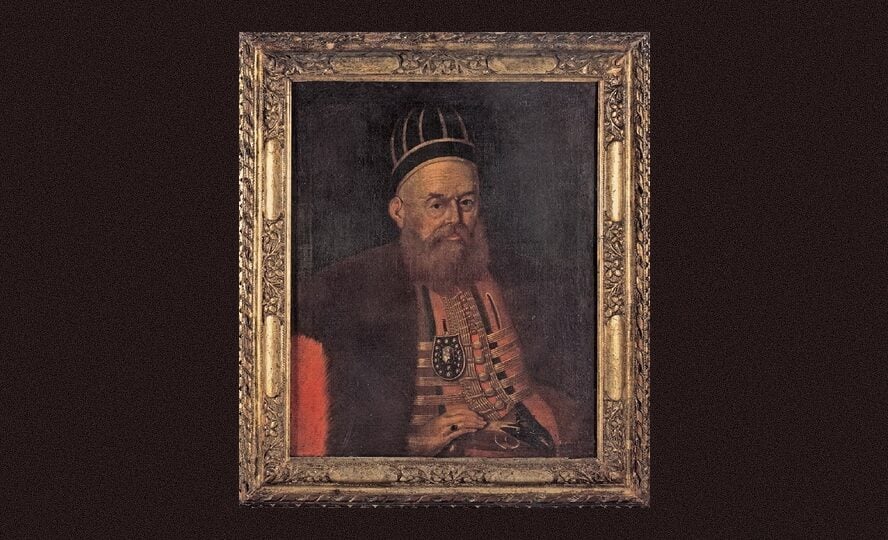

Ali Pasha of Ioannina, known as the Lion of Ioannina, was an Albanian-born Ottoman ruler who carved out a powerful, nearly independent state in the western Balkans around 1800. From his capital at Ioannina, in what is now northwestern Greece, he governed a large territory spanning parts of modern Albania and Greece, ran his own foreign policy, and became one of the most feared and famous figures of the late Ottoman era before the Sultan finally turned against him. This guide covers his rise, his rule, and his dramatic fall.
Who Was Ali Pasha?
Ali Pasha was born around 1740 in Tepelenë, in what is now southern Albania, into a local Albanian family. Rising through the violent world of Ottoman provincial politics, he accumulated power, titles and territory until he ruled a vast domain as pasha, nominally on behalf of the Sultan but in practice as a semi-independent lord. His Albanian origin is part of the long history of the Albanian people covered in where Albanian people come from.
The Rise of the Lion
Ali built his power through a combination of military force, shrewd alliances and ruthlessness. By the early 1800s he controlled Epirus and much of the western Balkans from Ioannina, commanding armies, collecting revenues and maintaining a court that impressed and alarmed European visitors. He became a legend in his own lifetime, admired for his cunning and feared for his cruelty, a strongman who embodied the fragmentation of late Ottoman authority.
A Near-Independent State
What made Ali Pasha remarkable was how far he pushed his autonomy. He conducted his own diplomacy, negotiating directly with Britain, France and Russia during the Napoleonic Wars as if he were a sovereign ruler rather than a provincial governor. His court at Ioannina became a center of power that drew envoys, adventurers and writers. The English poet Lord Byron visited him and wrote about the encounter, spreading Ali’s fame across Europe.
Ali Pasha and the Albanian World
Ali Pasha ruled a mixed population of Albanians, Greeks and others across a region that included Chameria and Epirus. His domain reflected the deep intermixing of peoples in the western Balkans, and his career is part of the broader story of Albanians who rose to great power within the Ottoman system, a tradition that also produced grand viziers and generals. Like the earlier resistance of Skanderbeg, though for very different ends, his career shows the outsized role Albanians played in the region’s history.
The Fall
Ali Pasha’s autonomy eventually became intolerable to the Ottoman Sultan. In 1820 the Sultan moved against him, and after a long siege at Ioannina, Ali was killed in 1822. His severed head was reportedly sent to the capital as proof of his end. His fall came just as the Greek War of Independence was breaking out, and the turmoil he helped create contributed to the conditions for that uprising.
Why Ali Pasha Matters
Ali Pasha is remembered as one of the most powerful and colorful figures of the late Ottoman Balkans, an Albanian who built something close to his own state on the empire’s edge. He remains a significant, if controversial, figure in the histories of both Albania and Greece, a symbol of a turbulent age when central authority was weak and local strongmen could rise to extraordinary heights. For more figures of Albanian history, see famous figures in Albanian history.
Ali Pasha in Dates
| Date | Event |
|---|---|
| About 1740 | Born in Tepelenë in southern Albania into a family of local beys; his father is killed when he is a boy and he begins as a bandit chief |
| 1788 | Appointed Pasha of Ioannina by the Sultan, the base from which he builds his state |
| 1798 | Defeats a French force at Nicopolis near Preveza, taking the town from the French Republic |
| 1803 | After years of war, crushes the Souliotes, the Albanian-speaking Orthodox clans of the Souli mountains |
| 1809 | Lord Byron visits his court at Tepelenë and describes it in Childe Harold’s Pilgrimage |
| 1812 | The massacre at Gardiki, revenge on a village that had wronged his family decades earlier |
| 1819 | Buys the coastal town of Parga from the British, who had held it since 1814 |
| 1820 | Declared a rebel by Sultan Mahmud II; an Ottoman army besieges him in Ioannina |
| January 24, 1822 | Killed on the island in Lake Pamvotis after surrendering; his head is sent to Istanbul |
The Lion’s Fortresses in Albania
| Site | What Ali Pasha built or rebuilt | Today |
|---|---|---|
| Tepelenë | His birthplace and second capital, with a fortress on the bluff above the Vjosa | The walls survive above the town; Byron’s visit is commemorated |
| Gjirokastër Castle | Expanded the fortress and built the aqueduct that supplied it | The largest castle in Albania and a UNESCO site |
| Porto Palermo | A triangular fortress on a peninsula in the bay south of Himarë | Open to visitors; the best preserved of his coastal forts |
| Butrint | Fortified the site and built the castle at the mouth of the Vivari channel | Part of the Butrint National Park |
| Preveza and Ioannina, Greece | His capital’s castle and the fortresses guarding the Ambracian Gulf | Ioannina castle holds his tomb and a museum |
Ali Pasha in Literature
Few Balkan rulers have had a longer life in fiction. Byron’s account of the ageing pasha, courteous and terrifying, receiving him at Tepelenë in 1809 made Ali a European celebrity while he was still alive. Alexandre Dumas built a subplot of The Count of Monte Cristo around his fall: the character Haydée is Ali’s daughter, sold into slavery after his betrayal, and her testimony destroys one of the novel’s villains. Ismail Kadare returned to him in Albanian fiction, and Greek and Albanian folk songs still tell of Kyra Vasiliki, the Greek wife who was with him at the end. The historical verdict is mixed. He was ruthless, treacherous and vengeful, and he also built roads, kept order in a lawless region, and ran a court that Europeans compared to a small kingdom. His revolt of 1820 tied down Ottoman armies at the moment the Greek War of Independence began, which is why Greek historians count a man who slaughtered Souliotes among the accidental founders of their state. For the world he came from, read our guides to Gjirokastër and Butrint, and for the other great Albanian of the Ottoman age, Skanderbeg.
How Albanians Remember Him
In Albania Ali Pasha occupies an odd place: a ruler who was Albanian by birth and language, who governed most of the south for thirty years, and whom the national movement never adopted as a hero. He served the Ottoman order for most of his life, his subjects included as many Greeks as Albanians, and his cruelty fell on both. What Albanian memory keeps is the state builder and the local lord: the roads and forts, the court at Tepelenë that made a mountain town famous across Europe, and the fact that for a generation the strongest man in the western Balkans spoke Albanian. Tepelenë still marks his name, Gjirokastër’s castle still carries his additions, and the Riviera’s most photographed fortress is his. He was, in the end, neither a national hero nor a foreign tyrant but something the region produced often in those centuries, a strongman who ran his own state inside a failing empire until the empire found the strength to remove him.
His Sons and the End of the House
Ali Pasha ruled through his family as much as through his army. His sons Muhtar and Veli were pashas in their own right, Veli governing the Morea and Thessaly and Muhtar commanding in the north, and his grandsons were being groomed for the succession when the Sultan moved against them all. The revolt of 1820 was a family war: the sons surrendered their provinces one by one, were taken to Anatolia, and were executed in 1822 within months of their father. Nothing of the dynasty survived, which is one reason Ali Pasha remains a figure of legend rather than of lineage. The state he built was absorbed back into the empire, and the Greek uprising he had inadvertently helped began to take its territory almost at once.
Frequently Asked Questions
Who was Ali Pasha of Ioannina?
An Albanian-born Ottoman ruler, called the Lion of Ioannina, who built a powerful semi-independent state in the western Balkans around 1800 from his capital at Ioannina.
Was Ali Pasha Albanian?
Yes. He was born around 1740 in Tepelenë, in what is now southern Albania, into a local Albanian family.
Why was Ali Pasha famous?
For his near-independent rule, his own diplomacy with the European powers during the Napoleonic Wars, and his fearsome reputation, which spread across Europe partly through Lord Byron’s writing.
How did Ali Pasha die?
The Ottoman Sultan moved against him for his excessive autonomy, and he was killed in 1822 after a long siege at Ioannina.
Learn More
Continue with Chameria and the Cham Albanians, Skanderbeg, and famous figures in Albanian history.
Sources
- Ali Pasha Tepelena (Encyclopaedia Britannica)
- Ali Pasha of Ioannina (Wikipedia)
- Wikipedia: Ali Pasha of Ioannina
- Wikipedia: Souliotes

Author: Dardanë Halimi
Dardanë Halimi is a writer and communications professional with an M.A. in Writing, Rhetoric, and Technical Communication from James Madison University. Her work focuses on storytelling, digital content, higher education, and strategic communication, with experience writing for academic, nonprofit, and marketing organizations in both the United States and Kosovo.