
- Name: Blue Eye; in Albanian Syri i Kaltër (“the blue eye”).
- Location: near Muzinë, opposite the village of Krongj, at the western foot of the Mali i Gjerë ridge, beside the Sarandë-Delvinë-Gjirokastër road; 18 to 22 km from Sarandë depending on the source.
- Type: karst spring, the largest of 18 springs at the foot of Mali i Gjerë.
- Flow: the main vent averages 6 m³ (6,000 litres) per second; all the springs together average about 18 m³ per second (17.7 m³/s per AKZM; 18,182 L/s per Eftimi and Malik, 2019).
- Depth: up to about 45 m according to the protected-areas agency; travel guides report divers going past 50 m without reaching the bottom.
- Size: about 10 m across.
- Protection: natural park (Category IV), 293.3 hectares, since January 2022.
- Access: no cars inside the park; about 2 to 2.5 km on foot from the parking, or the tourist train (300 lek when it started in 2024).
- Fees: 50 lek per person (the national tariff for visitors to managed protected parks); parking 300 lek for up to 3 hours according to a 2025 price list from Love Albania (no official source found); cash only.
- Swimming: forbidden in the spring.
- Best time: April to October; arrive early in July and August.
Where the Blue Eye Is
The Blue Eye is in Vlorë County in southern Albania, near the village of Muzinë and opposite the village of Krongj, at the western foot of the Mali i Gjerë ridge, about 70 to 100 m above sea level (AKZM). It sits beside the national road that runs from Sarandë via Delvinë to Gjirokastër. Distances vary by source: Albania’s National Tourism Agency gives about 18 km from Sarandë, while Lonely Planet and driving guides give about 22 km by road. This guide uses 18 to 22 km. Getting there:- From Sarandë: 18 to 22 km depending on the source; Love Albania estimates a 35 to 40 minute drive (Love Albania, updated May 2026).
- From Gjirokastër: about 37 km, roughly 45 to 50 minutes by car (Love Albania, updated May 2026).
- From Tirana: ~4 to 4.5 hours by car via Fier and Gjirokastër.
- By tour: half-day and full-day tours from Sarandë widely available.
- By bus: buses between Sarandë and Gjirokastër can drop you at the turn-off, then it is a walk of about 3 km (Lonely Planet). Not ideal in summer heat.
What the Blue Eye Actually Is
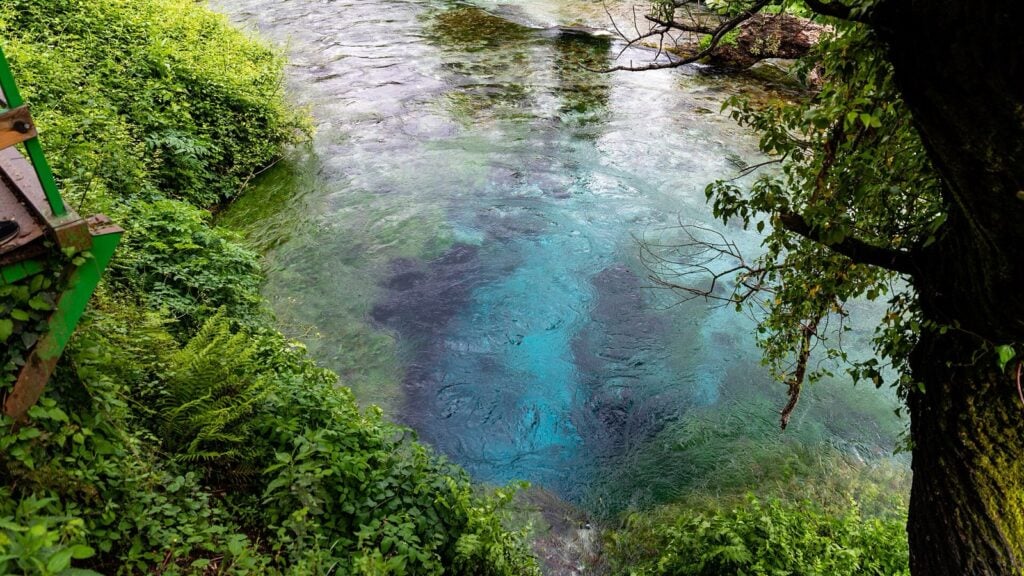
Syri i Kaltër is a karst spring: rain falling on the eastern slope of the Mali i Gjerë ridge soaks into the limestone, travels underground and comes back to the surface here (AKZM). It is the largest of 18 karst springs that rise at the foot of the Mali i Gjerë ridge (AKZM). AKZM gives the main vent’s average annual flow as 6 m³ per second, about 6,000 litres every second (AKZM). Measured as a whole, the Blue Eye spring system that feeds the Bistrica averages 18,182 litres per second and is used to generate electricity (Eftimi and Malik, Hydrogeology Journal, 2019); AKZM gives 17.7 m³ per second for all the springs together (AKZM). AKZM gives the depth of the vent as up to about 45 m (AKZM), and the tourism agency says the water rises from more than 45 m down (Albania’s National Tourism Agency). Travel guides report that divers have gone past 50 m without finding the bottom (Love Albania, updated May 2026). We found no published survey of the full depth, so treat any exact figure with caution. The colour follows the depth: the deep vent in the centre looks dark blue and the shallower water around it looks paler. AKZM says the spring got its name because its oval shape resembles an eye, “a large round eye” about ten metres across (AKZM). The Bistrica River begins here (AKZM). The spring water flows into the reservoir of the Bistrica hydropower plant (AKZM) and is used to generate electricity (Eftimi and Malik, 2019).What to Expect on a Visit
Entry and Facilities
Entry is 50 lek per person. That is the national tariff for visitors on foot or by bicycle entering managed protected parks through controlled access points (Council of Ministers decision no. 1156 of 2020, amended 2023), and Love Albania’s 2025 price list gives the same figure. The same list gives car parking as 300 lek for up to three hours (Love Albania, 2025 price list); we found no official source for the parking charge. Pay in cash, in lek, and check at the gate. In 2023 the park received 192,000 visitors (Shqiptarja, 2024). Facilities include:- A parking area about 2 to 2.5 km from the spring (no cars inside the park)
- Paved walkways and lighting, part of a 2022 upgrade by the Ministry of Tourism
- A small tourist train between the parking and the spring (300 lek in 2024)
- Two eateries near the spring; Lonely Planet also mentions cabins nearby
- Viewpoints at the edge of the spring
Viewing the Spring
You look into the pool from viewpoints at its edge. Looking down into the centre, the deep blue is at its most striking; around the shallower edges the water is clear and pale. The best colors are in bright direct sunlight, ideally midday to early afternoon. Cloudy days make the blue significantly less vivid.Swimming
Swimming in the Blue Eye is forbidden (Lonely Planet). The water is cold (AKZM) and wells up from a deep vent, so please respect the rule.Photography
The best photos come from directly above the spring in bright direct sunlight. A polarizing filter can dramatically enhance the color contrast in photos, cutting through surface reflections to reveal the depths. Drone photography from above shows the spring’s circular shape most dramatically, but drone rules should be checked in advance, regulations have changed periodically.What Else Is Nearby
The Blue Eye is on a natural travel corridor between Sarandë and Gjirokastër, so combining it with other stops is easy:- Sarandë, the main town at the southern end of the Albanian Riviera, with beaches, restaurants, and ferry connections to Corfu
- Ksamil, the beach village just south of Sarandë
- Butrint National Park, a UNESCO World Heritage archaeological site south of Sarandë
- Gjirokastër, the UNESCO-listed stone city about 37 km away by road (Love Albania, updated May 2026)
- Lekursi Castle, historic Ottoman-era fortress with panoramic views above Sarandë
When to Visit
- Spring (April to May): mild weather, moderate crowds, lush green surroundings. Water level is high after winter rain.
- Early summer (June): warmer weather, longer daylight, before peak tourist season.
- Peak summer (July to August): hot and crowded. Very busy on weekends. Best visited early morning to avoid tour buses.
- Autumn (September to October): warm, generally uncrowded, excellent light for photography.
- Winter (November to March): quieter and cooler; the spring itself remains dramatic year-round, and Love Albania (May 2026) lists the park as open daily, year-round, 08:00 to 20:00; check before you go (Love Albania, updated May 2026).
The Cold Water Reality
One detail worth knowing before you go: the water is cold. AKZM describes it as cold and crystal clear (AKZM). We found no official temperature figure, so we do not give one, but expect it to feel icy on a hot summer day. This means:- The area near the spring is noticeably cooler than the surrounding forest
- Bring a light layer even in hot weather if you plan to stay near the spring
The Two Blue Eyes: Don’t Confuse Them
There are actually two Blue Eyes in Albania, though the term usually refers to the more famous southern one:- Blue Eye of Sarandë / Muzinë, the famous karst spring described in this guide, in Vlorë County, southern Albania
- Blue Eye of Theth, a different pool near Theth in the northern Albanian Alps, reached on foot. See our Theth guide.
Practical Tips
- Bring cash, the entry fee is small but usually paid in cash (Albanian lek).
- Arrive early or late, midday is peak sunlight for colors but also peak crowds. Early morning or late afternoon gives you quieter moments.
- Wear comfortable shoes: it is about 2 to 2.5 km on foot from the parking to the spring, and the same back.
- Bring water, especially in summer; the walk in is about 2 to 2.5 km.
- Camera settings, polarizer for reducing reflection, low ISO for the bright water. Bracket exposures if the sunlight is intense.
- Time your visit: allow 30-60 minutes at the spring itself, plus the walk of about 2 to 2.5 km each way and travel. It works well as part of a half-day itinerary.
- Respect the site: it is a protected natural park. No litter, no swimming in the spring, and check drone rules before flying.
Frequently Asked Questions
What is the Blue Eye of Albania?
The Blue Eye (Syri i Kaltër in Albanian) is a karst spring near the village of Muzinë in southern Albania, about 18 to 22 km from Sarandë depending on the source. Water rises from a vent up to about 45 m deep into an oval pool about 10 m across, deep blue in the centre and paler at the edges. The main vent averages 6 m³ per second. It is the source of the Bistrica River and the centre of a protected natural park.
How deep is the Blue Eye?
Albania’s protected-areas agency (AKZM) gives the depth as up to about 45 m, and the national tourism agency says the water comes from more than 45 m down. Travel guides report that divers have gone past 50 m without reaching the bottom, so the full depth of the underground channel is not known.
Can you swim in the Blue Eye?
No. Swimming in the spring is forbidden (Lonely Planet). The water is cold and rises from a deep vent.
How do I get to the Blue Eye?
By car from Sarandë (about 18 to 22 km, depending on the source) or Gjirokastër (about 37 km) on the national road between them. Cars are not allowed inside the park: you park about 2 to 2.5 km from the spring and walk, or take the tourist train. Buses between Sarandë and Gjirokastër can drop you at the turn-off, about 3 km from the spring. Tours from Sarandë are widely available.
What’s the entry fee for the Blue Eye?
Entry is 50 lek per person, the national tariff for visitors to managed protected parks (Council of Ministers decision no. 1156 of 2020, amended 2023). Love Albania’s 2025 price list gives car parking as 300 lek for up to 3 hours; we found no official source for that. The tourist train costs extra (300 lek in 2024). Pay in cash and check at the gate.
When is the best time to visit?
April to October is the main season. Midday to early afternoon offers the most intense colors under direct sunlight. July and August are the most crowded; June and September offer better balance of weather and space. Cloudy days make the blue significantly less vivid.
How long should I plan to spend at the Blue Eye?
Allow 30-60 minutes at the spring plus the walk of about 2 to 2.5 km each way, and more if you stop to eat. It works well as part of a half-day itinerary from Sarandë or Gjirokastër.
Is the Blue Eye the same as the Blue Eye in Theth?
No, there are two Blue Eyes in Albania. The well-known one is in the south, near Sarandë. There is also a smaller, less visited Blue Eye near Theth in the northern Albanian Alps, reached on foot. They are different sites.
Where is the Blue Eye in Albania?
In southern Albania, near the village of Muzinë in Vlorë County, beside the road from Sarandë to Gjirokastër. It is about 18 to 22 km from Sarandë, depending on the source, and about 37 km from Gjirokastër by road.
What does Syri i Kaltër mean?
“The blue eye.” AKZM says the spring got its name because its oval shape, about ten metres across, resembles an eye. In searches it is often written without the Albanian letter ë, as “syri kalter.”
Is the Blue Eye open all year?
Love Albania (May 2026) lists the park as open daily, year-round, from 08:00 to 20:00. We found no official timetable, so check before you go.
Related Reading
- The Albanian Riviera: Complete Travel Guide
- Gjirokastër, Albania: Stone City & UNESCO Guide
- Theth: The Ultimate Guide to the Albanian Alps Village
- Valbona Valley: Complete Travel Guide
- Is Albania Safe to Visit?
- Butrint National Park: Where Greeks, Romans, and Byzantines Met
- Sarandë, Albania: Travel Guide
- Ksamil, Albania: Complete Travel Guide
Sources
- Parku Natyror “Syri i Kaltër” – AKZM, National Agency of Protected Areas
- Monument Natyre, Syri i Kaltër – AKZM (28 September 2022)
- Decision no. 60 of 26 January 2022 (natural parks, Category IV) – AKZM / Council of Ministers
- Syri i Kaltër – AKT, National Tourism Agency of Albania
- Assessment of regional flow type … of the Selita and Blue Eye karst springs, Albania – Eftimi and Malik, Hydrogeology Journal, 2019
- Blue Eye Spring – Lonely Planet
- Përfundon investimi, Syri i Kaltër bëhet me pedonale – Shqiptarja.com, 16 April 2022
- Në Syrin e Kaltër tren për të moshuarit e fëmijët – Shqiptarja.com, 29 April 2024
- Decision no. 1156 of 24 December 2020 on protected-area tariffs (amended by decision no. 339 of 31 May 2023) – Council of Ministers, published by AKZM (entry fee, point 6a)
- Blue Eye Saranda: complete guide – Love Albania, updated 8 May 2026; fee table dated 2025 (parking, hours, drive times, dive report)

Author: Dardanë Halimi
Dardanë Halimi is a writer and communications professional with an M.A. in Writing, Rhetoric, and Technical Communication from James Madison University. Her work focuses on storytelling, digital content, higher education, and strategic communication, with experience writing for academic, nonprofit, and marketing organizations in both the United States and Kosovo.