
Pyrrhus of Epirus was the king of an ancient land that spanned what is today southern Albania and northwestern Greece, and one of the most feared commanders of the Hellenistic age. He lived from about 319 to 272 BC and was considered by later generals, including Hannibal, to be among the greatest tacticians who ever lived. He is best remembered today for a phrase that outlived his kingdom: the “Pyrrhic victory,” a win so costly it amounts to a defeat.
This guide covers who Pyrrhus was, the land he ruled, his wars against Rome, why his name became a byword for ruinous success, and where he sits in the long history of the region.
Who Was Pyrrhus of Epirus?
Pyrrhus was a member of the Aeacid dynasty and a second cousin of Alexander the Great. He became king of the Molossians, the leading tribe of Epirus, as a young man, lost his throne, regained it, and spent his life waging ambitious campaigns across the Mediterranean: in Italy, Sicily, Macedonia and Greece. He was a restless, brilliant and ultimately overextended commander, admired for his skill on the battlefield and criticized for never consolidating what he won.
Where Was Epirus?
Epirus was a region of the western Balkans facing the Ionian Sea, covering parts of what are now southern Albania and northwestern Greece. Its people, the Epirotes, spoke a Greek dialect and lived alongside and among Illyrian tribes to the north. This borderland position, between the Greek world and the Illyrian one, is why Epirus features in the heritage stories of more than one modern nation. For the wider Illyrian context of the region see our guide to the Illyrian tribes and to nga vijnë shqiptarët.
Is Pyrrhus Albanian or Greek?
Historically, Pyrrhus was a Greek Hellenistic king: the Molossians spoke Greek and belonged to the Greek cultural world of the era. At the same time, his kingdom physically covered land that is now part of southern Albania, which is why he appears in regional heritage narratives on both sides of the modern border. The accurate statement is this: Pyrrhus ruled a land that spans two modern countries, and claims that reduce him to a single modern nationality read a much later idea of ethnicity back onto the ancient world. Getting that distinction right is exactly the kind of history worth being precise about.
The Wars Against Rome
Pyrrhus is most famous for the war he fought against the rising Roman Republic between 280 and 275 BC. Invited by the Greek city of Tarentum in southern Italy to help against Rome, he crossed the Adriatic with a large army and a corps of war elephants, animals the Romans had never faced.
The Battle of Heraclea, 280 BC
Pyrrhus won, in large part thanks to the shock of his elephants, but at a heavy cost in his best troops.
The Battle of Asculum, 279 BC
He won again, and again lost many of his most experienced men and officers. It was after this battle that, according to the historian Plutarch, Pyrrhus is said to have remarked that one more such victory would undo him.
The Pyrrhic Victory
That remark gave the world the term “Pyrrhic victory,” a success won at such crippling cost that it is effectively a defeat. The phrase is still in everyday use more than two thousand years later, in politics, business and sport. It endures because it captures a permanent truth about winning: that the price of a victory can be higher than its value.
Sicily, Macedonia and the End
Pyrrhus left Italy for Sicily, where he fought Carthage with early success before his allies turned against him. He returned to Italy, was checked by Rome, and went home to Epirus with his ambitions in the west spent. He then campaigned in Macedonia and Greece. In 272 BC, fighting in the streets of the city of Argos, he was killed, according to tradition struck by a roof tile thrown by an old woman, an unglamorous end for one of the age’s great soldiers.
Why Pyrrhus Still Matters
Pyrrhus is remembered for three reasons. He was a military innovator whom later commanders studied. He gave language a phrase that never went out of use. And he is a lasting example of a leader whose brilliance in battle was undone by a failure to secure the peace. For the region he ruled, he is also a reminder of how deep and layered the history of the western Balkans is, a history that runs from the Illyrians and Epirotes through figures like Mbretëresha Teuta and, much later, Skënderbeu.
Pyrrhus’s Life and Campaigns at a Glance
| Data | Ngjarje |
|---|---|
| 319 BC | Born into the Aeacid royal house of Epirus, which claimed descent from Achilles |
| 307 BC | Placed on the throne of Epirus as a boy, protected by the Illyrian king Glaucias, who had raised him at his court |
| 302 BC | Driven out; serves under Demetrius and Antigonus, then lives as a hostage in Ptolemy’s Egypt |
| 297 BC | Returns to Epirus with Ptolemy’s backing and secures the throne |
| 280 BC | Crosses to Italy with about 25,000 men and 20 war elephants at the invitation of Tarentum; defeats Rome at Heraclea |
| 279 BC | Wins again at Asculum, at a cost that gives the world the phrase Pyrrhic victory |
| 278 to 276 BC | Campaigns in Sicily against Carthage; nearly takes the whole island, then loses the Greek cities’ support |
| 275 BC | Fights Rome at Beneventum; inconclusive, but he abandons Italy |
| 274 BC | Seizes the throne of Macedon |
| 272 BC | Killed in street fighting in Argos, reportedly struck by a roof tile thrown by a woman |
Pyrrhus in Today’s Albania
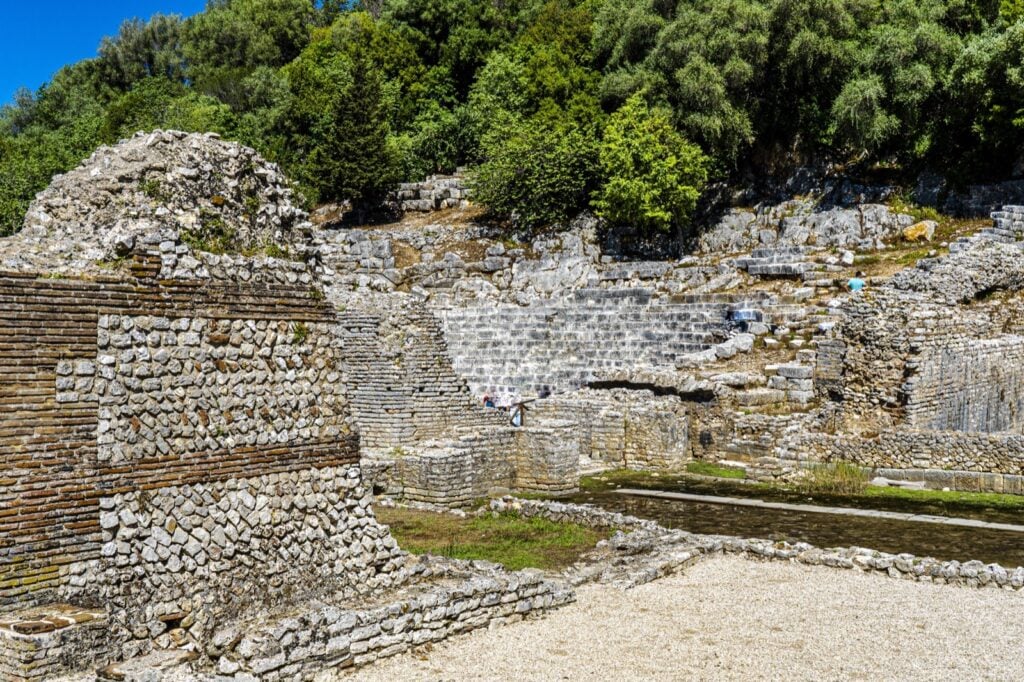
Epirus straddled the modern border, and several of its most important places are in southern Albania. Butrint, the walled city on the strait facing Corfu, was a major Epirote town in his time and is now a UNESCO World Heritage Site. Phoenice, modern Finiq near Sarandë, served as a capital of the Epirote League after the monarchy ended. Antigonea, in the Drino valley near Gjirokastër, was founded by Pyrrhus himself and named for his first wife Antigone; its ruins were identified only in the 1960s. And Pyrrhus’s own childhood was spent at the court of Glaucias of the Taulantii, the Illyrian king whose lands lay around present-day Durrës. Travelers can visit all of these sites; see the guides to Butrinti dhe Gjirokastër.
How the Ancients Rated Him
Hannibal, asked by Scipio to name the greatest generals, put Pyrrhus at the top: first of all in Plutarch’s account, and second only to Alexander in Livy’s, ahead of Hannibal himself, for his skill at choosing ground and laying out a camp. Plutarch’s Life of Pyrrhus, our fullest source, admires the soldier and faults the man: brilliant in battle, restless and easily bored between wars, always chasing the next kingdom instead of holding the last. The Romans, for their part, remembered him as the first foreign king to bring war elephants against them, and the war became a founding story of Roman resilience. For the world he came from, read the rulers of Illyria dhe fiset ilire.
One footnote belongs to Pyrrhus alone: his twenty elephants at Heraclea were the first the Romans had ever seen, and they called them Lucanian oxen after the region where they met them. The panic they caused in the Roman cavalry won the battle, and Rome spent the next century learning to fight them.
He lost the war and won the language, which is a kind of immortality.
Every Pyrrhic victory since has carried his name.
Few defeated kings have done as well.
Pyetje të shpeshta
Who was Pyrrhus of Epirus?
He was a Hellenistic Greek king of Epirus, a land spanning modern southern Albania and northwestern Greece, who lived from about 319 to 272 BC and was one of the ancient world’s greatest generals.
What is a Pyrrhic victory?
A Pyrrhic victory is a win achieved at such heavy cost that it is as damaging as a defeat. The term comes from Pyrrhus’s costly victories over Rome.
Was Pyrrhus Albanian?
Pyrrhus was a Greek king by culture and language, but his kingdom of Epirus covered land now in southern Albania, so he features in the regional heritage of both countries. He predates the modern idea of Albanian or Greek nationality.
Who defeated Pyrrhus?
Rome contained him in Italy, and he was later killed in 272 BC during street fighting in Argos, in Greece.
How is Pyrrhus connected to Alexander the Great?
Pyrrhus was a second cousin of Alexander the Great through the royal houses of Epirus and Macedon.
Explore More Albanian and Balkan History
Continue with our guides to fiset ilire, Mbretëresha Teuta dhe figura të famshme në historinë e Shqipërisë. Planning to see the region for yourself? Start with the vendet më të mira për t'u vizituar në Shqipëri.
Burimet
- Plutarch, Life of Pyrrhus (LacusCurtius, University of Chicago)
- Pyrrhus, king of Epirus (Encyclopaedia Britannica)
- Pyrrhus of Epirus (Wikipedia)
- Encyclopaedia Britannica: Pyrrhus, king of Epirus

Autor: Val Demiri
Valbona është redaktore dhe shkrimtare në ALB Connection, ku ajo mbulon njerëzit, bizneset dhe kulturën që formësojnë diasporën shqiptare. E diplomuar në gazetari në Universitetin e Ajovës, puna e saj përfshin profile të komunitetit, histori suksesi dhe reportazhe mbi jetën shqiptare në të gjithë SHBA-në, Evropën dhe më gjerë. Ajo tërhiqet nga historitë që festojnë arritjet e shqiptarëve dhe e mbajnë komunitetin të lidhur përtej kufijve.