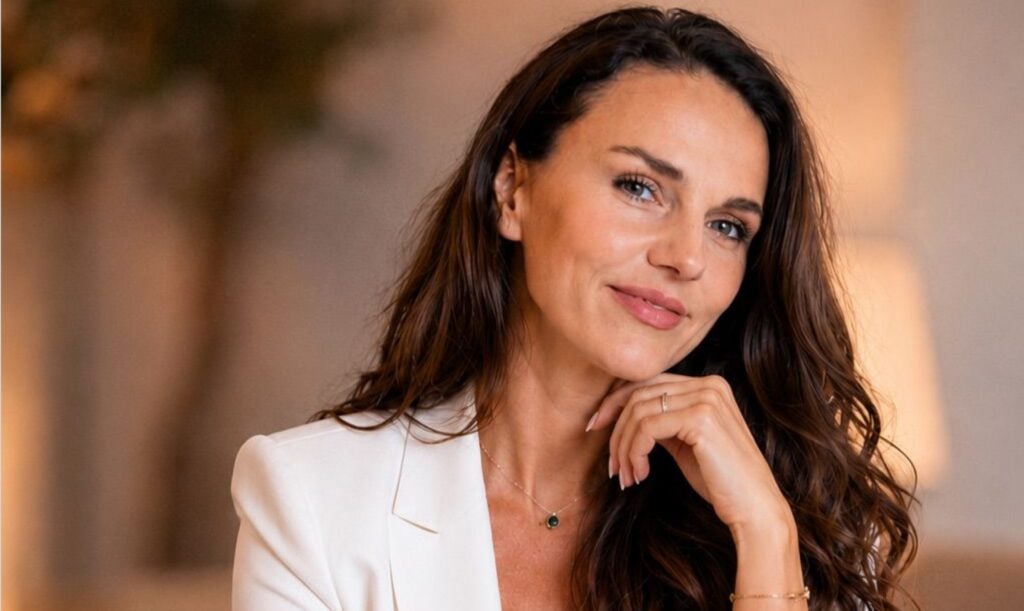
For more than a decade, Saranda Dervisholli worked in human resources, building a career in a performance-driven corporate environment. She took on responsibility, worked hard, and focused on achieving more. But over time, her own health became something she kept putting aside.
Today, she is the founder of MindandMovement, a Zurich-based practice supporting ambitious professional women who are used to performing at a high level but are increasingly struggling with their energy and health.
A state-certified Health Coach and Nutrient Therapist specialising in integrative diagnostics and nutrient medicine, Saranda combines laboratory diagnostics with nutrition, nervous system regulation, sleep optimisation, and strength training. She founded MindandMovement in 2021, following her own experience of burnout and a recovery that took more than two years.
Her work now focuses on helping women understand what may be affecting their health, regain their energy, and continue pursuing their ambitions without sacrificing their well-being.
Key takeaways
- Saranda Dervisholli founded MindandMovement in 2021 after her own experience with burnout.
- After more than a decade in HR, she shifted to health coaching and integrative diagnostics.
- She helps ambitious women better understand their health, energy, and hormonal concerns.
- Her Albanian background shapes her commitment to changing generational patterns around women’s health.
- She plans to grow MindandMovement through a team, in-person events, workshops, and retreats.
From Prishtina to Germany and Switzerland
Saranda was born in Prishtina and moved to Germany with her parents when she was five years old. Growing up as a child of the diaspora shaped how she approached work and responsibility.
“More than 30 years ago, adapting to a new country and culture was a very different experience from today,” she says. “There was a strong feeling that you had to fit in and prove yourself.”
She says that experience shaped her deeply.
“I learned early on to adapt – other culture, system and expectations, to take responsibility and to work very hard.”
After spending years in human resources, Saranda moved to Switzerland about six years ago because her partner was already living there. Switzerland became her new home and the place where she built MindandMovement.
Her professional path, however, had begun long before the practice existed. She spent many years working in a corporate environment, where performance and achievement were central to her career.
“As a woman with a migration background, I often felt I had to prove myself even more – in business life but also in private life,” she says.
She put her career and other people first, while her own needs and health often ended up at the bottom of the list.
The experience that changed her direction
Saranda’s decision to establish MindandMovement did not come simply from wanting a different career.
“My own burnout was my biggest lesson and the biggest wake-up call of my life,” she says.
It was not something that happened overnight. She describes a period of many months in which she kept going until she was completely exhausted.
“The turning point came when I finally understood that I could not go on like this, and that I no longer had the strength for anything.”
Her complete recovery took more than two years.
One of the most important lessons she took from that experience was that burnout often has signals that come before a person reaches that point. But when someone is used to performing, taking responsibility, and getting things done, it can become easy to ignore those signals.
“When you are used to performing, taking responsibility and getting things done, you become very good at ignoring your limits, pushing yourself out of your capacity and ignoring your body’s signals,” she says.
She recognises a similar pattern in many of the women who now come to her for support. They carry responsibility at work and at home, expect a great deal of themselves, and are used to functioning for the people around them.
Eventually, they may reach a point where their energy is gone and the strategies that once worked no longer do.
Her own experience changed how she thinks about success and health.
“No success in the world is worth losing your health for.”
Looking beyond the symptoms
Moving from traditional human resources into holistic health coaching also meant developing new expertise and explaining a different approach to potential clients.
Saranda is a state-certified Health Coach, a nutritional counsellor, and a Nutrient Therapist specialising in integrative diagnostics and nutrient medicine. She has also completed further training in laboratory analysis, hormonal health, gut health, and metabolic health.
She says one of the hardest parts of starting out was explaining why laboratory diagnostics could be part of health coaching.
“Blood values and hormone status were something they associated exclusively with a doctor,” she says of people’s initial reactions.
Her approach is based on looking at the broader picture. Depending on an individual’s situation, this can include examining micronutrients, hormones, thyroid function, metabolism, and gut health.
For Saranda, the aim is not to collect as many test results as possible. It is to understand the individual situation and identify possible causes and connections.
“Every woman’s picture is different, which is why there is no one-size-fits-all programme,” she says.
She is also clear about the boundaries of her work. Her coaching does not replace medical diagnosis or treatment. When findings require medical clarification or treatment, she refers clients to their doctors and believes in working with physicians where appropriate.
She sees her role as looking at the bigger picture, identifying areas that may need attention, and supporting women in making changes while ensuring that anything requiring medical care is handled medically.
What women deserve to understand about their health
Saranda believes there is still a significant need for education and awareness around women’s hormonal and metabolic health, particularly for women over 30.
“There are a few things I wish every woman knew,” she says.
One is that constant exhaustion, PMS, cycle problems, or hormonal weight changes should not automatically be dismissed as something a woman simply has to accept, or is just related to stress or age – it isnt!
She also wants women to know more about perimenopause. Although it is a natural phase of life, she says there are ways to support the body through it, including nutrition, nutrients, sleep, stress regulation, and strength training.
Another point she raises is the difference between a laboratory value falling within a reference range and whether someone is adequately supplied with a particular nutrient. She pays particular attention to where a value sits within the range when assessing nutrient status.
She also emphasises the connections between different bodily systems.
“Nutrients, thyroid function, sex hormones, stress hormones, metabolism and gut health are closely interconnected,” she says.
In her view, symptoms such as exhaustion, poor sleep, weight changes, or changes in the menstrual cycle rarely have just one cause.
She also challenges the assumption that the answer is always more discipline.
Many women respond to feeling unwell by pushing harder, eating less, exercising more, or adding another supplement. Saranda believes the first step should instead be understanding what may be happening in the body.
“I don’t think women should settle for ‘That’s just your age’ or ‘That’s just stress.’ They deserve to understand why their body is responding the way it is.”
When ambition leaves little room for health
Saranda mainly works with ambitious women aged 30 to 45, including professionals, executives, entrepreneurs, and mothers. Many are based in Switzerland and Germany, although she also works with international clients, including English-speaking women.
She describes her clients as women who have often achieved a great deal but find that their energy and health are no longer keeping up with the lives they lead.
Some experience hormonal or cycle-related complaints, sleep difficulties, exhaustion, or trouble concentrating. Others say they no longer feel like themselves, even after being told that their results are normal.
“I see women who are incredibly strong and resilient,” she says. “But many of them have become very good at taking care of everything and everyone except themselves.”
She notes that many have already tried different approaches, including supplements, intermittent fasting, more exercise, and going to bed earlier, without feeling better.
Her point is not that these women need to try harder.
“My clients don’t need someone to tell them to try harder. They already do.”
Instead, she wants to help them understand what is happening and where meaningful change might begin.
“Because no woman should have to choose between her career and her health.”
What working with MindandMovement looks like
Saranda usually works with clients over four to six months, giving them time to understand their individual situation and work through changes step by step.
The process begins with a detailed case history. She asks about lifestyle, nutrition, sleep, stress, the menstrual cycle, daily routines, and other factors that may be affecting a woman’s health.
Depending on the individual situation, laboratory diagnostics may be used to examine areas such as micronutrients, hormones, or gut health.
From there, Saranda develops an individual strategy. This can include nutrition, targeted nutrient therapy, nervous system regulation, sleep, and strength training.
The approach is tailored to each woman rather than following a single programme for everyone.
The goal is to help clients regain their energy, understand their bodies, and perform at their best without sacrificing their health.
There is also a community element to the coaching, which Saranda says has become an important part of MindandMovement.
Bringing women’s health into the Albanian community
Alongside her work with individual clients, Saranda is increasingly invited to speak at events, conferences, and workshops. She also organises her own events.
Being able to speak about health, women’s health, and a healthy lifestyle within the Albanian community is particularly meaningful to her because of her own roots.
“For me, these events are also about connection,” she says.
“Health is not only an individual topic. When one woman starts changing the way she looks at herself and her health, it often influences the people around her as well.”
Her Albanian background also shapes how she thinks about the expectations many women carry.
“I strongly believe that we learn through role models,” she says.
She points to a pattern she has seen across generations in many Albanian families, where women are taught to put others first.
“Our grandmothers did it, our mothers did it, and many of us have continued that pattern without ever questioning it.”
Family, children, and work can take priority until little is left for the woman herself.
Saranda wants to help change that pattern. For her, taking care of one’s health does not mean becoming less committed to family or work.
“Taking care of yourself is not selfish. When you are healthy and have energy, you can be there for your family, your children and your work in a completely different way.”
She describes the issue as one of balance rather than ambition itself.
“For me, this is not about becoming less ambitious. It is about not sacrificing your health for your ambition.”
Making conversations about women’s health easier
Saranda says she is seeing changes in how Albanian women approach their health.
“I work with many Albanian women today, and I can see that things are changing,” she says. “Women are asking more questions, they are more aware, taking their health more seriously and becoming more open about topics that were rarely discussed in previous generations.”
She also hears from women who make changes for themselves and then find that other members of their families begin asking questions.
“What I find particularly powerful is how quickly this spreads within families,” she says. “A woman makes changes for herself, and suddenly her mother, sister, daughter or friends start asking questions too.”
For women who are curious about their health but hesitant to take the first step, her advice is to begin by paying attention to their symptoms and asking the right questions and doing the right lab tests.
She also wants women to challenge the idea that hormonal problems are simply something they must accept.
“We need to break the stigma, that it’s just an ‘hormonal – age or stress – problem’ and accept it, there is a lot you can change for better.”
For Saranda, change can begin with one woman doing something differently and other women seeing that it is possible for them too.
Choosing a different career path
Saranda’s own decision to leave a stable corporate career is also part of the experience she draws on when speaking to women who want to build something of their own.
She remembers that when she changed direction, very few people understood her decision.
Before MindandMovement became successful, she worked as a fitness instructor for 15 euros per session after leaving a well-paid human resources job in the pharmaceutical industry.
Her advice to women considering a similar change is to believe in themselves, even when others do not immediately understand their plans – your why matters!
She also encourages them to think carefully about the people they surround themselves with.
“The people around you influence the way you think, the decisions you make and what you believe is possible,” she says.
She recommends spending time with people who have already taken a different path, who can offer inspiration and support, and who demonstrate that there is more than one way to build a successful life.
“And don’t wait for the perfect moment – it does not come. You create along the way.
Building toward the future
Over the next few years, Saranda wants to establish MindandMovement as a leading health brand for ambitious women from the business world who want to protect their health and energy rather than sacrifice them.
She plans to continue developing her expertise in integrative diagnostics and wants to build a team around the practice.
She also wants to bring women together beyond online coaching through more in-person events, workshops, and retreats, while continuing to develop the MindandMovement community.
Her plans reflect the importance she places on both individual support and bringing women together.
“If you wanna go fast if you go alone, if you wanna go far, go together,” she says.
After experiencing burnout herself and spending more than two years recovering, Saranda has built her work around helping other women better understand their health and the signals their bodies may be giving them.
Her message to women is not to abandon their ambitions. It is to take their own health seriously as they pursue them.
Connect with her
-
LinkedIn: Saranda Dervisholli
-
Instagram: @saranda.dervisholli
FAQs
1. Who is Saranda Dervisholli?
Saranda Dervisholli is the founder of MindandMovement, a Zurich-based health coaching practice. She is a state-certified Health Coach and Nutrient Therapist specialising in integrative diagnostics and nutrient medicine.
2. What is MindandMovement?
MindandMovement is a health and lifestyle coaching practice supporting ambitious professional women who want to better understand their health, improve their energy, and protect their well-being while pursuing their careers and personal goals.
3. Why did Saranda Dervisholli start MindandMovement?
After more than a decade working in human resources, Saranda experienced burnout and spent more than two years recovering. That experience led her to change career direction and establish MindandMovement in 2021.
4. Who does Saranda work with?
She mainly works with ambitious women aged 30 to 45, including professionals, executives, entrepreneurs, and mothers. Many are based in Switzerland and Germany, although she also works with international and English-speaking clients.
5. What does Saranda’s health coaching approach include?
Depending on each client’s situation, her approach can include laboratory diagnostics, nutrition, targeted nutrient therapy, nervous system regulation, sleep optimisation, and strength training. She tailors the process to the individual rather than following a one-size-fits-all programme.
6. Does MindandMovement provide medical diagnosis or treatment?
No. Saranda’s coaching does not replace medical diagnosis or treatment. When findings require medical clarification or treatment, she refers clients to their doctors and believes in working with physicians where appropriate.
7. What does working with MindandMovement involve?
Saranda usually works with clients over four to six months. The process begins with a detailed case history covering areas such as lifestyle, nutrition, sleep, stress, menstrual cycle, and daily routines. Depending on the individual, laboratory diagnostics may also be used to help develop a personalised strategy.
8. How does Saranda connect her work to the Albanian community?
Saranda speaks at events, conferences, and workshops, including within the Albanian community. She wants to encourage more open conversations about women’s health and challenge generational patterns in which women often put family, work, and others before their own well-being.
9. What are Saranda’s plans for MindandMovement?
She wants to continue developing her expertise in integrative diagnostics, build a team, and grow MindandMovement through in-person events, workshops, retreats, and its wider community.

Author: Dardanë Halimi
Dardanë Halimi is a writer and communications professional with an M.A. in Writing, Rhetoric, and Technical Communication from James Madison University. Her work focuses on storytelling, digital content, higher education, and strategic communication, with experience writing for academic, nonprofit, and marketing organizations in both the United States and Kosovo.