No. Albanian is not a Slavic language, despite being spoken in a region with many Slavic-language neighbors. Albanian (Shqip) is one of eleven primary branches of the Indo-European language family, occupying its own independent branch with no close living relatives. It is not Slavic. It is not Romance. It is not Greek. It is its own thing, and it has developed separately from the other branches since prehistoric times.
If you’ve ever heard anyone call Albanian a Slavic language, that’s a misconception worth correcting, and the longer story of where Albanian actually sits in the linguistic family tree is one of the most interesting questions in Indo-European studies.
Short Answer: Is Albanian Slavic?
No. Albanian is not a Slavic language. It forms its own independent branch of the Indo-European family, with no close living relatives (UT Austin Linguistics Research Center). Albania is a Balkan country but not a Slavic one: its official language is Albanian (Constitution of Albania, Art. 14), while neighboring Montenegro and North Macedonia, and nearby Serbia, speak Slavic languages.
Albanian is its own branch of Indo-European, parallel to (but separate from) the Slavic, Romance, Germanic, Hellenic, Indo-Iranian, and Celtic branches. The ancient language most often proposed as Albanian’s ancestor is Illyrian, the Paleo-Balkan language of the ancient inhabitants of the western Balkans, but Illyrian is so poorly attested that the relationship can’t be definitively proven. What is clear is that Albanian is not, was not, and never has been Slavic.
Key takeaways
- No, Albanian is not a Slavic language. It is its own independent branch of Indo-European, called Albanoid.
- Albanian shares its language family with English, Hindi, and Spanish, but not with Russian, Polish, Serbian, or Bulgarian.
- Many linguists link Albanian to ancient Illyrian, one of the languages of the pre-Roman Balkans, but the connection is debated and has not been proven.
- Albanian has several hundred Slavic loanwords from centuries of contact, but its core vocabulary and grammar are not Slavic.
- About 7.5 million native speakers worldwide (a 2017 estimate cited by the Albanian language overview on Wikipedia). Two main dialects: Gheg (north) and Tosk (south).
Albanian vs Slavic Languages at a Glance
Here is Albanian side by side with Serbian (a South Slavic language spoken near Albania) and Russian (an East Slavic language). The words come from the Wiktionary Swadesh lists of basic vocabulary for Albanian, Serbo-Croatian and Russian.
| Albanian | Serbian | Russian | |
|---|---|---|---|
| Branch of Indo-European | Albanoid (its own branch) | Slavic (South Slavic) | Slavic (East Slavic) |
| Alphabet | Latin, 36 letters | Cyrillic (official) and Latin | Cyrillic |
| Definite article | Suffix on the noun (libri, “the book”) | None | None |
| One, two, three, four, five | një, dy, tre, katër, pesë | jedan, dva, tri, četiri, pet | odin, dva, tri, chetyre, pyat’ |
| Water | ujë | voda | voda |
| Mother | nënë | majka, mati | mat’, mama |
| Hand | dorë | ruka | ruka |
| Dog | qen | pas | sobaka |
| Day | ditë | dan | den’ |
| Fish | peshk | riba | ryba |
| Good | i mirë | dobar | khoroshiy, dobryy |
| Night | natë | noć | noch’ |
Serbian and Russian match each other almost word for word, because they share a recent common ancestor, Proto-Slavic. Albanian matches neither. The few resemblances, such as dy and dva (two), tre and tri (three), or natë and noć (night), are also found in English two, three and night. They are inherited from Proto-Indo-European, the distant ancestor of all these languages, not borrowed from Slavic. Serbian’s constitution names Cyrillic as the official script (Constitution of Serbia, Art. 10), although the Latin alphabet is also widely used.
Why People Get This Wrong
Three reasons. First, Albania borders Slavic-speaking countries: Montenegro to the north and North Macedonia to the east, with Serbian and Bulgarian spoken further inland. Its other neighbors are not Slavic-speaking: Kosovo to the northeast, where Albanian is the main language, and Greece to the south. To outsiders, “Balkan language” sometimes gets mentally collapsed into “Slavic language,” which is wrong but understandable. Second, Albanian has borrowed words from its Slavic neighbors over centuries of contact (gozhdë “nail,” lopatë “shovel,” and others), and these loanwords can superficially make Albanian sound or look more Slavic than it actually is. Third, the alphabet (written Albanian uses the Latin script with some additional letters) doesn’t immediately signal which language family the language belongs to.
The reality is that Albanian is so independent within Indo-European that linguists have given it its own branch: Albanoid. It is the only surviving member of that branch.
What Does “Albanoid” Mean?
“Albanoid” is the name linguists use for the branch of Indo-European that contains Albanian, together with any extinct languages that came from the same ancestor. The term was introduced by the American linguist Eric Hamp, and some scholars use the variant “Albanic.” Today the branch has only one living member: Albanian, with all its dialects, including Gheg, Tosk, Arbëresh in Italy and Arvanitika in Greece (Albanoid languages, Wikipedia).
Which ancient languages also belonged to the branch is debated. The candidate with the most written evidence is Messapic, an extinct language of southeastern Italy known from about six hundred inscriptions. In a 2022 survey of the Indo-European branches published by Cambridge University Press, Adam Hyllested and Brian D. Joseph call Messapic likely the closest Indo-European language to Albanian, but say the connection must remain speculative without more evidence. They are also cautious about Illyrian, because so little of that language survives (Hyllested and Joseph 2022).
Among living languages, the same study concludes that the evidence favors a closer connection between Albanian and Greek than with any other branch. That is a deep, prehistoric relationship, comparable to the one between English and Latin, not a sign that the languages are similar today. In short, “Albanoid languages” means Albanian plus its extinct relatives, and Slavic languages are not among them.
Where Albanian Actually Sits in the Indo-European Family
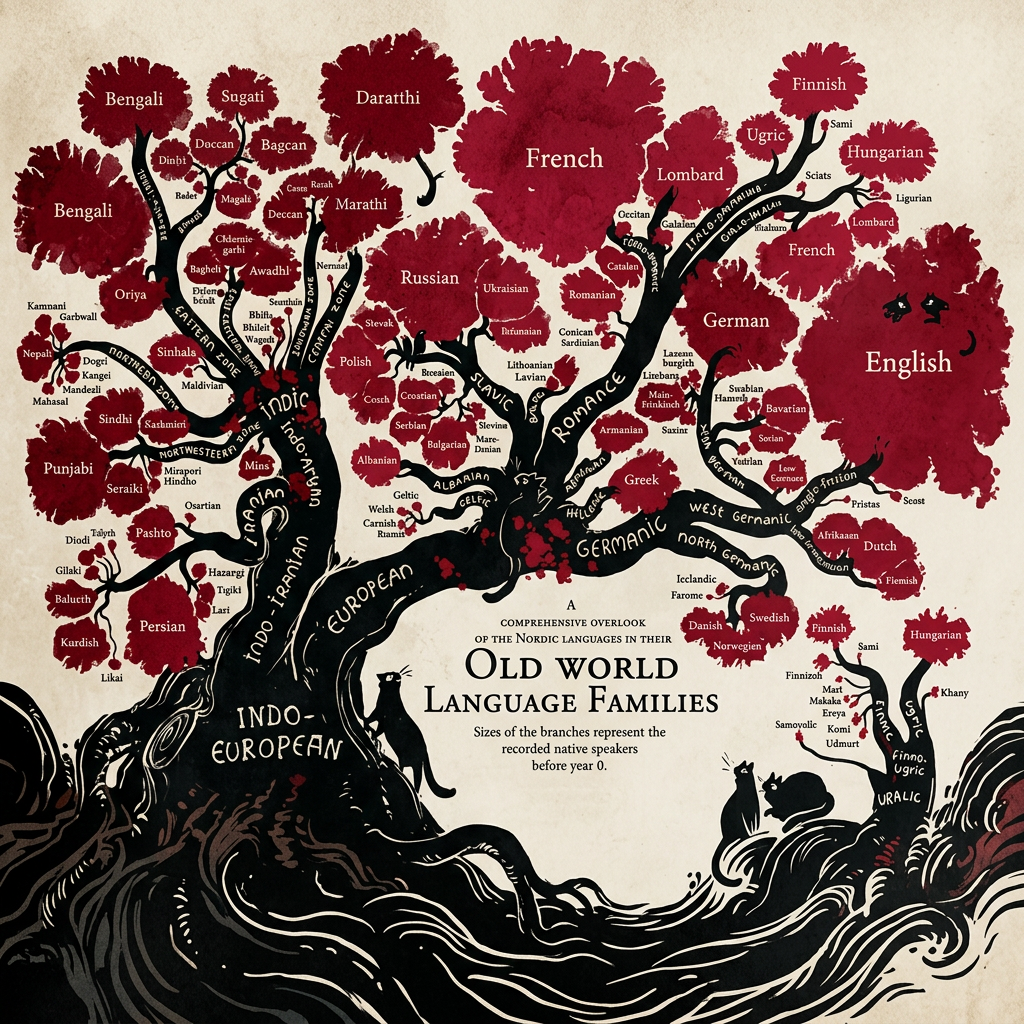
Indo-European is a vast language family with roughly 445 living languages (an Ethnologue count), spoken as a first language by close to half the world’s population (Indo-European languages, Wikipedia). Within it, the major branches are:
- Indo-Iranian (Hindi, Urdu, Bengali, Persian, Pashto, etc.)
- Slavic (Russian, Polish, Ukrainian, Czech, Bulgarian, Serbian, etc.)
- Germanic (English, German, Dutch, Swedish, etc.)
- Italic (Latin and its descendants, the Romance languages: Spanish, French, Italian, Portuguese, Romanian, etc.)
- Celtic (Irish, Welsh, Scottish Gaelic, Breton, etc.)
- Hellenic (Greek)
- Baltic (Lithuanian, Latvian). Many linguists group Baltic and Slavic together as one Balto-Slavic branch, which is why counts of the main branches vary between ten and twelve.
- Albanoid (Albanian, the only surviving member)
- Armenian
- Anatolian (extinct: Hittite, Luwian)
- Tocharian (extinct)
Each of these branches diverged from a common ancestor, Proto-Indo-European. According to the most widely accepted theory, the steppe hypothesis, it was spoken roughly 6,000 years ago on the Pontic-Caspian Steppe north of the Black Sea, although its exact homeland is still debated. Over the millennia, the branches of the language family developed independently into the languages we know today. Albanian was the last branch to appear in writing. By the time written records of Albanian appear in the 15th century, it was already a fully distinct language (Hyllested and Joseph 2022).
Albanian and the Illyrian Question
Many linguists think Albanian descends, at least partially, from Illyrian, the Paleo-Balkan language of the ancient inhabitants of what is today Albania, Kosovo, and the western Balkans. The case for the Illyrian connection rests on geography (differences between the Gheg and Tosk dialects in how they treat old loanwords suggest Albanian speakers were already living around the Shkumbin river before the Slavs arrived in the 6th century AD, per the scholarship summarized on Wikipedia), some place-name evidence, and process of elimination (the other Paleo-Balkan candidates, such as Thracian and Dacian, are equally poorly attested and a weaker geographic fit).
That said: Illyrian is so sparsely attested that the connection cannot be definitively proven. Illyrian is known mostly from personal names and place names recorded in ancient inscriptions and by Greek and Roman writers, with no continuous text. The UT Austin Linguistics Research Center notes there is no concrete linguistic evidence for any of the proposed links (LRC). For more, see our guide to the Illyrian language. Whether Albanian descends purely from Illyrian, partially from Illyrian and partially from other Paleo-Balkan languages, or from a related but distinct ancestor is one of the great unresolved questions of historical linguistics.
What About Loanwords?
Albanian has borrowed words from many languages over its history. Latin (during Roman rule), Greek (ancient, medieval and modern), Slavic (medieval contact), Turkish (during Ottoman rule, from the 15th century until independence in 1912), Italian (through Venetian and Adriatic trade and the 20th century, including the 1939 to 1943 occupation), and English (modern era). The borrowed layer sits on top of an independent native vocabulary. Numbers, pronouns and many basic words, such as ujë (water), natë (night) and dorë (hand), come from the language’s prehistoric Indo-European roots. Some everyday words are old Latin loans, such as mik (friend), and a few core words, such as zemër (heart), have no known source at all (Wikipedia, citing Matasović 2018).
Slavic Loanwords in Albanian: How Many, and Which Ones?
Albanian does have Slavic loanwords, and quite a few of them. Slavic speakers settled in the Balkans from the 6th century AD, and the heaviest borrowing from South Slavic languages happened between about the 7th and 9th centuries, with contact continuing through the Middle Ages (Albanian language, Wikipedia).
How many? Estimates depend on the method and on which dialects are counted. Vladimir Orel’s Albanian Etymological Dictionary (Brill, 1998) is cited for about 556 Slavic loanwords in Albanian (Wikipedia, citing Orel 1998). Book-length studies by Gunnar Svane (Slavische Lehnwörter im Albanischen, 1992) and Xhelal Ylli (Das slavische Lehngut im Albanischen, 1997) catalogue them by subject. Either way, they are a few hundred words in a language with a much larger vocabulary, and they are mostly practical words for farming, tools, the household and some social terms.
| Albanian word | Meaning | Slavic source |
|---|---|---|
| gozhdë | nail | Proto-Slavic *gvozdь (nail) |
| lopatë | shovel | *lopata (shovel, spade) |
| kosë | scythe | *kosa (scythe) |
| plug | plough | *plugъ (plough) |
| bisedë | conversation | *besěda (gathering, conversation) |
| zakon | custom, practice | *zakonъ (law) |
| rob | slave, captive (historical) | *orbъ (servant, slave) |
The etymologies above follow the Wiktionary entries, which cite Orel’s dictionary and the etymological dictionaries of Kolec Topalli and Anila Omari. The UT Austin Linguistics Research Center also lists nevojë (need) and gati (ready) among the borrowings from South Slavic (LRC).
The loanwords also show that Albanian was already a formed language before the Slavs arrived. Older Latin and Greek loans went through the same sound changes as native Albanian words, while Slavic loans did not, which places the main sound changes of Albanian before Slavic contact (Wikipedia, citing Adams 1997 and Fortson 2010). Borrowing words from a neighbor, as English did from French, does not change which family a language belongs to.
What Makes a Language Slavic, and Why Albanian Is Not
The Slavic branch of Indo-European is a tight, well defined group. It splits into three sub branches: East Slavic (Russian, Ukrainian, Belarusian), West Slavic (Polish, Czech, Slovak), and South Slavic (Serbian, Croatian, Bulgarian, Macedonian, Slovene). What binds them together is a large shared core of inherited vocabulary and grammar. The everyday words for water, mother, and night are recognizably related across all Slavic languages, and they share a system of noun cases and verb aspect inherited from Proto Slavic.
Albanian fails every part of this test. Its inherited core vocabulary is not Slavic: the Albanian words for water (ujë), night (natë), and mother (nënë) come from its own Indo-European line, not from Proto Slavic. Its grammar developed separately. Linguists place Albanian on its own branch, called Albanoid, of which it is the only surviving member. A language can sit next to Slavic neighbors and trade words with them for centuries and still not be Slavic, and that is exactly the case with Albanian.
Albanian Compared to Its Neighbors
The quickest way to see where Albanian belongs is to line it up against the language families it is most often confused with.
| Language | Family or Branch | Relationship to Albanian |
|---|---|---|
| Serbian, Macedonian | Indo-European, Slavic | Neighbors and loanword sources, not on the same branch |
| Greek | Indo-European, Hellenic | Distant Indo-European cousin, long contact |
| Italian | Indo-European, Romance | Distant cousin and a source of loanwords |
| Turkish | Turkic, not Indo-European | Unrelated, Ottoman-era loanwords only |
| Albanian | Indo-European, Albanoid | Its own branch, the only living member |
Does Albanian Sound Like Russian?
Not really, and the two are not mutually intelligible in any way. A Russian speaker cannot understand Albanian, and an Albanian speaker cannot understand Russian without learning it. People who hear Albanian for the first time sometimes say it sounds “Eastern European” because both languages have sounds such as sh, zh and ch and a rolled r, but the sound systems are quite different.
- Sounds Albanian has and Russian lacks: the th and dh sounds of English “thin” and “this,” the vowel y (like German ü), and the vowel ë. Standard Albanian has seven vowels and 29 consonants (Albanian language, Wikipedia).
- Features of Russian that Albanian lacks: nearly every Russian consonant comes in a “hard” and a “soft” (palatalized) version, and unstressed vowels are reduced, so an unstressed o sounds like a (Russian phonology, Wikipedia).
- Stress: Russian stress can fall on any syllable and often moves between forms of the same word. In Albanian, stress usually stays on the same syllable of a word through its different forms.
- Everyday words: yes is po in Albanian and da in Russian, no is jo and net, and thank you is faleminderit and spasibo. The basic vocabulary in the table above shows the same pattern.
Is Albania a Slavic Country? Balkan vs Slavic
No. Albania is a Balkan country, but it is not a Slavic country. “Balkan” is a geographic term for the countries of the Balkan Peninsula in southeastern Europe. “Slavic” refers to the Slavic languages and the peoples who speak them. Many Balkan countries speak Slavic languages, but several do not.
- Balkan countries whose main languages are Slavic: Serbia, Montenegro, North Macedonia, Bulgaria, Bosnia and Herzegovina, Croatia and Slovenia (South Slavic languages, Wikipedia).
- Balkan countries whose main languages are not Slavic: Albania (Albanian), Kosovo (Albanian), Greece (Greek), and Romania (Romanian, a Romance language), plus the European part of Turkey.
Albania’s constitution makes Albanian the official language (Art. 14). In Kosovo, Albanian and Serbian are both official languages (Constitution of Kosovo, Art. 5), and ethnic Albanians form the large majority of the population according to the 2024 census (Demographics of Kosovo, Wikipedia). In Montenegro, Albanian is one of the languages in official use alongside Montenegrin (Constitution of Montenegro, Art. 13). The United Nations statistical classification places Albania in Southern Europe (UN M49).
Whether Albanians as a people are “Slavic” is a question about ancestry and identity rather than language. We cover the genetic studies and how Albanians are classified in the US in Are Albanians White or Slavic?
Gheg and Tosk: The Two Main Dialects
Albanian has two major dialect groups, split roughly by the Shkumbin river in central Albania. Gheg is spoken in the north, including Kosovo, North Macedonia, and Montenegro, while Tosk is spoken in the south. The two differ in pronunciation and some grammar but remain mutually understandable. Standard Albanian, the official form used in education and media, is based largely on Tosk. For a fuller breakdown, see our guide to Gheg vs Tosk.
The Albanian Alphabet and Sound System
Modern Albanian is written in a Latin based alphabet of 36 letters, standardized at the Congress of Manastir in 1908. Alongside the familiar Latin letters it includes the vowel ë and the consonant ç, plus digraphs such as dh, gj, ll, nj, rr, sh, th, xh, and zh, each standing for a single sound. The spelling is highly regular and phonetic, so once you know the alphabet you can pronounce almost any written word you meet.
Grammar Features That Set Albanian Apart
Albanian has several grammatical features that mark it as its own branch rather than a member of a neighboring family. The definite article is attached to the end of the noun as a suffix, so “libër” (a book) becomes “libri” (the book). Albanian nouns carry grammatical gender and a system of cases, and the verb system includes an admirative mood used to express surprise or to report something secondhand, a feature also found in Bulgarian and Macedonian (both Slavic) and in Turkish. These are deep structural traits, though the suffixed article and the admirative are shared with other Balkan languages through long contact, and where they first arose is debated.
How Old Is Albanian, and When Was It First Written?
Albanian is an old language whose spoken history runs far deeper than its written record. Most scholars trace it to a Paleo Balkan language of antiquity, most commonly identified with Illyrian, spoken in the western Balkans long before the common era. The first securely dated Albanian text is the Formula e Pagëzimit, a short baptismal formula written in 1462, and the first full Albanian book is Gjon Buzuku’s Meshari, or Missal, of 1555. By the time these were written the language was already fully formed, which tells us it had been spoken and developing for many centuries before. For more on those roots, see where Albanian people come from.
This article is about the language. If your question is about Albanians as a people, see Are Albanians White or Slavic? Albanian Ethnicity Explained.
Frequently Asked Questions
Is Albanian related to Greek?
Both Albanian and Greek are Indo-European languages, but they sit on separate branches (Albanian on the Albanoid branch and Greek on the Hellenic branch, respectively). They’ve borrowed words from each other and share some structural features from millennia of contact, but they are not closely related in the linguistic sense.
Is Albanian related to Italian?
No. Italian is a Romance language descended from Latin. Albanian has borrowed Latin and Italian words, but is not part of the Romance branch. The Arbëresh communities of southern Italy speak a dialect of Albanian brought to Italy by migrants from the 15th century onward, not an Italian dialect.
Is Albanian close to Turkish?
No. Turkish is part of the entirely separate Turkic language family. Five centuries of Ottoman rule left a layer of Turkish loanwords in Albanian, but the languages are unrelated at the deep structural level.
Is Albanian hard to learn?
It depends on your starting language. The grammar has features unfamiliar to English speakers: definite articles attached to nouns, masculine and feminine gender plus a small neuter class, noun cases, and an admirative mood that English doesn’t have. The phonology is fairly straightforward. The 36-letter alphabet is regular and phonetic. Most learners say the hardest part is the verb system; the easiest part is the spelling.
Is Albanian a dying language?
No. Albanian has about 7.5 million native speakers (a 2017 estimate) and is an official language of Albania and Kosovo, an official language in North Macedonia alongside Macedonian, and a language in official use in Montenegro (Wikipedia). The diaspora variants (Arbërisht in Italy, Arvanitika in Greece) are endangered, but standard Albanian itself is not.
What language family does Albanian belong to?
Albanian is part of the Indo-European language family, the same family as English, German, Hindi, Persian, Spanish, and most European languages. Within Indo-European, it forms its own branch called Albanoid, of which it is the only surviving member.
Is Albanian closer to Italian or Greek?
Neither is a close relative: Italian is Romance, Greek is Hellenic, and Albanian is its own Albanoid branch. In the deep prehistory of Indo-European, Hyllested and Joseph (2022) find the evidence favors a closer link with Greek (Cambridge University Press). Albanian has also borrowed words from both, especially Latin and Italian on one side and Greek on the other.
Why do some people think Albanian is Slavic?
Three reasons: Albania borders Slavic-speaking countries; Albanian has borrowed words from neighboring Slavic languages over the centuries; and the term “Balkan language” is sometimes mentally conflated with “Slavic language” by non-linguists. None of these makes Albanian Slavic.
Are Albanians Slavic?
No. Albanians speak Albanian, which is not a Slavic language, and Albania is not a Slavic country. Questions about ancestry and genetics are covered in our article Are Albanians White or Slavic?
Is Kosovo Slavic?
Most people in Kosovo speak Albanian, which is not Slavic. Kosovo’s constitution makes Albanian and Serbian, a Slavic language, its two official languages, reflecting its Serbian-speaking minority.
Is Albanian a language isolate?
No. A language isolate, such as Basque, has no proven relatives at all. Albanian belongs to the Indo-European family, so it is related to English, Greek and Russian at a deep level. It is the only living language on its own branch, which is why it is sometimes loosely called an isolate within Indo-European.
What language is Albanian closest to?
No living language is close to Albanian. Among the Indo-European branches, recent scholarship sees the closest link with Greek, and the extinct Messapic language of southern Italy may have been on Albanian’s own branch. Through long contact, Albanian also shares grammar features with Balkan neighbors such as Macedonian, Bulgarian, Greek and Romanian.
How many Slavic words are in Albanian?
Several hundred. Vladimir Orel’s etymological dictionary (1998) is cited for about 556 Slavic loanwords, such as gozhdë (nail), lopatë (shovel) and kosë (scythe). They were mostly borrowed between the 7th and 9th centuries and later in the Middle Ages, and they did not change Albanian’s core vocabulary or grammar.
Is Albania Balkan or Slavic?
Albania is Balkan but not Slavic. “Balkan” describes where a country is, on the Balkan Peninsula of southeastern Europe. “Slavic” describes a language group. Albania, Kosovo, Greece and Romania are Balkan countries whose main languages are not Slavic.
How old is the Albanian language?
No one can give an exact age. Albanian’s ancestor split from the other Indo-European branches in prehistory, and evidence from its dialects suggests Albanian speakers were living in roughly their present area before the Slavs arrived in the 6th century AD. The earliest securely dated written record is from 1462, by which time the language was already fully formed. Its ancient predecessor is often thought to be Illyrian, but that link has not been proven.
Connect With the Albanian-American Community
Ready to connect with Albanian-owned businesses? Browse our directory of Albanian entrepreneurs across the US. Share your Albanian business success story with our community. Subscribe for more insights on the Albanian language and culture.
Sources and Further Reading
- Albanian language, Wikipedia
- Albanian language | History, Grammar & Vocabulary, Britannica
- Origin of the Albanians, Wikipedia
- Introduction to Albanian, Linguistics Research Center, UT Austin
- Albanian, Ethnologue
- Albanian Language Resources, Library of Congress
- Hyllested, A. and Joseph, B. D. (2022), “Albanian,” in T. Olander (ed.), The Indo-European Language Family: A Phylogenetic Perspective, Cambridge University Press
- Albanoid languages, Wikipedia
- Indo-European languages, Wikipedia
- South Slavic languages, Wikipedia
- Russian phonology, Wikipedia
- Albanian Swadesh list, Wiktionary
- Serbo-Croatian Swadesh list, Wiktionary
- Russian Swadesh list, Wiktionary
- Constitution of Albania (Art. 14), Constitute Project
- Constitution of Kosovo (Art. 5), Constitute Project
- Constitution of Montenegro (Art. 13), Constitute Project
- Constitution of Serbia (Art. 10), Constitute Project
- Demographics of Kosovo, Wikipedia
- Standard country or area codes for statistical use (M49), United Nations Statistics Division
Read More on the Albanian Language
If you want to go deeper into the Albanian language (the history, the dialects, the alphabet, and what it’s like to grow up bilingual in the Albanian-American diaspora), see our full guide to the Albanian language (Shqip). For where the name comes from, see what “Shqiptar” means. For the difference between the two main dialects, see gheg vs tosk.
Related Reading
- The Albanian Language: A Complete Guide
- Gheg vs Tosk: The Two Albanian Dialects
- The Albanian Alphabet: All 36 Letters Explained
- Albanian Last Names: Most Common Surnames
- Common Albanian Phrases: 50 Essential Words

Author: Dardanë Halimi
Dardanë Halimi is a writer and communications professional with an M.A. in Writing, Rhetoric, and Technical Communication from James Madison University. Her work focuses on storytelling, digital content, higher education, and strategic communication, with experience writing for academic, nonprofit, and marketing organizations in both the United States and Kosovo.