The 2021 Canadian census counted 41,620 people of Albanian ethnic or cultural origin, according to Statistics Canada. Another 3,730 people reported Kosovar origin; because people can report more than one origin, the two groups overlap and should not simply be added together. About 71 percent of Albanian Canadians (29,575 people) lived in Ontario, including 20,205 in the Toronto metropolitan area, and 29,265 people reported Albanian as their mother tongue. These are the most recent published figures; ethnic origin results from the 2026 census have not been released yet.
Canada is home to a well-established Albanian community, most of it built over the past few decades and concentrated overwhelmingly in Ontario. From the Greater Toronto Area to the border city of Windsor, Albanian Canadians have put down deep roots. This guide covers how many there are, where they live, how the community formed, and the life they have built.
It is part of our Albanians Around the World series.
Quick Facts: Albanians in Canada
- Population: 41,620 people of Albanian origin and 3,730 of Kosovar origin (2021 census; the groups overlap).
- Language: 29,265 people with Albanian as their mother tongue, and 38,345 who can hold a conversation in Albanian (2021 census).
- Where they live: About 71 percent in Ontario, led by the Greater Toronto Area, with communities in Montreal, Calgary, Hamilton, London, and Windsor.
- Main origins: Kosovo, Albania, and North Macedonia.
- How they came: A small early presence, then Kosovo War refugees and post-communist migrants from the 1990s onward.
- Faith: Mixed. In the 2021 census, Christians (mainly Catholic and Orthodox), Muslims, and people with no religion each made up roughly a third.
On This Page
- How Many Albanians Live in Canada?
- Timeline: Albanians in Canada
- How the Community Grew
- Where Albanians Live in Canada
- Community and Everyday Life
- Albanian Organizations and Places of Worship in Canada
- Frequently Asked Questions
How Many Albanians Live in Canada?
The 2021 census counted 41,620 Canadians of Albanian origin. The community is strikingly concentrated: about 71 percent live in Ontario (29,575 people), followed by Quebec (4,650), Alberta (3,240), and British Columbia (2,455). In practical terms that means most Albanian Canadians live in and around a handful of cities, above all Toronto.
Canada asks about ethnic origin directly, so its census gives an official count rather than an estimate. Several measures are useful, and each answers a slightly different question:
| 2021 census measure | People | What it counts |
|---|---|---|
| Albanian ethnic or cultural origin | 41,620 | Everyone who reported Albanian origin: 32,775 as their only origin and 8,845 together with another origin |
| Kosovar ethnic or cultural origin | 3,730 | People who reported Kosovar origin; some also reported Albanian |
| Albanian mother tongue | 29,265 | The first language learned at home and still understood |
| Can speak Albanian | 38,345 | Knowledge of Albanian well enough to hold a conversation |
| Albanian spoken most often at home | 14,105 | Albanian as the only main home language |
Sources: Statistics Canada tables 98-10-0356 (ethnic origin), 98-10-0182 (mother tongue and home language) and 98-10-0216 (knowledge of languages). Statistics Canada rounds counts randomly to a multiple of 5, so figures from different tables can differ by a few people.
The census counts only what people report. Ethnic Albanians born in Kosovo, North Macedonia or Montenegro are counted as Albanian only if they described themselves that way, and some of their children and grandchildren no longer report the origin, so the real community may be somewhat larger. We found no published estimate with a stated method that goes beyond the census, so the census figure is the one given here.
How the Community Grew
Canada’s Albanian community is mostly recent. According to The Canadian Encyclopedia, the first Albanians arrived at the beginning of the 20th century, after revolutionary upheavals at home, and most of those who came after the Second World War settled in Montreal or Toronto. Windsor, across the river from the large Albanian community of Metro Detroit, also has a long-standing community: Tie Domi, born there in 1969 to Albanian parents, is its best-known son. The community grew dramatically in the 1990s and 2000s, when the collapse of communism in Albania and the Kosovo War sent refugees and economic migrants abroad, and Canada’s points-based immigration system drew skilled Albanians and Kosovars to Toronto, Montreal, and the west. A Canadian-born and Canadian-raised generation is now coming of age.
Timeline: Albanians in Canada
| Year | Event | Source |
|---|---|---|
| Early 1900s | First Albanian immigrants arrive in Canada | The Canadian Encyclopedia |
| After 1945 | Post-war arrivals settle mainly in Montreal and Toronto, with some in Calgary and smaller Ontario towns such as Peterborough | The Canadian Encyclopedia |
| 1950s | Albanian Muslims in Toronto organize; the Albanian Muslim Society of Toronto gives 1957 as its founding year | Iqra.ca (2026) |
| 1999 | Operation Parasol: 5,051 Kosovar refugees airlifted to Canada, plus 2,292 through family reunification | Canadian Museum of Immigration at Pier 21 |
| 2001 to 2021 | Census count of people of Albanian origin rises from 14,935 to 41,620 | Statistics Canada |
| 2016 | Ontario passes the Albanian Heritage Month Act, proclaiming November as Albanian Heritage Month (Royal Assent on December 8, 2016) | Legislative Assembly of Ontario |
Where Albanians Live in Canada
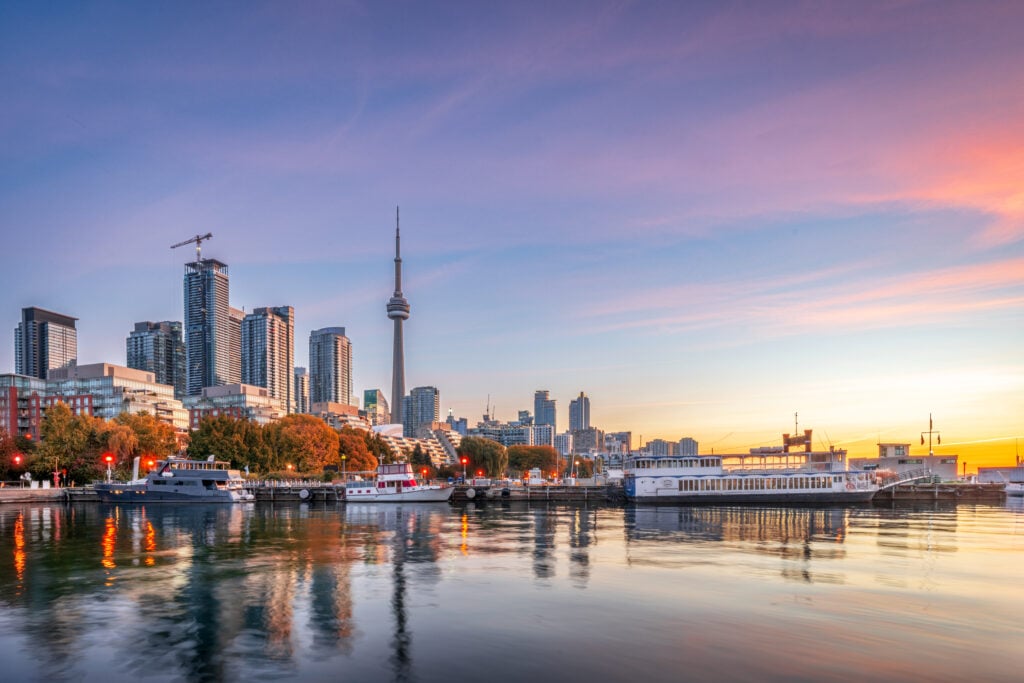
The heart of the community is the Greater Toronto Area, home to the largest concentration of Albanians in the country, along with a historic community in Windsor. Beyond Ontario, the main centers are Montreal in Quebec and Calgary and Edmonton in Alberta. The map shows the provincial pattern.
About 41,620 Canadians are of Albanian origin (2021 census), and roughly 71 percent live in Ontario, above all in the Greater Toronto Area. Hover or tap a province.
Provinces shaded by number of residents of Albanian origin. Source: Statistics Canada, 2021 Census.
Community and Everyday Life
Albanian Canadians have built the familiar institutions of a settled diaspora: cultural associations, mosques and churches, Albanian-language weekend schooling, and businesses from restaurants to construction and professional services. The community is mixed in faith, split roughly in thirds between Christians (mainly Catholic and Orthodox), Muslims, and people with no religion, and it keeps the strong family ties and hospitality that travel with Albanians everywhere. Close links to the larger Albanian-American community just across the border, and to the homeland, remain a defining feature. The community’s institutions run deep: the Albanian Muslim Society of Toronto, which gives 1957 as its founding year, is among the oldest Albanian organizations in the country, and the Albanian Canadian Community Association organizes cultural events in Toronto today.
Albanian Canadians by Province and City: 2021 Census Data
Statistics Canada publishes Albanian and Kosovar ethnic or cultural origin for every province and metropolitan area. The figures below come from table 98-10-0356. They count everyone who reported the origin, alone or alongside another origin, among people living in private households. Some people reported both Albanian and Kosovar origin, so the two columns should not be added.
| Province or metropolitan area | Albanian origin, 2021 | Kosovar origin, 2021 |
|---|---|---|
| Canada | 41,620 | 3,730 |
| Ontario | 29,575 | 2,010 |
| Quebec | 4,650 | 445 |
| Alberta | 3,240 | 370 |
| British Columbia | 2,455 | 450 |
| Nova Scotia | 505 | 125 |
| Manitoba | 485 | 115 |
| Saskatchewan | 405 | 55 |
| Toronto (metropolitan area) | 20,205 | 605 |
| Montreal (metropolitan area) | 4,090 | 280 |
| Calgary (metropolitan area) | 1,920 | 140 |
| Hamilton (metropolitan area) | 1,770 | 470 |
| Vancouver (metropolitan area) | 1,740 | 295 |
| London, Ontario (metropolitan area) | 1,700 | 260 |
| Windsor (metropolitan area) | 1,485 | 110 |
| Ottawa and Gatineau (metropolitan area) | 1,325 | 135 |
| Kitchener, Cambridge and Waterloo (metropolitan area) | 1,135 | 335 |
| Edmonton (metropolitan area) | 1,060 | 120 |
Kosovar origin is most common relative to Albanian origin in Hamilton and Kitchener, Cambridge and Waterloo, while Toronto’s community reports Albanian origin overwhelmingly.
Two things stand out. The Toronto metropolitan area alone accounts for nearly half of all Albanian Canadians. And within Ontario, Albanian Canadians are spread along a string of cities, from Windsor through London, Kitchener and Hamilton to Toronto and on to Ottawa.
The growth has been steady. The 2001 census counted 14,935 Canadians of Albanian origin and the 2006 census 22,395. By 2016 the figure was 36,185, of whom 28,425 gave Albanian as their only origin and 7,755 gave it together with another. The Canadian Encyclopedia cautions that census figures may still undercount the community, because Canadians of Albanian origin may have been born in several different countries, and later generations do not always name their background.
A First-Generation Community
Statistics Canada also breaks ethnic origin down by generation, and the result confirms how new this community is. Of the 41,625 people of Albanian origin in that table, 28,670 were first generation, meaning born outside Canada. Another 11,585 were second generation, and only 1,370 were third generation or more.
The pattern is similar for people of Kosovar origin: of 3,730, 2,390 were first generation and 1,305 second generation (Statistics Canada, table 98-10-0341).
That is a very different profile from the century-old Albanian communities south of the border, such as the one described in our guide to Albanians in Michigan, just across the river from Windsor.
Albanian Language Retention in Canada
The 2021 census asked several language questions, and together they give a useful picture of language retention.
- 29,265 people reported Albanian as their mother tongue, the first language they learned.
- 38,345 people said they knew Albanian well enough to hold a conversation.
- 14,105 people said Albanian was the language they spoke most often at home (14,110 in the Census Profile, which is rounded separately).
In other words, knowledge of the language is nearly as widespread as Albanian origin itself, but fewer than half of mother-tongue speakers use it as their main home language. The mother-tongue figure has been stable: the 2016 census recorded 28,725 people with Albanian as their mother tongue.
Religion in the Census
Statistics Canada cross-tabulates religion with ethnic origin, which allows a factual answer to a question that is often guessed at. In 2021, Muslims were the largest single religious group among Albanian Canadians, at 13,335 people. A nearly equal number, 13,100, reported no religion or a secular perspective.
Christians of all denominations together numbered 14,960. Within that total, 7,430 were Catholic and 5,280 were Christian Orthodox. The three broad groups, Christian, Muslim and non-religious, are therefore close to one third each. For the Orthodox tradition in North America, see our history of the Albanian Orthodox Church.
Operation Parasol: The 1999 Kosovo Airlift
A defining moment for the community was Operation Parasol, the emergency airlift of Kosovar refugees in the spring of 1999. According to the Canadian Museum of Immigration at Pier 21, the first evacuation flight landed at Canadian Forces Base Trenton in Ontario on 4 May 1999, and the last arrived on 26 May. More than 90 percent of the refugees were received at two air bases, Trenton and Greenwood in Nova Scotia.
From there, families were housed at military bases: Kingston and Borden in Ontario, Aldershot and Halifax in Nova Scotia, and Gagetown in New Brunswick. In all, Canada brought 5,051 Kosovar refugees under the evacuation program and admitted a further 2,292 under a parallel family reunification program, for more than 7,000 arrivals in 1999.
Canada had offered temporary safe haven, with the option to apply for permanent resident status once in the country. After the peace agreement of June 1999, thousands of Kosovars who had fled abroad began to return home, but many of those in Canada chose to stay. By 2001, Canadian officials noted that nearly 70 percent of the Kosovars had decided to resettle permanently. Australia ran a similar program the same year, covered in our guide to Albanians in Australia. For the war itself, see our history of the Kosovo War.
All figures in this section come from the Canadian Museum of Immigration at Pier 21, which also records that the first repatriation flight left Canada for Skopje on 7 July 1999 and that Operation Parasol formally ended on 31 August 1999.
Where Earlier Arrivals Settled
The Canadian Encyclopedia notes that most of the Albanian immigrants who came after the Second World War settled in either Montreal or Toronto. Some found work in Calgary, and a few settled in smaller Ontario communities such as Peterborough.
Albanian Organizations and Places of Worship in Canada
The oldest Albanian institutions in Canada grew out of Toronto’s small post-war Muslim community. These are organizations whose existence and activity we could confirm in published sources:
- Albanian Muslim Society of Toronto: based at 564 Annette Street in Toronto’s west end. The society gives 1957 as its founding year; an earlier history of Toronto’s Muslim community dates an Albanian Muslim Society to 1952 and an Albanian mosque near Keele and Dundas to 1954 (Iqra.ca, 2009). In September 2026 the society reported that it had bought a property at 124 to 126 Queens Plate Drive in Etobicoke for a new mosque and cultural center (Iqra.ca, 2026).
- Albanian Canadian Community Association: a Toronto cultural association that welcomed Ontario’s Albanian Heritage Month legislation and organizes Independence Day events (Tirana Times).
Christian Albanian Canadians, who outnumber Muslims in the census, mostly worship in general Catholic and Orthodox parishes; we did not find a dedicated Albanian Catholic or Albanian Orthodox parish in Canada in the sources we checked. In Ontario, November has been Albanian Heritage Month by law since the Albanian Heritage Month Act, 2016 (Legislative Assembly of Ontario), and it ends with Albanian Independence Day on November 28.
Albanian Canadians on the Ice
The best-known Albanian Canadians have made their names in the national sport. Tie Domi was born in Windsor, Ontario, on November 1, 1969, to Albanian parents (Wikipedia). Over a 16-year National Hockey League career with the Toronto Maple Leafs, New York Rangers and Winnipeg Jets, he became the Maple Leafs’ all-time leader in penalty minutes and ranks third in penalty minutes in league history. His son, Max Domi, followed him into the NHL.
A newer name is Arber Xhekaj, born in Hamilton, Ontario, on January 30, 2001. His father, Jack, is an Albanian from Kosovo, and his mother, Simona, is from the Czech Republic. Both left their home countries in the 1990s and met in Hamilton. Arber made his NHL debut on defense for the Montreal Canadiens in 2022, and the team selected his younger brother, Florian, 101st overall in the 2023 NHL draft (Wikipedia).
For more Albanian names in sport and public life, see our list of famous Albanians.
Frequently Asked Questions
How many Albanians live in Canada?
The 2021 census counted 41,620 people of Albanian ethnic or cultural origin, about 71 percent of them in Ontario, according to Statistics Canada. A further 3,730 people reported Kosovar origin, though some of them also reported Albanian, so the two figures overlap. The census counts only what people report, so the real community may be somewhat larger.
What is the Albanian population in Canada by city?
In the 2021 census, the Toronto metropolitan area had 20,205 people of Albanian origin, followed by Montreal (4,090), Calgary (1,920), Hamilton (1,770), Vancouver (1,740), London, Ontario (1,700) and Windsor (1,485).
How many Kosovars live in Canada?
The 2021 census counted 3,730 people who reported Kosovar ethnic or cultural origin, 2,010 of them in Ontario. Many people from Kosovo report Albanian origin instead, so they are also included in the 41,620 Albanian Canadians.
How many people speak Albanian in Canada?
In 2021, 29,265 people reported Albanian as their mother tongue, 38,345 could hold a conversation in Albanian, and about 14,100 spoke it most often at home.
What religion are Albanian Canadians?
In the 2021 census, 14,960 Albanian Canadians were Christian (7,430 Catholic and 5,280 Orthodox), 13,335 were Muslim and 13,100 reported no religion, so each group is close to one third.
Where do most Albanian Canadians live?
Overwhelmingly in Ontario, led by the Greater Toronto Area, with communities in Montreal, Calgary, Hamilton, London, and Windsor.
Where are Albanian Canadians from?
Mostly from Kosovo, Albania, and North Macedonia.
When did Albanians come to Canada?
The first Albanians arrived at the beginning of the 20th century and more came after the Second World War, but the community grew above all from the 1990s, through post-communist migration from Albania and the 1999 airlift of more than 7,000 Kosovar refugees. In 2021, 28,670 of the 41,625 people of Albanian origin in Statistics Canada’s generation table had been born outside Canada.
Is there an Albanian Heritage Month in Canada?
Yes, in Ontario. The Albanian Heritage Month Act, 2016 proclaims November as Albanian Heritage Month in the province each year; it received Royal Assent on December 8, 2016.
Sources
- Statistics Canada, 2021 Census of Population
- Wikipedia: Albanian Canadians
- Statistics Canada: Census Profile, 2021 Census of Population, Canada and Ontario
- Statistics Canada: Table 98-10-0341-01, Religion by ethnic or cultural origins
- Statistics Canada: Table 98-10-0356-01, Ethnic or cultural origin by gender and age
- Statistics Canada: Table 98-10-0182-01, Mother tongue by language spoken most often at home
- Statistics Canada: Table 98-10-0216-01, Knowledge of languages
- Legislative Assembly of Ontario: Bill 36, Albanian Heritage Month Act, 2016
- Iqra.ca: Albanian Muslim Society of Toronto secures new mosque and cultural centre (2026)
- Iqra.ca: Planting the seeds, history of the Islamic Foundation of Toronto (2009)
- Tirana Times: November proclaimed as Albanian heritage month in Canada
- The Canadian Encyclopedia: Albanian Canadians
- Canadian Museum of Immigration at Pier 21: 1999, Canada’s Resettlement and Repatriation of Kosovar Refugees
- Wikipedia: Tie Domi
- Wikipedia: Arber Xhekaj
Related Reading
- Albanians Around the World: The Global Diaspora
- Albanians in the United States
- The Kosovo War: A Complete History
- Albanians in Germany
- Albanians in Australia
- Albanians in Michigan

Author: Dardanë Halimi
Dardanë Halimi is a writer and communications professional with an M.A. in Writing, Rhetoric, and Technical Communication from James Madison University. Her work focuses on storytelling, digital content, higher education, and strategic communication, with experience writing for academic, nonprofit, and marketing organizations in both the United States and Kosovo.