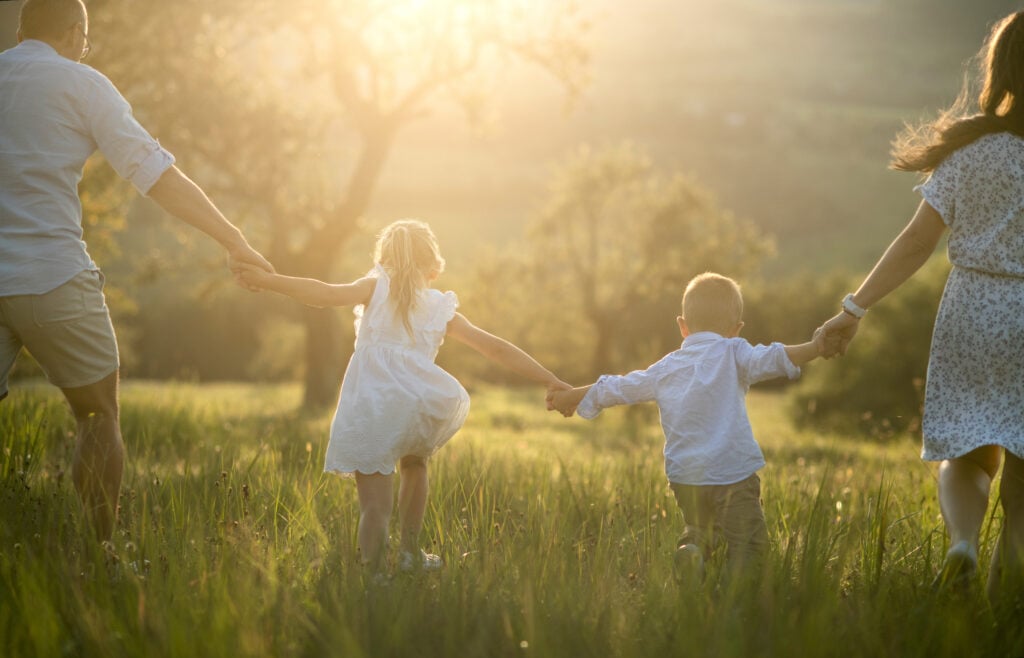
Walk into an Albanian household anywhere in the world and you will notice something immediately: the warmth is not performative. The table is full whether or not guests were expected. The elders are seated first. The children are kept close. Albanian family values are not a set of rules posted on the wall. They are woven into daily life in ways that are subtle, powerful, and deeply meaningful to those who carry them.
Albanian families are defined by strong collectivist values including loyalty to family above all else, radical hospitality toward guests, intergenerational living, and a code of honor known as besa. These traditions, rooted in centuries of Albanian history and culture, shape how Albanian families communicate, make decisions, raise children, and relate to the wider community, both in Albania and across the diaspora.
The Albanian word for family is familje (familja, “the family”), a learned borrowing from Latin familia, according to Wiktionary. An older word from the same Latin root, fëmijë, now means children. For the wider kin group Albanians use fis, glossed as clan, tribe or large family (Wiktionary).
TLDR
- Family is the central unit of Albanian society, prioritized above individual preferences
- Besa (word of honor) creates a cultural expectation of loyalty and integrity within the family
- Hospitality is a moral duty, not just a social nicety
- Multigenerational households are common and expected in many families
- Elders are treated with deep respect and their guidance carries real authority
- Education and hard work are core values passed down through generations
- Albanian family identity remains strong even across multiple generations in the diaspora
On This Page
- The Collectivist Foundation
- How Albanian Households Are Structured
- The Role of the Extended Family
- Besa: The Code That Holds It Together
- Hospitality as a Moral Obligation
- Respect for Elders
- Education and the Work Ethic
- Albanian Families in the Diaspora
- How Family Life Changes in America
- FAQs
The Collectivist Foundation of Albanian Family Life
To understand Albanian family values, you need to understand one foundational concept: in Albanian culture, the family comes before the individual. This is not unique to Albanians, but the degree to which it shapes daily decision-making, social obligations, and personal identity is notable.
As documented by AFS-USA in their cultural profile of Albania, family is the core institution of Albanian society. Traditionally, multiple generations live under one roof, with grandparents, parents, and children sharing responsibilities, meals, and daily life. This structure creates a powerful support network where child-rearing is a community effort, elders are cared for at home, and major decisions are made with the whole family input.
How Albanian Households Are Structured
The traditional Albanian household was large, lived together across several generations, and was organized through the male line. Households today are much smaller, but parts of that pattern still shape family life.
The Library of Congress country study of Albania describes the older system. Until the end of World War II, society in the north, and to a much lesser extent in the south, was organized by kinship and descent. The basic unit was the extended family, which formed “a single residential and economic entity held together by common ownership.” Descent was traced through the male line, and brides usually came from outside the clan. In the southern Tosk regions the extended family was also the most important social unit, although patriarchal authority there had been weakened by the estates of the Muslim beys (Library of Congress Country Studies).
Marriage was patrilocal: a bride left her parents’ home and moved into her husband’s family. The demographer Mathias Lerch, in a 2013 study in Demographic Research based on Albania’s 2001 census and a 2002 health survey, explains that in this system sons, not daughters, were expected to support their parents in old age, which helps explain a documented preference for sons. Communist industrialization and urbanization challenged these institutions, yet Lerch found that municipalities where patriarchal household patterns were stronger still had earlier marriages and larger families (Lerch, 2013).
The latest census figures, set out further down this page, show the shift: Albania’s average household fell to 3.2 people in 2023 and Kosovo’s to 4.33 in 2024, yet households of five or more people still house more than a third of Albania’s population.
The Role of the Extended Family
For Albanians, family has traditionally meant much more than parents and children. Several extended families made up a clan, or fis. According to the Library of Congress study, the clan chief held patriarchal power over the whole group: he arranged marriages, assigned tasks, settled disputes, and decided the group’s course on matters such as blood feuds and politics (Library of Congress Country Studies). The customary law of the north, the Kanun, likewise obligates the individual to guard the honor of family, clan and tribe, as the Gale Encyclopedia of Multicultural America notes in its entry on Albanian Americans (Jurgens).
Clan authority of that kind belongs to the past, but the wider family still carries real weight. It shows up in three practical ways:
- Big occasions are family events. Weddings, funerals and holidays bring together cousins, aunts and uncles, not only the immediate family. See our guide to Albanian wedding traditions.
- Money crosses borders. Remittances from relatives abroad equaled 8.4 percent of Albania’s GDP and 17.3 percent of Kosovo’s in 2024, as the World Bank figures below show.
- Care for elders is a family matter. With so many children living abroad, families often have to organize the care of aging parents across borders. Our guide on caring for aging parents from abroad covers the practical side.
Besa: The Code That Holds It All Together
Perhaps the most distinctive feature of Albanian family culture is besa. The word translates roughly as “word of honor” and it functions as both a personal and communal code of conduct. Besa obligates Albanians to act with integrity, protect those in their care, honor their commitments, and treat guests with respect. Albania was one of the only European countries where the Jewish population actually grew during the Holocaust, a fact recognized by the United States Holocaust Memorial Museum.
Hospitality as a Moral Obligation
There is a saying in Albanian culture that translates as: “The house belongs first to God and then to the guest.” Albanian hospitality, known as mikpritja, is considered a moral duty rather than a social option. When a guest arrives, they are fed first, seated in the best spot, and treated with full attention regardless of whether the family was prepared for company.
Respect for Elders and Intergenerational Authority
Elders in Albanian families occupy a position of significant authority and reverence. Decisions about major life events, including marriage, education, and career, are often discussed with parents and grandparents, whose perspective is considered essential rather than optional. Albanian children are typically taught to greet elders formally, to offer their seat, to listen before speaking, and to avoid contradicting an elder in public.
In the diaspora, second-generation Albanian Americans sometimes navigate tension between these expectations and more egalitarian American norms. You can read more about that experience in our article on growing up Albanian in America.
Education, Ambition, and the Albanian Work Ethic
Albanian families place enormous value on education and professional achievement. The Harvard Growth Lab statistical profile of Albanian Americans, based on Census Bureau survey data for 2012, found that 31.9 percent of first generation Albanian Americans held at least a bachelor’s degree, compared with 29.2 percent of other Americans, while the second generation stood at 26.5 percent. Albanian parents often speak of success not as an individual achievement but as something the whole family shares in.
Albanian Families in the Diaspora
The Albanian diaspora in America is concentrated primarily in New York, Michigan, and Massachusetts, which together held 58 percent of Albanian Americans in the Harvard Growth Lab profile. As documented by Germin research on Albanian diaspora identity, families that maintain Albanian language in the home, celebrate Albanian holidays, and participate in community events tend to produce children who feel strongly connected to their roots. Find Albanian professionals and businesses near you through the ALB Connection directory.
How Albanian Family Life Changes in America
Albanian families in the United States keep many of the old expectations, but they adapt them. The Gale Encyclopedia of Multicultural America describes the traditional Albanian household as a patriarchy headed by the eldest male, in which children have a duty to honor their parents and respect their wishes, and marriages were traditionally arranged by parents or a matchmaker. It adds that the dowry customary in Albania is not followed in the United States, and that many Albanian American women “feel caught between two worlds” (Jurgens).
The generations are now roughly balanced. The Harvard Growth Lab profile found that, in most Albanian American communities, the US born or US raised second generation outnumbered the immigrant first generation, with exceptions such as Pennsylvania, Maryland and Ohio (Nedelkoska and Khaw, 2015). Our article on growing up Albanian in America looks at how children of immigrants balance these expectations.
Ties to the homeland stay strong. In a 2015 survey of Albanian Americans in New York, Detroit and Boston, about 62 percent said they bought products imported from home, and respondents reported spending about US$1,200 a year on them (Orozco, 2015). For how this plays out at home, see our guides to Albanian parenting style and teaching your kids Albanian.
What the Census Says About Albanian Households
Official statistics give a measurable picture of the family patterns described above. Albania’s 2023 Population and Housing Census counted 755,950 households with an average of 3.2 members each, down from 3.9 in the 2011 census. Kosovo’s 2024 census found an average of 4.33 people per private household, down from 5.90 in 2011.
Households are getting smaller in both countries, but large family homes remain a big part of daily life. In Albania, households of five or more people are fewer than one in five of all households, yet they are home to more than a third of the population.
| Measure | Figure | Source and year |
|---|---|---|
| Average household size, Albania | 3.2 members (3.9 in 2011) | INSTAT, Census 2023 |
| Average household size, Kosovo | 4.33 members (5.90 in 2011) | Kosovo Agency of Statistics, Census 2024 |
| Households with five or more members, Albania | 19.5 percent of households, 35.8 percent of the population | INSTAT, Census 2023 |
| One-person households, Albania | 13.7 percent of households, 4.3 percent of the population | INSTAT, Census 2023 |
| People in private households who live in a family unit, Albania | 88.1 percent | INSTAT, Census 2023 |
| Households that own their home, Albania | 82.5 percent | INSTAT, Census 2023 |
| Remittances received as a share of GDP | Albania 8.4 percent, Kosovo 17.3 percent | World Bank, 2024 |
Living alone is uncommon. About 103,000 people in Albania lived by themselves at the time of the census, and 62.5 percent of them were aged 60 or older. Among family units, 52.2 percent were couples with children, 37.5 percent were couples without children, and 10.3 percent were single parents with children.
The census also hints at who leads the household. INSTAT asks each household to name a reference person, the member who generally makes the main decisions and is recognized as such by everyone else. Almost half of these reference persons, 49.0 percent, were 60 or older, and only 15 percent were under 40. About one in four, 24.3 percent, were women.
An Aging Homeland and What It Means for Elder Care
The tradition of caring for parents and grandparents at home faces a demographic test. The average age of Albania’s population rose from 35.3 years in 2011 to 42.5 years in 2023, and people aged 65 and over now make up about 20 percent of residents, up from about 11 percent. Over the same period the resident population fell by about 420,000.
Kosovo is younger, with an average age of 34.84 in its 2024 census, but it is moving the same way. The share of its population aged 65 and over grew from 6.70 percent in 2011 to 10.97 percent in 2024.
Family Support Across Borders
With so many relatives living abroad, family loyalty often takes the form of money sent home. World Bank data show that personal remittances equaled 8.4 percent of Albania’s GDP in 2024 and 17.3 percent of Kosovo’s. In Kosovo the share has stayed above 15 percent in every year since 2019. Those transfers are the financial side of the diaspora story told in our guide to Albanians around the world.
Women, Education, and Work in the Numbers
INSTAT’s Women and Men in Albania report, published in September 2025, puts figures on the generational shift in gender roles. Of the 28,193 students who graduated in the 2023 to 2024 academic year, 65.8 percent were women. Among adults aged 25 and over, 18.8 percent of women hold a higher education degree, compared with 16.1 percent of men. For the early history of girls’ education, see our profile of the Qiriazi sisters.
The same report shows where traditional expectations still hold. Labor force participation for ages 15 to 64 was 82.3 percent for men and 69.3 percent for women. Among working women, 51.2 percent were employees and 28.5 percent were classed as unpaid family workers. And 14.0 percent of women reported being out of the labor force because of household duties, compared with 0.4 percent of men.
Public life is changing too. Women held 35.7 percent of seats in Albania’s Parliament in 2024, and the gender pay gap narrowed to 4.9 percent. For one sector where this shift is visible, see our feature on Albanian women in technology.
For couples where one partner is not Albanian, see our guide to dating an Albanian and marrying into an Albanian family.
Frequently Asked Questions
What does besa mean in Albanian families?
Besa means “word of honor,” a principle set out in the Kanun, the customary law of the northern highlands. It obligates Albanians to keep promises, protect those in their care, and act with integrity. Within families, it means parents follow through on what they promise children, relatives stand by one another in hardship, and family commitments are treated as sacred. It is the moral foundation of Albanian family life.
Are Albanian families really as close as people say?
Yes, and the closeness is structural, not just emotional. Multigenerational households, shared decision-making, and a deep sense of collective responsibility create genuinely tight family bonds. Extended family (cousins, aunts, uncles) also plays a meaningful role. For many Albanians, the family network functions as a social safety net, a source of identity, and the primary site of trust and loyalty.
How do Albanian families view education?
Education is treated as a family priority, not just an individual one. Albanian immigrant parents frequently made enormous sacrifices to ensure their children could attend and complete university. A Harvard Growth Lab profile based on 2012 Census Bureau data found that first generation Albanian Americans were slightly more likely than other Americans to hold a bachelor’s degree. Success in school is seen as honoring the family and fulfilling the promise of immigration.
What is Albanian hospitality like in practice?
Albanian hospitality is genuine and generous. Guests are fed before family members, offered the best seat, and treated with full attention. The cultural principle that the house belongs to God and the guest means that no one leaves hungry or unwelcomed. This is rooted in centuries of Albanian tradition and the concept of besa. Visiting an Albanian home is a memorable experience.
Are gender roles changing in Albanian families?
Yes, significantly, especially in the diaspora and urban Albania. Albanian women are now among the most educated in the community, and younger couples are sharing household responsibilities more equitably. Traditional expectations remain present in some families, but they coexist with recognition of women’s professional and personal independence. The shift is generational and ongoing.
How do Albanian families preserve culture in America?
Albanian families in the US maintain culture through Albanian language use at home, participation in Albanian Orthodox or Muslim religious communities, attendance at cultural festivals, and connection to Albanian community organizations. Research confirms that families who maintain these practices produce children with stronger heritage identity and cultural pride.
What is a typical Albanian family like?
Traditionally it is close knit, multigenerational and organized through the father’s line, with respect for elders and a strong sense of duty to relatives. Households have become smaller: Albania’s average was 3.2 people in the 2023 census and Kosovo’s 4.33 in 2024. Most people still live in a family unit, and extended family remains important for weddings, holidays, money and care for elders.
How do you say family in Albanian?
Family is familje, and “the family” is familja. The related word fëmijë means children, and fis means clan or extended kin group.
What is it like to marry into an Albanian family?
Expect the wider family to be involved. Traditionally a bride moved into her husband’s family home and parents had a large say in the match. In the United States, practices differ a great deal between families, so ask your partner what their own family expects. Our guide to dating an Albanian covers what partners usually ask about.
Do Albanian families prefer sons?
Research has documented a preference for sons in Albania. A 2013 study in Demographic Research linked it to the traditional system in which sons continue the family line and are expected to support their parents in old age, while daughters marry into another family. Attitudes vary widely between families, regions and generations, and they are changing along with women’s education and work.
Resources
- Harvard Growth Lab: Albanian Community in the US – Statistical profiling of Albanian Americans
- AFS-USA: Albania Cultural Profile – Family structure and social norms
- US Holocaust Memorial Museum: Albania – Documents how Albanian besa led families to shelter Jewish refugees
- Germin: Albanian Diaspora Cultural Identity – Research on diaspora identity maintenance
Connect with the ALB Connection community directory and find Albanian-owned businesses and professionals. Submit your business to get featured.
Sources
- INSTAT: Albanian Population and Housing Census 2023
- INSTAT: The population of Albania
- Kosovo Agency of Statistics: Population and Housing Census in Kosovo 2024, First Final Results
- INSTAT: Men and Women in Albania, 2024 (published September 2025)
- World Bank: Personal remittances, received (% of GDP), Albania and Kosovo
- Library of Congress Country Studies, Albania: Social System (via countrystudies.us)
- Mathias Lerch, Patriarchy and fertility in Albania, Demographic Research 29:6 (2013)
- Jane Jurgens, Albanian Americans, Gale Encyclopedia of Multicultural America (via everyculture.com)
- Harvard Growth Lab: The Albanian Community in the United States, Statistical Profiling of the Albanian-Americans (2015)
- Harvard Growth Lab: The Demand for and Supply of Nostalgic Products among the Albanian-Americans, Manuel Orozco (2015)
- Wiktionary: familje

Author: Dardanë Halimi
Dardanë Halimi is a writer and communications professional with an M.A. in Writing, Rhetoric, and Technical Communication from James Madison University. Her work focuses on storytelling, digital content, higher education, and strategic communication, with experience writing for academic, nonprofit, and marketing organizations in both the United States and Kosovo.