Italy is unique in the Albanian world: it is home to two Albanian communities separated by five hundred years. In the villages of the south live the Arbëreshë, descendants of Albanians who fled the Ottoman conquest in the 1400s and who still speak an archaic form of Albanian today. In the cities of the north live one of the largest modern Albanian communities anywhere, built since the dramatic boat crossings of 1991. This guide tells both stories.
It is part of our Albanians Around the World series.
Quick Facts: Albanians in Italy
- Modern community: 414,622 Albanian citizens resident on 1 January 2025 (ISTAT), one of the largest Albanian populations in the world. This counts citizenship, not origin: Albanians who have become Italian citizens, about 26,000 of them in 2025 alone, are not included. A conservative estimate from the official figures: about 637,800 to 668,000 residents of Albanian origin who were born abroad (method shown below).
- Historic community: The Arbëreshë, an estimated 100,000 people across roughly fifty towns in southern Italy, settled from the 15th century.
- Where they live: Modern migrants mostly in the north (Lombardy, Emilia-Romagna, Tuscany, Veneto); Arbëreshë in Calabria, Sicily, Basilicata, Molise, and Apulia.
- Defining moment: The Vlora ship, which carried about 20,000 Albanians to Bari on 8 August 1991.
- Famous roots: Italian prime minister Francesco Crispi and the poet Girolamo De Rada were Arbëreshë; the thinker Antonio Gramsci had Arbëresh ancestry.
On This Page
- Two Albanian Communities in Italy
- The Arbëreshë: A 500-Year-Old Community
- The Modern Migration After 1991
- A Conservative Estimate, and How It Is Built
- Where Albanians Live in Italy
- Notable Italian Albanians
- Albanian Italians Today
- Frequently Asked Questions
Two Albanian Communities in Italy
No other country has an Albanian story quite like Italy’s. The two communities share a language and an origin, but they arrived five centuries apart, settled at opposite ends of the country, and even follow different faiths.
| Arbëreshë (historic) | Modern community | |
|---|---|---|
| Arrived | 15th to 18th century, fleeing the Ottoman conquest after Skanderbeg | Since 1991, after the fall of communism in Albania |
| Where | Southern Italy: Calabria, Sicily, Basilicata, Molise, Apulia | Northern and central Italy: Lombardy, Emilia-Romagna, Tuscany, Veneto |
| Size | Estimated around 100,000, in about 50 towns | 414,622 Albanian citizens (1 January 2025), plus many former Albanians who are now Italian citizens |
| Language and faith | Arbërisht, an archaic Albanian; Byzantine Rite Catholic | Modern Albanian; mostly Muslim, with Christian minorities |
The Arbëreshë: A 500-Year-Old Community
When the Albanian hero Skanderbeg died in 1468 and the Ottomans completed their conquest of Albania, waves of Albanians crossed the Adriatic to seek refuge in the Kingdom of Naples and Sicily. Some had already been granted land by Alfonso of Aragon in return for Skanderbeg’s military help. Over the 15th to 18th centuries they founded dozens of villages across the south, and their descendants, the Arbëreshë, are still there today. Our full guide to the Arbëreshë tells their story town by town.
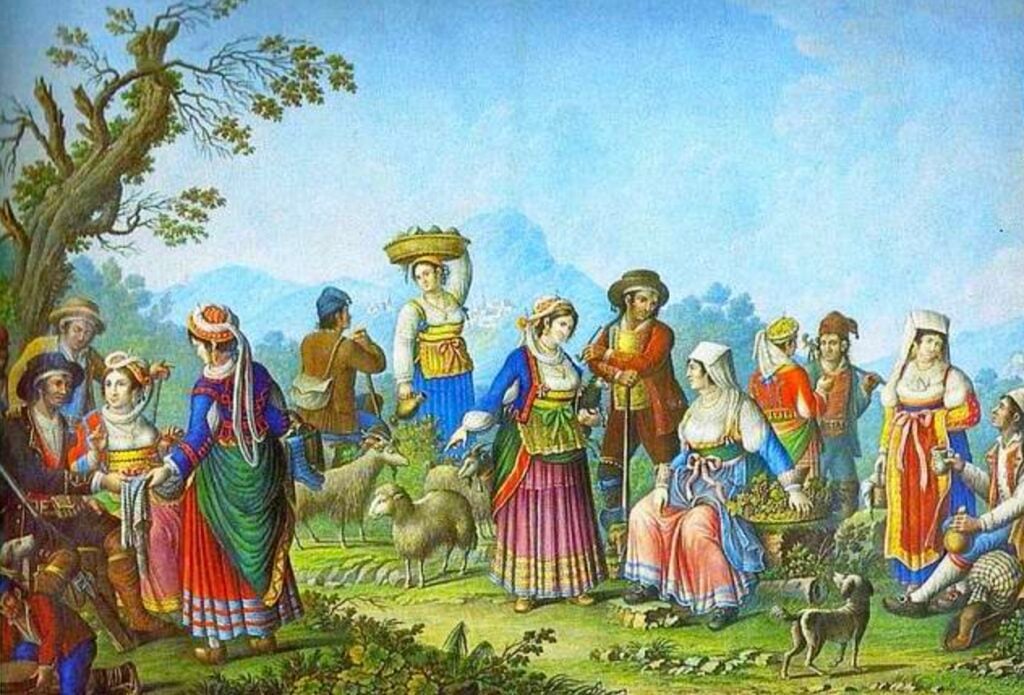
Around 100,000 Arbëreshë live in some fifty communes across Calabria, Sicily, Basilicata, Molise, and Apulia, with the largest cluster in Calabria in towns such as Lungro, San Demetrio Corone, Spezzano Albanese, and Civita, and in Sicily at Piana degli Albanesi. What makes them remarkable is continuity. They still speak Arbërisht, a form of Albanian frozen close to how it sounded five hundred years ago, and they kept their Byzantine Rite Catholic faith, organized today around the eparchies of Lungro in Calabria and Piana degli Albanesi in Sicily. Church colleges founded in the 1700s, and figures like the poet Girolamo (Jeronim) De Rada, kept the language and a sense of Albanian identity alive across the centuries. The Arbereshe even gave the world the first Albanian newspaper, L’Albanese d’Italia, published in Naples in 1848. Their traditions live on in the Byzantine Easter rites and the vallje, the ring dances performed in Calabrian towns each Easter, and since 1999 Italian law has formally protected Arberisht as a historic minority language.
The Modern Migration After 1991
The second community was born almost overnight. When communism collapsed in Albania in 1991, after nearly fifty years of the most isolated dictatorship in Europe, tens of thousands of Albanians rushed to cross the narrow Adriatic to Italy. In March 1991 a first wave reached the ports of Puglia. Then, on 8 August 1991, the freighter Vlora, packed with an estimated 20,000 people, sailed into Bari. The photograph of the ship, every inch of it covered in passengers, became one of the defining images of postwar European migration. Most of those aboard were held in a stadium and sent back, but the exodus had begun. Many Albanian families in Italy today trace their arrival to the 1991 boat exodus to Brindisi and Bari.
A second exodus came in 1997, when the collapse of massive pyramid savings schemes plunged Albania into chaos and armed revolt, sending a fresh wave of refugees across the Adriatic. That spring also brought tragedy: on 28 March 1997, the Kater i Rades, a small Albanian vessel crowded with people fleeing the unrest, sank after colliding with an Italian navy ship enforcing a blockade in the Strait of Otranto. At least 81 people died, one of the darkest moments in the story of Albanian migration to Italy.
Through the 1990s and 2000s, Albanians came to Italy in large numbers for work, drawn by the short crossing, a language many already knew, and jobs in construction, farming, care work, and small business. Despite a hostile early reputation, the community integrated quickly. On 1 January 2020 there were 421,591 Albanian citizens in Italy (ISTAT), a figure that eased to 414,622 by 1 January 2025 as more than 340,000 Albanians took Italian citizenship between 2012 and 2024, and about 26,000 more did so in 2025, when Albanians and Moroccans remained the two largest groups of new Italian citizens. These ISTAT counts are of citizens only, so Italians of Albanian origin are not in them. Today Albanians are one of Italy’s largest and most settled immigrant communities.
A Conservative Estimate, and How It Is Built
A conservative estimate from the official figures: about 637,800 to 668,000 residents of Albanian origin who were born abroad and now live in Italy. This is an estimate, not an official figure. Italy does not record ethnicity, so we build the range from ISTAT’s published counts and state every assumption. It covers the modern migration only, not the historic Arbëreshë community.
| Group | Official count (January 1, 2025) | Share counted as Albanian | Result |
|---|---|---|---|
| Residents born in Albania | 578,402 | All | 578,402 |
| Residents born in Kosovo | 45,980 | 90.79 percent, the Albanian share in Kosovo’s 2024 census | 41,745 |
| Residents born in North Macedonia | 72,563 | 24.3 to 66 percent (see below) | 17,633 to 47,892 |
| Total | 637,780 to 668,039 |
The North Macedonia range runs from the Albanian share of that country’s resident population in its 2021 census (24.3 percent) to the Albanian share among citizens living abroad who took part in the same census (about 66 percent). The second figure is our own arithmetic from the published totals: Albanians were 29.52 percent of all 2,097,319 people counted and 24.3 percent of the 1,836,713 residents, which leaves about 173,000 Albanians among the 260,606 people counted abroad.
What the range leaves out. These tables count people by where they were born, whatever passport they hold now, so people born in Albania who have since become Italian citizens are still counted. More than 340,000 Albanian citizens became Italian between 2012 and 2024. The tables leave out every child and grandchild born in Italy: the range covers the immigrant generation only. No Italian agency publishes a figure that adds the Italian-born generation. Some people born in Kosovo before 2008 may still be recorded under Serbia, and Albanians from Montenegro or Serbia are outside the count as well. The real community is therefore likely to be larger than our range, but we do not put a number on what cannot be measured.
Last reviewed: September 18, 2026. Inputs: ISTAT figures published by Eurostat, population on January 1 by country of birth (table migr_pop3ctb); Kosovo Agency of Statistics, Census 2024; State Statistical Office of North Macedonia, Census 2021.
Where Albanians Live in Italy
The modern community is concentrated in the north, where about 60 percent of Italy’s Albanians live. Lombardy leads with around 82,000 Albanian citizens, followed by Emilia-Romagna and Tuscany, which together host more than 100,000, and by Piedmont and Veneto. The historic Arbëreshë, by contrast, remain rooted in the southern regions their ancestors settled. The map shows both patterns.
About 415,000 Albanian citizens live in Italy (ISTAT, January 1, 2025), one of the largest Albanian communities in the world, alongside the centuries-old Arbereshe minority of the south. Hover or tap a region.
Shading shows the modern Albanian community, concentrated in the north; tooltips also flag the historic Arbereshe (Italo-Albanian) towns of the south. Sources: Italian Ministry of Labour report on the Albanian community (2023), ISTAT.
Hover over the southern regions and you will find the Arbëreshë towns; hover over the north and you will see where the post-1991 community built its new life.
Notable Italian Albanians
The Arbëreshë have shaped Italian history far beyond their numbers. Francesco Crispi, twice prime minister of Italy in the late 1800s and a leading figure of the Risorgimento, the movement that unified Italy, came from a Sicilian Arbëresh family. The constitutional scholar Costantino Mortati, educated at the Italian-Albanian college of San Demetrio Corone, helped write the constitution of the modern Italian Republic. The poet Girolamo De Rada is remembered as a father of modern Albanian literature, and the influential thinker Antonio Gramsci had Arbëresh roots on his father’s side. Together they are a reminder that Albanians have been part of Italian life for half a millennium.
Both communities sustain a rich associational life. Among the Arbereshe, cultural groups such as the association named after the poet Gennaro Placco in Civita work to keep the language alive, while the modern community runs cultural associations in the northern cities where it settled.
Albanian Italians Today
Two generations on, Albanians are woven into Italian public life. In music, Ermal Meta, born in Fier, won the Sanremo Festival in 2018, and Anna Oxa, of Albanian descent, is a Sanremo legend with two victories to her name, while the opera tenor Saimir Pirgu sings on the world’s great stages. On television, the dancer Kledi Kadiu became a household name through the show Amici. In football, Igli Tare spent years as sporting director of Lazio and held the same role at AC Milan in the 2025/26 season, while Kristjan Asllani, a Serie A champion with Inter in 2024, plays for the Albania national team. In contemporary art, Adrian Paci exhibits around the world from his base in Milan. They are the modern face of a community that Italy has, at times reluctantly and now largely warmly, made its own.
Frequently Asked Questions
How many Albanians live in Italy?
414,622 Albanian citizens were resident in Italy on 1 January 2025, according to ISTAT, one of the largest Albanian communities in the world. That figure counts citizenship, not origin, so it leaves out the estimated 100,000 Arbëreshë whose families have lived in southern Italy since the 15th century and the many former Albanian citizens who are now Italian (about 26,000 Albanians acquired Italian citizenship in 2025). A conservative estimate from the official figures is about 637,800 to 668,000 residents of Albanian origin who were born abroad, with the method shown in this guide, and the real figure is likely higher.
Who are the Arbëreshë?
They are ethnic Albanians of southern Italy, descendants of refugees who fled the Ottoman conquest of Albania from the 15th century. They still speak Arbërisht, an archaic Albanian, and follow the Byzantine Rite Catholic faith.
What was the Vlora ship?
A freighter that carried about 20,000 Albanians across the Adriatic to Bari on 8 August 1991, one of the largest single boat arrivals in modern European history and a symbol of the post-communist exodus.
Where in Italy do most Albanians live?
The modern community is concentrated in the north, especially Lombardy, Emilia-Romagna, Tuscany, and Veneto. The historic Arbëreshë live in the south, in Calabria, Sicily, Basilicata, Molise, and Apulia.
Sources
- Eurostat: Acquisition of citizenship by age group, sex and former citizenship (migr_acq), Italy, data supplied by ISTAT
- Tuttitalia, Albanesi in Italia: Albanian citizens resident in Italy, 1 January 2025 (ISTAT data)
- ISTAT, Demographic indicators, year 2025 (March 31, 2026): acquisitions of citizenship in 2025
- Italian Ministry of Labour, Report on the Albanian Community in Italy (2023)
- Wikipedia: Arbëreshë people
- Wikipedia: Vlora (ship), the 1991 exodus
- Wikipedia: Tragedy of Otranto, the 1997 sinking of the Kater i Rades
- Eurostat: Population on 1 January by country of birth (migr_pop3ctb), Italy, data supplied by ISTAT
- Government of Kosovo: First final results of the 2024 Census (ethnic composition)
- Balkan Insight: North Macedonia census 2021, residents and non-residents counted
Related Reading
- Albanians Around the World: The Global Diaspora
- Skanderbeg: Albania’s National Hero
- Arbëreshë: The Albanians of Italy, 500 Years On
- Jeronim De Rada
- Albanians in Switzerland
- Albanians in Germany
More Albanian diaspora communities
- Albanians in North Macedonia
- Albanians in Serbia
- Albanians in Croatia
- Albanians in Argentina
- Albanians Around the World

Author: Dardanë Halimi
Dardanë Halimi is a writer and communications professional with an M.A. in Writing, Rhetoric, and Technical Communication from James Madison University. Her work focuses on storytelling, digital content, higher education, and strategic communication, with experience writing for academic, nonprofit, and marketing organizations in both the United States and Kosovo.