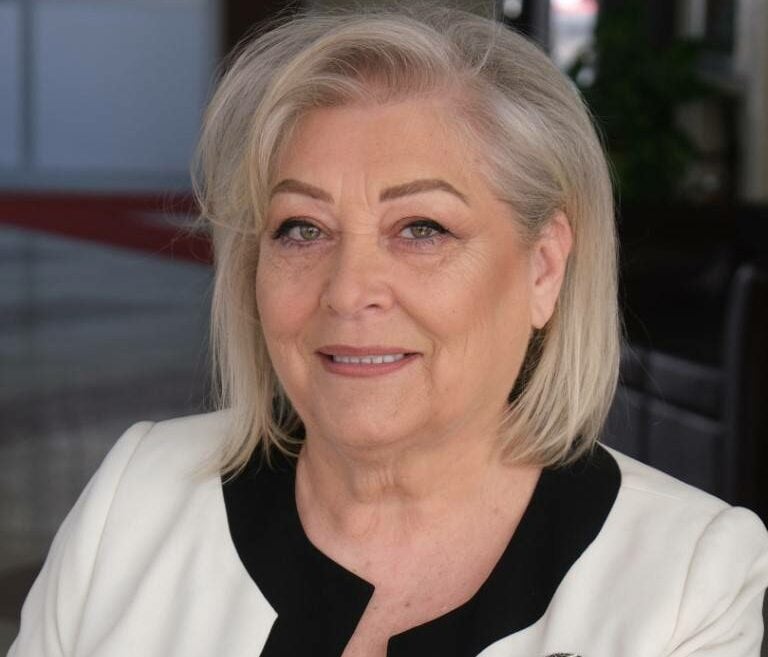

Kosovo’s Assembly elected Justina Shiroka-Pula, an economist and head of the Academy of Sciences and Arts, as the country’s sixth president in a vote that began six minutes before a constitutional deadline and ended after midnight. The deal that made it possible also changed the law governing the Hague-based court that convicted four former KLA leaders last month.
Kosovo has a president again. In the first minutes of Wednesday, October 7, 2026, the Assembly in Prishtina elected Justina Shiroka-Pula with 81 votes, one more than the 80 required, ending a vacancy that had lasted since April and averting a dissolution of parliament that would have sent the country to its third election in 19 months, the Associated Press reported.
Shiroka-Pula, 72, was sworn in later the same day. “Today, I accept with great honor and full responsibility the duty of President of the Republic of Kosovo,” she told the Assembly, according to European Western Balkans. “This mandate does not belong to one person alone. It belongs to our citizens, our institutions, and the state for which so many generations sacrificed.”
She is the third woman to hold the office, after Atifete Jahjaga and Vjosa Osmani, and the first president drawn from the Academy of Sciences and Arts, which she has led since December 2025.
The vote at a glance
| Detail | Result |
|---|---|
| Date | Session of October 6, 2026; ballot began at 11:54 p.m. and the result was announced after midnight on October 7 |
| Votes for Justina Shiroka-Pula | 81 |
| Votes for Eliza Hoxha (PDK) | 1 |
| Invalid ballots | 2 |
| Deputies who voted | 84 of 120 |
| Threshold | 80 votes (two thirds of the Assembly) in the first round |
| Nominated by | Prime Minister Albin Kurti (Vetëvendosje), with the Democratic Party of Kosovo (PDK) agreeing to take part |
| Sworn in | October 7, 2026, before the Assembly, with a ceremony at the Presidency |
Sources: Prishtina Insight; RFE/RL; European Western Balkans.
How the night unfolded
The Constitutional Court had given the Assembly until October 6 to elect a head of state. For most of the day the two largest parties were deadlocked. The opposition PDK and the Alliance for the Future of Kosovo (AAK) said they would not help elect a president until amendments to the law on the Kosovo Specialist Chambers passed their second reading, Prishtina Insight reported. Prime Minister Kurti agreed to hold that vote first.
The amended law passed with 88 votes. Less than an hour before midnight, Kurti put forward Shiroka-Pula, a former PDK minister and deputy who left the party in 2014, as his candidate. PDK leader Bedri Hamza told reporters she was “an acceptable name, with the aim of allowing the procedures to move forward and the conditions to be fulfilled,” and the party entered its own candidate, Eliza Hoxha, so that the vote could proceed. The Democratic League of Kosovo (LDK) then joined the session, according to European Western Balkans.
The secret ballot opened six minutes before midnight and closed twelve minutes after it, RFE/RL reported. Because the deadline had technically passed while voting was under way, some observers questioned whether the result could be challenged. Enver Hasani, a former president of the Constitutional Court, said there was no violation because the procedure had begun within the deadline.
Nineteen months without a full-time president
The vacancy was the product of a long stalemate. Under Kosovo’s constitution the president is elected by the Assembly and needs 80 of 120 votes in the first two rounds, which no single party or coalition has held. The timeline below is drawn from the Assembly record as compiled on Wikipedia and from Al Jazeera.
| Date | What happened |
|---|---|
| March 5, 2026 | First attempt to elect a president. Vetëvendosje nominated Glauk Konjufca; PDK and LDK stayed away and only 66 deputies were present, short of the 80 needed for a quorum. |
| March 25, 2026 | The Constitutional Court annulled a decree dissolving the Assembly and set a new deadline. |
| April 4, 2026 | Vjosa Osmani’s five-year term expired. Assembly Speaker Albulena Haxhiu became acting president. |
| April 28, 2026 | Second attempt failed for lack of a quorum; 64 deputies were present. |
| June 7, 2026 | Snap parliamentary election. Vetëvendosje won again but still lacked a two-thirds majority. |
| September 9, 2026 | New Assembly constituted and Kurti’s government sworn in, starting a 60-day window to elect a president. |
| September 13, 2026 | Consensus candidate Bekim Sejdiu withdrew for lack of support. |
| September 16, 2026 | The Specialist Chambers convicted Hashim Thaçi, Kadri Veseli, Jakup Krasniqi and Rexhep Selimi of war crimes. |
| September 23, 2026 | The Constitutional Court ordered the Assembly to elect a president by October 6. |
| October 7, 2026 | Justina Shiroka-Pula elected with 81 votes and sworn in. |
Donika Emini, a research fellow at the University of Graz’s Centre for Southeast European Studies, told Al Jazeera she saw the election “as a mix of political necessity and the need to stabilise institutions.”
The price of the deal: a changed law for the Hague court
The presidential vote cannot be separated from the law that preceded it. On September 16, the Kosovo Specialist Chambers in The Hague convicted four former KLA leaders of war crimes and sentenced them to between 13 and 25 years. The verdict set off weeks of protests in Prishtina. PDK, the party Thaçi founded, proposed amendments to the law that created the court, and the Assembly approved them at first reading on October 5 and at second reading on October 6, Balkan Insight and RFE/RL reported.
| Change | What the amended law says, as reported |
|---|---|
| Maximum sentence | Capped at 15 years |
| Where sentences are served | In Kosovo, rather than in third countries |
| Pardons | The President of Kosovo may pardon those with final convictions |
| Time frame | Jurisdiction narrowed to July 1, 1999 to December 31, 2000 |
| Scope | Limited to alleged organ-trafficking offenses tied to specific detention sites; other cases would move to Kosovo’s regular courts |
| Oversight | International organizations may monitor proceedings; the Constitutional Court is to review the law |
Sources: RFE/RL; RFE/RL on the EU reaction; Balkan Insight.
The European Union, which funds the court, reacted within hours. An EU spokesperson said the legislation “goes against Kosovo’s international obligations toward the EU” and that the court’s “current mandate and independence must be fully respected,” RFE/RL reported. The Specialist Chambers declined to comment on the vote beyond saying the court remained “fully focused on implementing its mandate to ensure fair, impartial, and secure judicial proceedings.”
The amendments are not yet in force. Under Kosovo’s constitution a law must be promulgated by the president, so one of Shiroka-Pula’s first decisions will concern the very law that cleared the way for her election, AP noted. The Constitutional Court is also expected to review it.
Who is Justina Shiroka-Pula
Shiroka-Pula was born in Prishtina on December 20, 1953. She graduated in economics from the University of Prishtina in 1976, completed a doctorate there on demographic investment and Kosovo’s economic development, and did further studies in development economics at the University of Zagreb. She has taught at the University of Prishtina’s Faculty of Economics since 1978 and headed its department of management and informatics, according to Al Jazeera.
Her public career has two chapters. From January 2008, a month before Kosovo declared independence, to February 2011 she served as minister of energy and mining in Hashim Thaçi’s first government, then sat as a PDK deputy until 2014, when she left the party. She became a corresponding member of the Academy of Sciences and Arts in 2016, a full member in 2020, and on December 19, 2025 was elected its president, the first woman in the post, RFE/RL reported. She ran for the presidency as an independent.
Reactions
Albania’s President Bajram Begaj wrote that “in every challenge and at every step towards a European future, Albania and Kosovo will stand together,” Prishtina Insight reported. Prime Minister Edi Rama posted on X: “I wish you and Kosovo success, Mrs. President,” according to Kosovarja.
The EU’s representative in Kosovo, Dirk Schuebel, congratulated the new president and called for “renewed political and institutional stability” and closer ties with the Union. The United Kingdom’s ambassador, Jonathan Hargreaves, pledged to “deepen our long-standing partnership as Kosovo looks ahead to its multiethnic, democratic, and Euro-Atlantic future.” Slovenia’s President Nataša Pirc Musar said she looked forward to cooperation “both at the bilateral level and within the Brdo-Brioni Process,” all according to Prishtina Insight.
In her first address, Shiroka-Pula set out her own terms. “I will be president of all citizens. I will work for unity, justice, development and strengthening of our institutions,” she said, adding that Kosovo “must move forward as a democratic, secure state with a clear Euro-Atlantic orientation and strong friendship with our allies,” European Western Balkans reported. The Albanian original of the speech is on Koha.
Why this matters for Albanian-Americans
For the diaspora, the presidency is the office that represents Kosovo abroad. It is the president who receives ambassadors, signs laws, speaks for the state at the United Nations and in Washington, and, for many Albanian-American communities, is the face of Kosovo at diaspora gatherings from New York to Detroit. Nineteen months without a full-time president, two snap elections and a dissolution averted by minutes have been hard to explain to American partners who already struggle to follow Balkan politics.
Two things to watch. First, whether the new president promulgates the court law and how the EU and the United States respond, because the relationship with Kosovo’s Western partners is the diaspora’s main point of leverage. Second, whether the Vetëvendosje-PDK understanding that produced this vote holds long enough for the Assembly to work normally. The Albanian-American community lobbied for Kosovo’s independence for decades; a functioning presidency is part of what that effort was for.
How to follow the story
- The Presidency publishes decrees and statements at president-ksgov.net, including any decision on the Specialist Chambers law.
- The Constitutional Court’s review of the amended law and any EU response will be reported by RFE/RL’s Balkan Service and Prishtina Insight, both in English.
- For background on the verdict that shaped this election, read our report on the Hague convictions of the four KLA leaders.
- Kosovo’s first president, Ibrahim Rugova, was also an academic before he was a politician. Our profile covers the office’s origins.
What comes next
Shiroka-Pula’s term runs five years. Her first weeks will be defined by the court law on her desk, the EU’s reaction to it, and the appeals that all four convicted KLA leaders have the right to file in The Hague. ALB Connection will follow each of those threads.
Frequently Asked Questions
Who is the new president of Kosovo?
Justina Shiroka-Pula, an economist born in Prishtina in 1953, former minister of energy and mining, and president of the Academy of Sciences and Arts of Kosovo since December 2025. The Assembly elected her on October 7, 2026.
How many votes did she receive?
81 of the 84 ballots cast in the 120-seat Assembly. The threshold in the first round is 80 votes, two thirds of all deputies. One vote went to PDK’s Eliza Hoxha and two ballots were invalid.
Why was the vote held at midnight?
The Constitutional Court had set October 6 as the last day to elect a president. Parties reached agreement late in the evening, and the ballot began six minutes before midnight. Had no president been elected, the Assembly would have been dissolved and a new election called.
Why had Kosovo been without a president?
Vjosa Osmani’s term ended on April 4, 2026. Two attempts to elect a successor in March and April failed because opposition parties stayed away and the Assembly lacked a quorum. A snap election followed in June, and a consensus candidate withdrew in September. Speaker Albulena Haxhiu served as acting president in the meantime.
What is the deal with the Hague court law?
PDK and AAK made their participation conditional on the Assembly first passing amendments to the law on the Kosovo Specialist Chambers. The amendments cap sentences at 15 years, allow sentences to be served in Kosovo, give the president pardon powers and narrow the court’s jurisdiction. The EU says the changes go against Kosovo’s international obligations.
Is the presidency a powerful office?
It is largely ceremonial. The president represents the state abroad, is commander-in-chief of the security force, promulgates laws and signs decrees. The constitution requires a two-thirds majority to elect a president, which is why the office has been so hard to fill.
Who were Kosovo’s previous presidents?
Ibrahim Rugova, Fatmir Sejdiu, Atifete Jahjaga, Hashim Thaçi and Vjosa Osmani, with Jakup Krasniqi, Glauk Konjufca and Albulena Haxhiu serving as acting presidents between terms. Shiroka-Pula is the third woman to hold the office.
Sources & References
- Prishtina Insight, Kosovo Elects President Dodging New Political Deadlock, October 7, 2026
- Prishtina Insight, Justina Shiroka-Pula Inaugurated as Kosovo’s President, October 7, 2026
- RFE/RL, Kosovo Elects President After Opposition Agrees To Last-Minute Deal, October 7, 2026
- RFE/RL, EU Says Kosovo’s Changes To War Crimes Court Law Violate International Obligations, October 7, 2026
- Reuters, Kosovo parliament elects new president, avoiding snap election, October 7, 2026
- Associated Press, Kosovo Lawmakers Elect a New President in a Late-Night Vote to Avert Snap Election, October 7, 2026
- Al Jazeera, Justina Shiroka Pula: Kosovo’s new president, elected during a crisis, October 7, 2026
- Balkan Insight, Kosovo Parliament Moves Towards Changing Law to Curb Hague Special Court, October 5, 2026
- European Western Balkans, Justina Shiroka-Pula elected President of Kosovo by Parliament, October 7, 2026
- Koha, Shiroka-Pula: Do të jem presidente e gjithë qytetarëve (Albanian), October 7, 2026
- Kosovarja, Rama congratulates Justina Shiroka-Pula, October 7, 2026
- Wikipedia, 2026 Kosovan presidential election (timeline cross-check)